MD vs MS vs PG Diploma: How to Choose the Best Branch After NEET PG
By Doctutorials
7 Views
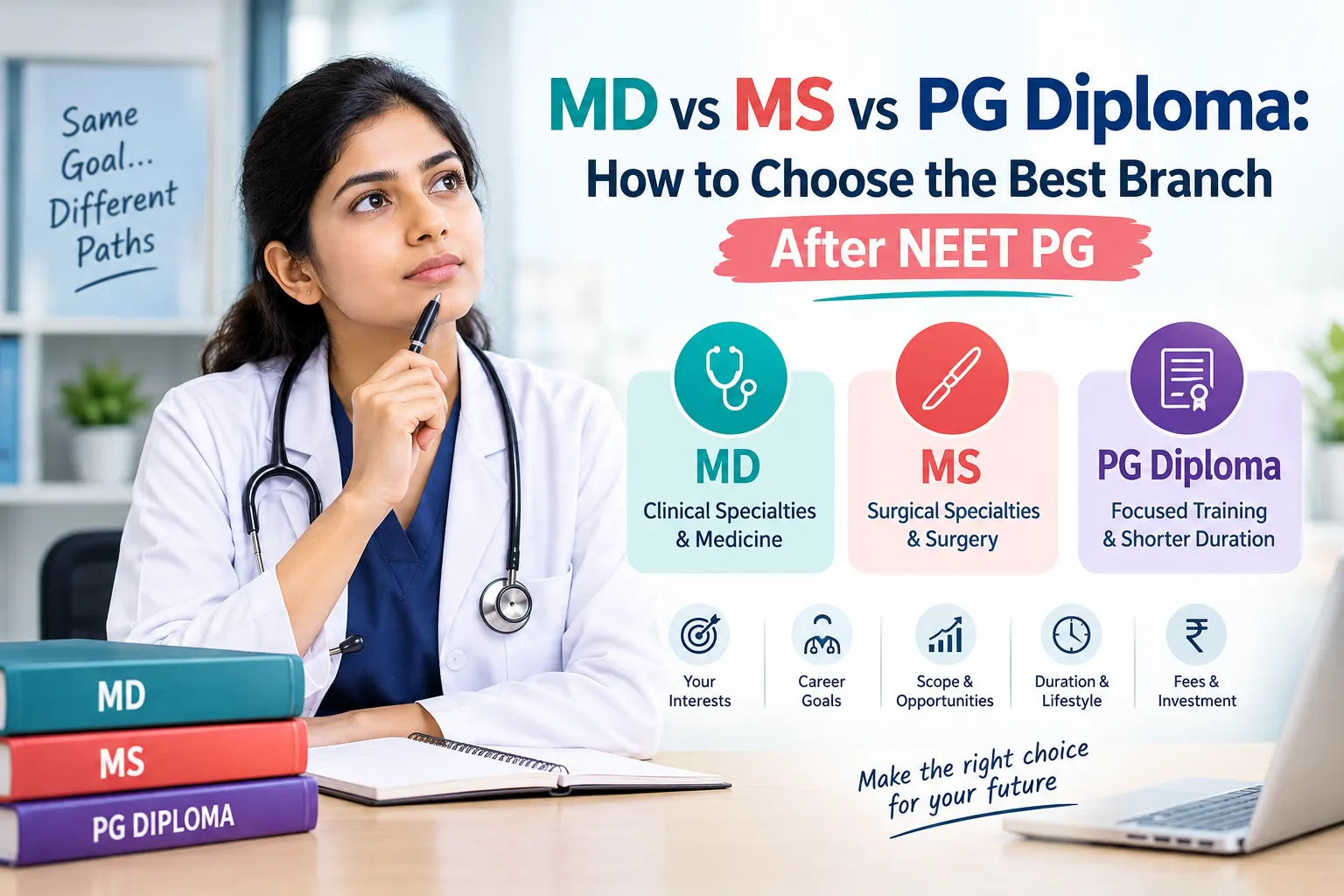
Choosing a branch is the biggest decision after NEET PG, because it shapes your daily work, your income, your lifestyle and your future options for super-specialty. This guide explains the difference between MD, MS and PG Diploma, and gives a simple way to pick the branch that suits you.
MD vs MS vs PG Diploma: The Basic Difference
- MD (Doctor of Medicine): A 3-year postgraduate degree in medical and non-surgical branches such as General Medicine, Paediatrics, Dermatology, Psychiatry, Radiodiagnosis, Anaesthesiology and Pathology.
- MS (Master of Surgery): A 3-year postgraduate degree in surgical branches such as General Surgery, Orthopaedics, ENT and Ophthalmology. Some branches, like Obstetrics and Gynaecology, are offered as MD or MS depending on the college.
- PG Diploma: A shorter 2-year postgraduate course offered in a limited set of branches such as DCH, DGO, DA, DOMS and DLO, with fewer seats than MD and MS.
DNB (Diplomate of National Board) seats, offered through NBEMS-accredited hospitals, are treated as equivalent to MD and MS in most cases, so they are worth considering as a parallel option.
MD vs MS vs PG Diploma at a Glance
|
Point |
MD |
MS |
PG Diploma |
|---|---|---|---|
|
Duration |
3 years |
3 years |
2 years |
|
Type of work |
Non-surgical, medicine-based |
Surgical, procedure-based |
Branch-specific, shorter training |
|
Typical branches |
Medicine, Paediatrics, Dermatology, Psychiatry, Radiodiagnosis, Anaesthesiology |
General Surgery, Orthopaedics, ENT, Ophthalmology |
DCH, DGO, DA, DOMS, DLO |
|
Seats |
Many |
Many |
Limited |
|
Super-specialty (DM/MCh) |
Eligible in the matching broad specialty |
Eligible in the matching broad specialty |
Generally not eligible, check the latest rules |
|
Best for |
Doctors who prefer diagnosis, long-term patient care or lab and imaging work |
Doctors who enjoy procedures and operating |
Doctors who want a shorter path and quicker practice |
Seat availability, eligibility rules and equivalence decisions are set by the National Medical Commission and the counselling authorities, so confirm the current rules before you choose.
How to Choose Your Branch: 6 Factors to Consider
- Your interest: You will work in this branch for decades. Think about which rotations you enjoyed most during MBBS and internship.
- Procedural or non-procedural work: Surgery, Orthopaedics and Ophthalmology are hands-on and procedural. Medicine, Dermatology and Psychiatry rely more on clinical reasoning and long-term follow-up.
- Lifestyle: Emergency duties, night calls and workload differ a lot between branches. Talk to seniors in each branch before deciding.
- Career path: Decide whether you want private practice, a government job, teaching, a hospital career or super-specialty.
- Rank and seat availability: Your NEET PG or INI-CET rank decides what you can get. Prepare a realistic list of branches and colleges in order of preference.
- Money and bond: Compare fees, stipend and any service bond for each seat, because they vary widely between states and institutes.
Super-Specialty and Future Options
If you plan to do DM or MCh through NEET SS or INI-SS later, choose a broad specialty that leads to it. MD Medicine leads to DM courses such as Cardiology, Neurology and Gastroenterology, and MS General Surgery leads to MCh courses such as Neurosurgery, Plastic Surgery and Paediatric Surgery. PG Diploma holders generally have fewer options here, so read the latest eligibility rules in the NBEMS and AIIMS bulletins.
Common Mistakes to Avoid
- Choosing a branch only because of last year's closing ranks or what friends are choosing.
- Ignoring lifestyle and workload until after joining.
- Taking a PG Diploma without checking its long-term career and eligibility limits.
- Not reading the service bond and fee rules for the seat.
- Skipping DNB seats, which can be a strong alternative.
Frequently Asked Questions
What is the difference between MD and MS? MD covers medical and non-surgical branches, while MS covers surgical branches. Both are usually 3 years.
Is PG Diploma worth it? It can be a good choice if you want a shorter course and a quicker start to practice, but it has fewer seats and generally fewer super-specialty options, so check the current rules first.
Can I do DM or MCh after a PG Diploma? Generally the super-specialty entrance exams ask for MD, MS or DNB, so check the latest NEET SS and INI-SS eligibility criteria.
Is DNB equal to MD or MS? In most cases DNB is treated as equivalent to MD and MS, but check the current NMC notifications.
Which branch is best after NEET PG? There is no single best branch. The best choice depends on your interest, rank, lifestyle and career goals.
Can I switch branches after joining? Rules for leaving or changing a seat depend on the state, institute and counselling authority, so read the seat leaving policy and bond terms before you join.
Rules, seat matrices and eligibility change often, so use this guide for understanding and rely on the official NMC, NBEMS, AIIMS and MCC notifications for final decisions.
Related Reading
Expert Insights: Navigating the Complex World of Education & Learning
Welcome to our in-depth exploration of Education & Learning. In an era defin...
Why Education & Learning is Transforming the Global Industry Landscape
Welcome to our in-depth exploration of Education & Learning. In an era defin...