Master Data Management Best Practices: How to Build a Single Source of Truth
32 Views
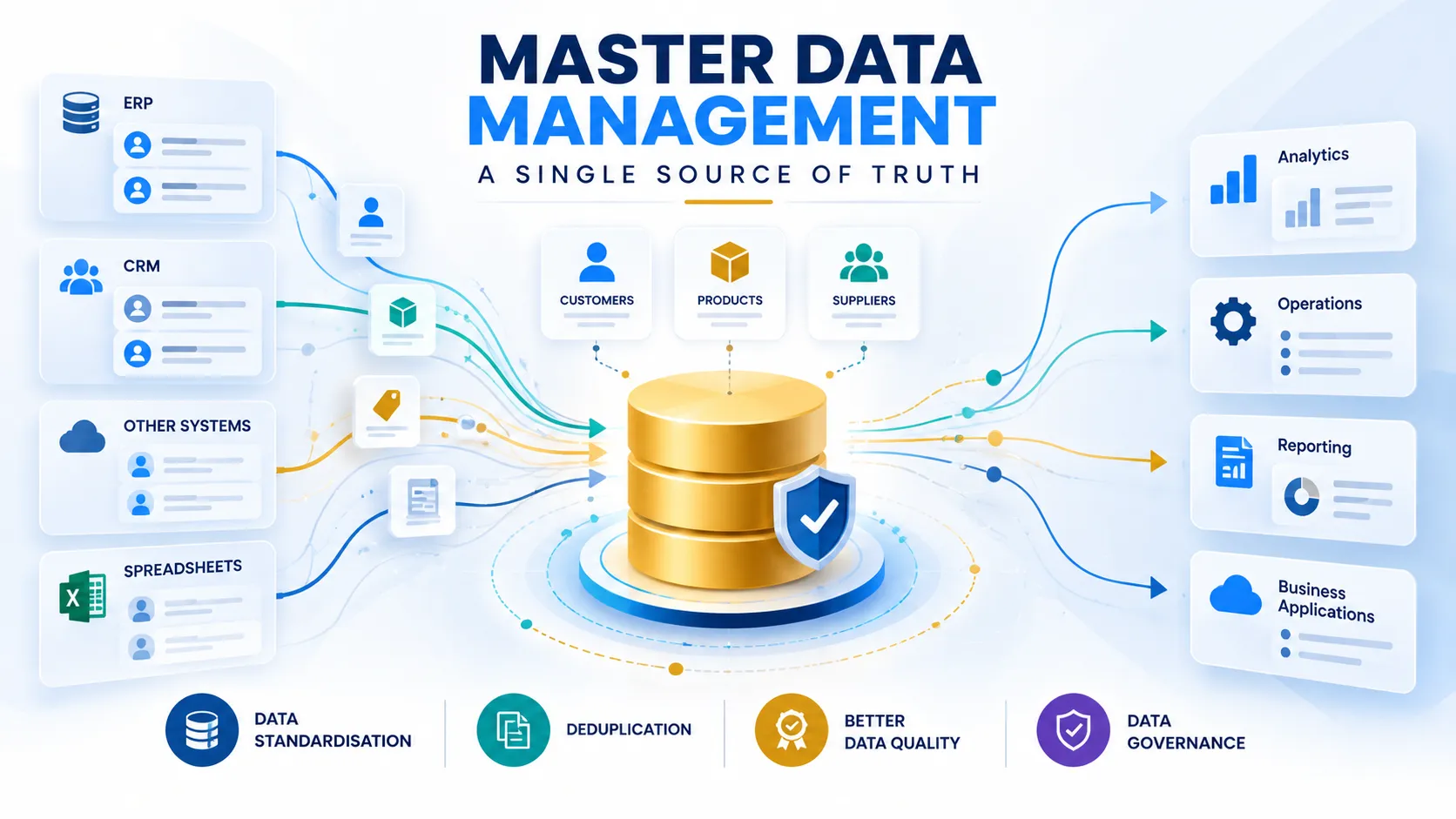
Businesses rely on accurate data to manage customers, products, suppliers and everyday operations. But when information is scattered across ERP systems, CRM platforms, spreadsheets and other applications, maintaining consistency becomes difficult.
Duplicate records, outdated information and inconsistent data formats can affect reporting, business processes and decision-making.
This is where Master Data Management (MDM) becomes valuable. With the right strategy, organisations can establish reliable master data, strengthen governance and create a single, consistent view of critical business information.
What Is Master Data Management?
Master Data Management is the process of creating, maintaining and governing consistent records for essential business entities, including customers, suppliers, products and equipment.
An effective MDM strategy helps organisations standardise information, manage duplicate records and maintain trusted data across connected systems.
A key objective is to establish a single source of truth, giving teams access to reliable information while supporting operational efficiency and informed decision-making.
Why Do Businesses Need an MDM Strategy?
Without effective master data management, organisations may encounter several challenges:
-
Duplicate records: The same customer or supplier may exist multiple times across business applications.
-
Inconsistent information: Product descriptions, customer details and supplier records may differ between systems.
-
Poor data quality: Missing fields, outdated information and incorrect values can affect reporting.
-
Limited visibility: Data silos make it difficult to develop a unified view of business operations.
-
Governance challenges: Unclear ownership and inconsistent policies can make data maintenance difficult.
A structured MDM programme helps address these challenges by introducing common standards, governance processes and data quality controls.
7 Master Data Management Best Practices
1. Identify Critical Master Data Domains
Start by identifying which data domains are most important to your business.
Common examples include:
-
Customer master data
-
Product master data
-
Supplier and vendor master data
-
Equipment and asset data
Prioritise domains based on business impact, data quality challenges and operational requirements. Starting with a clearly defined scope can make an MDM initiative easier to manage.
2. Establish Clear Data Governance Policies
Master data governance defines how business data is created, maintained, accessed and monitored.
Establish clear policies for data ownership, approval workflows, access permissions and quality standards.
Assign data owners and data stewards who are responsible for maintaining information quality and resolving data issues.
Documented governance policies help create accountability and support consistent data management practices.
3. Standardise Data Formats and Definitions
Different systems may store the same information using different naming conventions, formats or structures.
Define common standards for fields such as product descriptions, customer addresses, units of measurement and supplier identifiers.
Use consistent data definitions, validation rules and reference data wherever appropriate.
Data standardisation makes it easier to compare, consolidate and exchange information across enterprise applications.
4. Improve Data Quality Through Validation and Deduplication
Reliable master data requires ongoing data quality management.
Implement processes to identify incomplete records, incorrect values, duplicates and inconsistencies.
Useful data quality practices include:
-
Data profiling to understand existing data conditions
-
Validation rules to detect invalid or missing values
-
Deduplication to identify potential duplicate records
-
Data cleansing and enrichment to improve record completeness
-
Quality dashboards to monitor ongoing performance
Automated data quality checks can help teams identify problems earlier and maintain more consistent information.
5. Create and Maintain Golden Records
A golden record represents a trusted, consolidated view of a business entity, created by matching and reconciling information from relevant sources.
For example, customer records from different systems may contain overlapping information. Matching rules and survivorship rules can help determine how records are linked and which values are retained.
Organisations should define their matching criteria, source priorities, exception handling and review procedures before implementing golden record management.
This helps establish reliable master data without losing important context or business controls.
6. Integrate Master Data Across Enterprise Systems
Master data needs to remain consistent across the applications that use it.
Assess how information moves between ERP, CRM, procurement, supply chain and analytics systems.
Define integration requirements, data mapping, transformation rules and synchronisation schedules. Depending on business needs, organisations may require batch processing, event-driven updates or other integration patterns.
Well-designed master data integration helps reduce disconnected processes and supports more consistent information across departments.
7. Monitor Data Quality and Continuously Improve
Master data management is an ongoing business discipline, not a one-time cleansing exercise.
Track measurable indicators such as:
-
Duplicate record rate
-
Data completeness
-
Validation failure rate
-
Record accuracy
-
Data issue resolution time
-
Governance policy compliance
Review these metrics regularly and refine data quality rules as business requirements change.
Continuous monitoring helps organisations maintain trusted master data as their systems, products and operations evolve.
How MDM Supports Better Business Decisions
Consistent master data gives business teams a stronger foundation for operational reporting, analytics and planning.
A unified customer view can support customer service and account management. Consistent product information can improve coordination across inventory, procurement and sales. Reliable supplier data can support procurement workflows and supplier reporting.
The value of MDM depends on data quality, governance, integration and adoption across the organisation.
Choosing the Right Master Data Management Solution
When evaluating an MDM solution, consider whether it supports your business data domains, governance requirements and existing technology landscape.
Important capabilities to assess include:
-
Data stewardship and workflow management
-
Data governance and security controls
-
Data profiling, cleansing and deduplication
-
Golden record creation and survivorship rules
-
Integration with ERP, CRM and other enterprise systems
-
Data quality dashboards and monitoring
-
Scalability and implementation requirements
The right solution should align with your organisation’s data strategy rather than introducing unnecessary complexity.
Build a More Reliable Data Foundation with ChainSys
Creating trusted master data requires a combination of governance, data quality management and integration.
Explore ChainSys Master Data Management solutions to learn how ChainSys supports centralised governance, golden record creation, hierarchies and survivorship rules for managing critical enterprise data.
With a structured MDM approach, organisations can work towards more consistent information, better data visibility and a stronger foundation for business decisions.
Frequently Asked Questions
What are Master Data Management best practices?
Key practices include defining data ownership, standardising data, implementing governance policies, improving data quality, managing golden records and monitoring data continuously.
What is a golden record in MDM?
A golden record is a trusted consolidated representation of a business entity, created by matching and reconciling relevant source records according to defined rules.
How does data governance support MDM?
Data governance establishes ownership, policies, access controls and accountability, helping organisations maintain consistent and reliable master data.
How is MDM different from data integration?
MDM focuses on managing and governing critical business entities, while data integration connects systems and moves or synchronises information. They can work together as part of an enterprise data strategy.