Mapping China's Parallel Internet: The Apps a Billion People Use
29 Views
China's internet looks familiar at first glance and foreign on the second. The apps have chat bubbles, short videos, livestreams, and checkout buttons, just like their American counterparts. But the companies behind them, the rules they follow, and the way they bundle services together belong to a parallel ecosystem that grew up largely cut off from Silicon Valley. Understanding that ecosystem starts with mapping each Chinese platform to something you already know.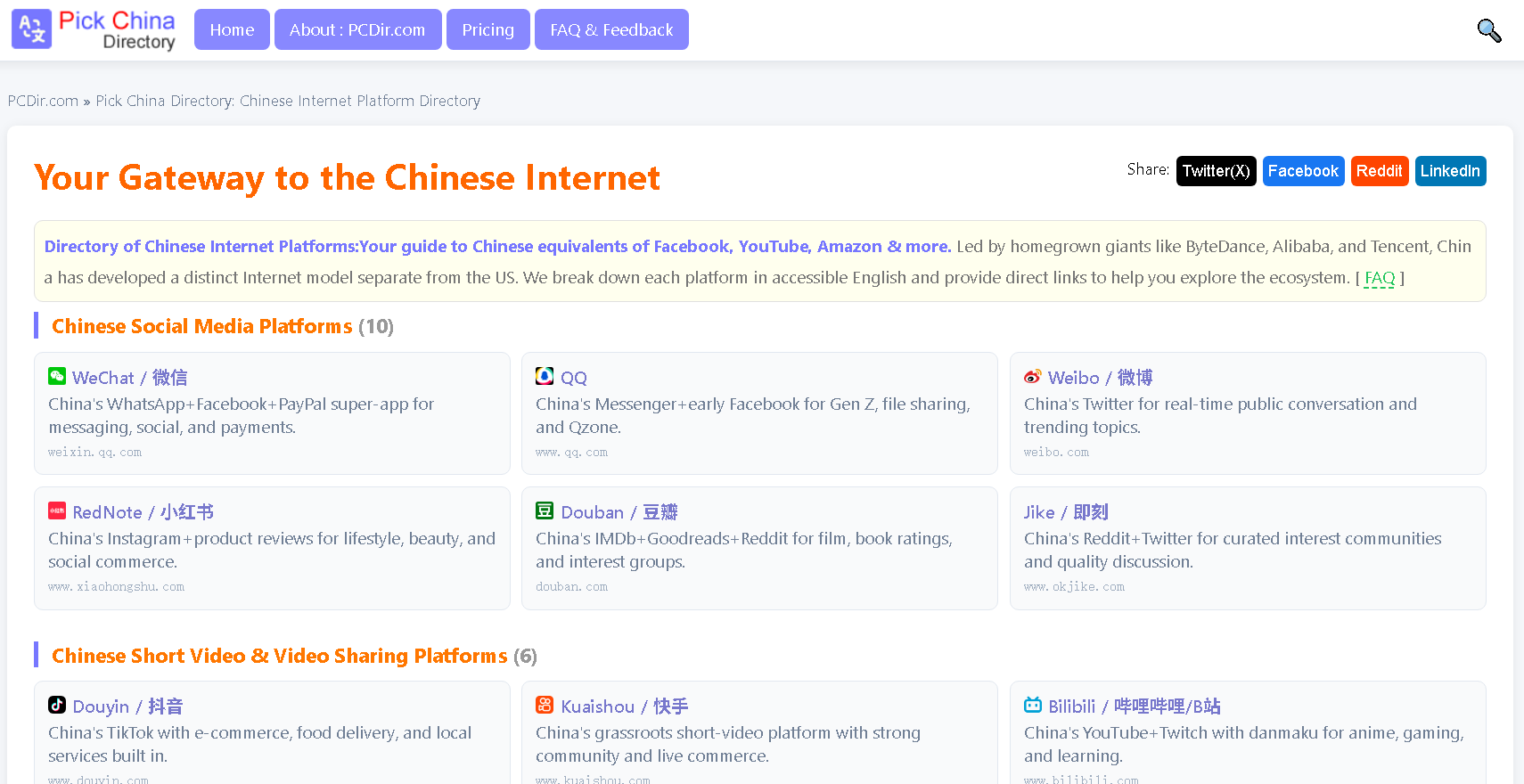
A Parallel Internet, Not a Copy
In the early years, Chinese startups openly cloned American models: search, portals, e-commerce, and social networks all had local twins. The split came later. When the largest US platforms stopped operating in mainland China, homegrown services filled the gap under a separate regulatory framework, and mobile accelerated the divergence. Companies built apps first and treated websites as an afterthought, packing payments, shopping, government services, and publishing into single super-apps. That is why asking for China's YouTube or China's Amazon usually yields several answers instead of one, and why a resource like PCDir's China web directory pairs every Chinese platform with its closest American analogue, from WeChat with WhatsApp to Douyin with TikTok.
WeChat: The App That Ate Everything
No mapping exercise matters more than getting WeChat right. Western coverage often calls it China's WhatsApp, but that captures maybe a tenth of it. WeChat's mini-programs and Official Accounts let businesses run storefronts, booking systems, and media channels entirely inside the chat app, and some companies have retired their websites altogether. Hundreds of millions of users pay bills, file documents, hail rides, and read news without ever leaving the conversation screen. The closest Western comparison is not one app but a stack: messaging plus an app store plus a browser plus a wallet. Anyone doing business with Chinese audiences has to treat it as infrastructure, not just another social channel.
Shopping, Video, and the Live Commerce Twist
E-commerce shows the same pattern of familiar surface, different engine. Pinduoduo pairs group discounts with game-like sharing mechanics that have no real Amazon equivalent, while Douyin turned short video into a storefront: livestream hosts demo products for hours, viewers tap to buy mid-broadcast, and the algorithm collapses discovery and checkout into one feed. Short drama apps, which serialize soap operas into sixty-second episodes behind micropayments, grew into a multi-billion-yuan format with barely a Western counterpart. Live streaming itself is a bigger category in China than in the US, spanning gaming, shopping, education, and even court proceedings.
Search, News, and the Walled Garden Effect
Information discovery works differently too. With the dominant global search engine absent, local players rank an index shaped by domestic content farms, official media accounts, and Q&A communities where professionals answer under real names. News consumption skews toward aggregator apps that blend algorithmic feeds with licensed newspaper content, and commentary often lives on microblogging timelines rather than open blogs. For researchers, this means checking several surfaces instead of one: the search result, the in-app account behind it, and the discussion thread it spawned. It also means machine translation is a daily tool rather than a fallback, since the highest-quality explainers in any niche are usually published in Chinese first and translated, if at all, months later.
How to Explore Without Getting Lost
The practical advice for newcomers is to pick one category at a time. Start with the platforms that overlap your daily habits: a search engine, a map app, one chat app, one payment method. Learn which services require a local phone number, which have usable English interfaces, and which only make sense inside their parent super-app's orbit. The directory approach works because the landscape keeps shifting: apps merge, rebrand, and retire web versions with little notice, so a maintained map of more than twenty categories, from AI models to travel and local life, saves hours of trial and error. China's internet rewards the curious visitor, provided they arrive with a guide rather than assumptions.