Machine Learning for Kids: A Beginner's Guide to Learning AI
17 Views
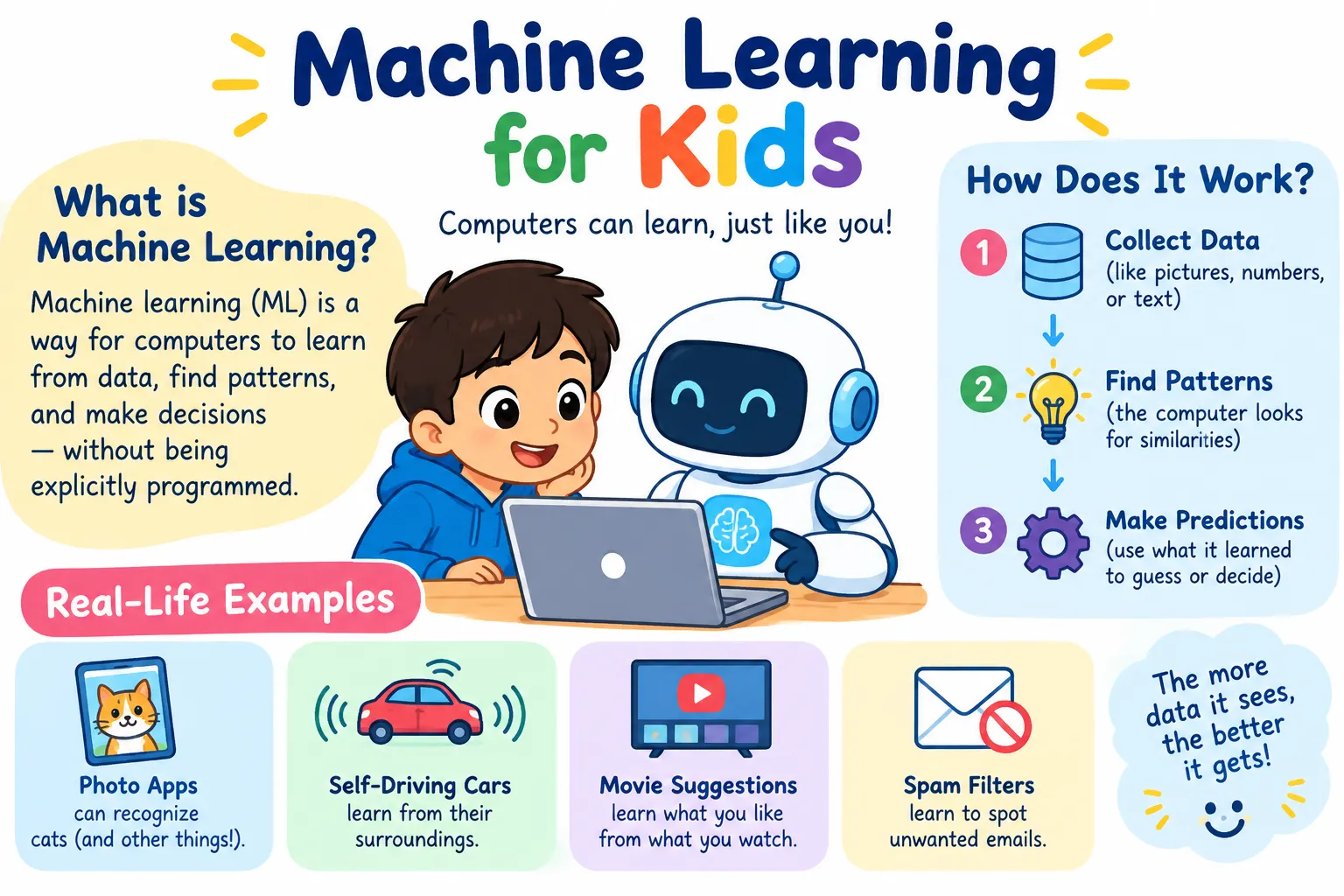
Technology is changing how people learn, work, and solve everyday problems. From voice assistants to recommendation systems, machine learning is becoming an important part of modern life. Introducing children to these concepts can help them understand how computers learn from information and make predictions. Machine Learning for Kids is an engaging way to introduce young learners to artificial intelligence, programming, logical reasoning, and creative problem-solving.
MasterJi Coding Classes encourages children and teenagers to explore technology through structured coding education and practical learning activities. With age-appropriate guidance, students can discover how machine learning works while developing skills that support their future learning.
What Is Machine Learning for Kids?
Machine learning is a branch of artificial intelligence (AI) that allows computers to identify patterns in data and use those patterns to make predictions or classifications.
For example, a machine learning system can learn to recognize pictures of cats and dogs by examining examples. After training, it can attempt to classify new pictures based on the patterns it has learned. Its answers may not always be correct, which makes testing and evaluation important.
Machine Learning for Kids introduces these ideas in simple, practical ways. Children can explore how computers process examples, identify patterns, and improve a model by using suitable training data.
Instead of only reading about technology, students can experiment with beginner-friendly tools, visual activities, and coding projects to understand the concepts.
Why Should Children Learn Machine Learning?
Learning machine learning can help children understand modern technology while developing useful thinking skills.
1. Develop Logical Thinking
Machine learning activities encourage children to observe information, identify patterns, and consider how different examples affect a result. These tasks can strengthen logical reasoning and analytical thinking.
2. Improve Problem-Solving Skills
When an AI model produces an incorrect result, students can investigate possible reasons. They may need to examine the training examples, improve the data, or change their approach.
This process encourages patience, experimentation, and learning from mistakes.
3. Encourage Creativity
Children can use machine learning concepts to create simple projects based on their interests. They might explore image classification, text recognition, or a basic interactive application.
These activities combine imagination with technical learning.
4. Understand Artificial Intelligence
AI tools are becoming common in education, communication, entertainment, and business. Learning machine learning helps children understand how some of these technologies work rather than treating them as mysterious systems.
5. Build a Foundation for Future Learning
Early exposure to machine learning can encourage students to explore programming, mathematics, data science, robotics, and computer science as they grow older.
The goal is not to make every child an AI expert immediately. It is to develop curiosity and a solid understanding of basic concepts.
What Do Kids Learn in Machine Learning Classes?
A suitable learning program should introduce concepts gradually, based on a child's age, experience, and interests.
Understanding Data and Patterns
Data is the information used by machine learning systems. Children can learn how examples are collected, organized, and used to identify patterns.
For instance, students might sort pictures into categories and explore how a computer can learn from labeled examples.
They can also discover why incomplete, inaccurate, or unbalanced data may lead to unreliable results.
Introduction to Python Programming
Python is widely used in machine learning because it has readable syntax and supports many AI libraries.
Students can begin with variables, loops, conditions, functions, and lists. Once they understand these fundamentals, they can gradually explore simple programs that process information.
Beginners may start with visual programming tools before moving to text-based coding.
Exploring Machine Learning Models
A model is a system trained to recognize patterns in data. Children can experiment with beginner-friendly classification models and observe how different examples affect their predictions.
They may explore the difference between training data and testing data, learning why a model should be evaluated using examples it has not previously seen.
Introduction to Real-World Applications
Students can investigate how machine learning is used in everyday technology, including spam filtering, image recognition, recommendation systems, and speech recognition.
These examples help connect classroom learning with familiar experiences.
Fun Machine Learning Projects for Kids
Practical projects can make machine learning concepts easier to understand. The following activities are suitable starting points when adapted to a child's experience.
1. Image Classification Project
Children can use an age-appropriate image-training tool to teach a model to distinguish between two categories, such as leaves and flowers.
They can test the model with new images and discuss why lighting, image quality, or limited examples might affect its predictions.
2. Simple Text Classifier
Students can explore how a model might categorize short messages into groups, such as positive and negative statements.
This project introduces the idea that computers can identify patterns in text, while also showing that language can be complicated and that models can misunderstand meaning.
3. Create a Basic Prediction Project
Older children with some programming experience can explore a simple prediction model using a suitable dataset.
For example, they might examine how several numerical features relate to a result. They can then compare predictions with actual values and discuss the model's limitations.
4. Build an Interactive AI Project
Students can combine a trained model with a simple application that responds to user input. This helps them understand how machine learning can become part of a larger software project.
Children should use appropriate datasets, avoid uploading private information, and ask an adult for guidance when using online AI tools.
What Is the Best Age to Start Machine Learning?
There is no single ideal age for every child. The right starting point depends on a student's interests, reading skills, mathematical understanding, and familiarity with computers.
· Ages 5–7: Begin with sorting games, pattern recognition, sequencing, and simple logic activities.
· Ages 8–10: Explore visual coding, basic AI demonstrations, and beginner-friendly interactive projects.
· Ages 11–13: Introduce simple machine learning models, data concepts, and introductory Python programming.
· Ages 14–18: Explore Python-based machine learning, data analysis, model evaluation, and more advanced projects.
These are general suggestions, not strict age requirements. Students should progress at a comfortable pace and focus on understanding rather than memorizing technical terms.
How to Choose the Right Machine Learning Course for Kids
Parents should compare several factors before selecting a learning program.
Age-appropriate lessons: The curriculum should match the child's current knowledge and learning goals.
Hands-on activities: Practical exercises help students apply concepts and learn through experimentation.
Clear explanations: Instructors should explain technical ideas in accessible language and encourage questions.
Progressive learning: Students should build programming fundamentals before moving to more complex machine learning topics.
Responsible AI education: Children should understand that machine learning models can make mistakes and may reflect biases in their training data.
MasterJi Coding Classes is an option for families exploring coding and AI education. Parents should confirm the availability of specific machine learning courses, the curriculum, class format, and level of instructor support before enrolling.
Why Consider MasterJi Coding Classes?
MasterJi Coding Classes supports students interested in learning programming and exploring modern technology. A structured learning approach can help children develop coding knowledge, practice problem-solving, and gradually explore more advanced subjects.
Students interested in machine learning may benefit from first understanding Python, basic algorithms, and data concepts. Practical projects can then help them connect these skills with AI applications.
Parents should look for learning experiences that encourage curiosity, allow students to ask questions, and provide constructive feedback. The aim should be to help children understand how technology works and use their knowledge creatively.
Conclusion
Machine Learning for Kids provides an accessible introduction to artificial intelligence, data, and programming. Through interactive activities and practical projects, children can explore how computers identify patterns, make predictions, and solve specific problems.
MasterJi Coding Classes can be considered by families looking for coding education and opportunities to explore AI concepts. Choosing an age-appropriate program and practicing consistently can help young learners build a strong foundation for future technology learning.
By starting with simple activities and progressing gradually, children can discover machine learning in an engaging, responsible, and enjoyable way.
Frequently Asked Questions (FAQs)
1. What is machine learning for kids?
Machine learning for kids introduces children to how computers use data to identify patterns and make predictions. Beginner-friendly activities and projects help them understand basic AI concepts.
2. Can children learn machine learning without coding experience?
Yes. Children can begin with visual tools, demonstrations, and simple activities. They can learn programming fundamentals later as they become comfortable with the concepts.
3. Which programming language is useful for machine learning?
Python is a popular language for machine learning because it is relatively easy to read and has many supporting libraries. Beginners can first learn basic programming concepts before using advanced tools.
4. What are some beginner machine learning projects for kids?
Suitable projects include image classification, simple text categorization, pattern recognition, and basic prediction activities. Project difficulty should match the child's age and experience.
5. How can MasterJi Coding Classes help children explore machine learning?
MasterJi Coding Classes is an option for families exploring coding and technology education. Parents should contact the provider to confirm available machine learning courses, teaching formats, curriculum, and project-based learning opportunities.
Related Reading
Expert Insights: Navigating the Complex World of Education & Learning
Welcome to our in-depth exploration of Education & Learning. In an era defin...
Why Education & Learning is Transforming the Global Industry Landscape
Welcome to our in-depth exploration of Education & Learning. In an era defin...