Leading Distribution Transformer Exporter in India for Quality Power Solutions
5 Views
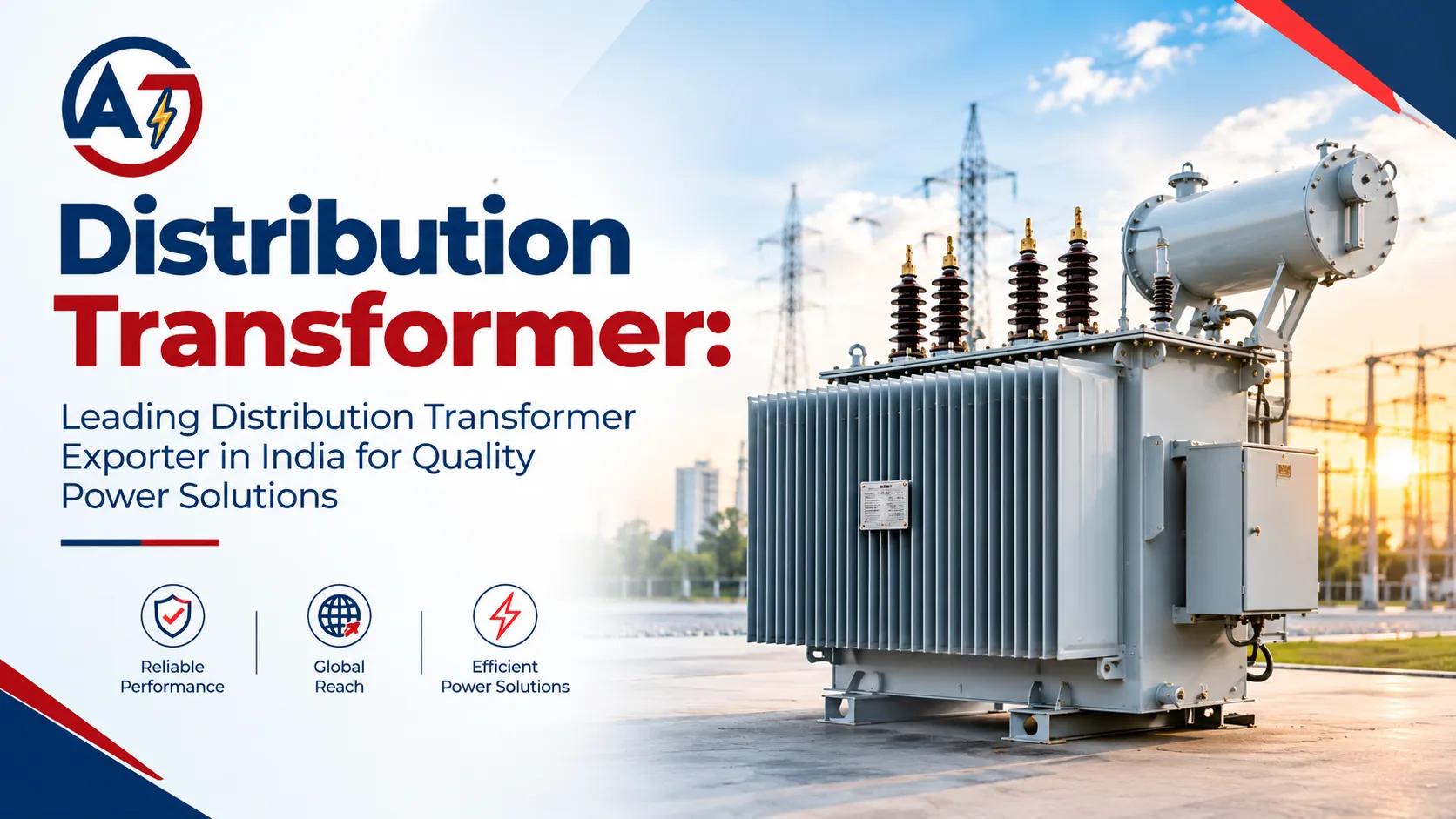
Quick Summary: This is a buyer's guide for importers, EPC contractors and utilities sourcing a distribution transformer from India. It covers the role of the transformer, oil-immersed and dry-type designs, core and winding materials, efficiency labels and losses, sizing, key fittings, the proof to demand from an exporter, applications, export basics, and five costly mistakes.
Introduction
A distribution transformer is easy to ignore until it fails. It hangs on a pole or is placed in a yard, stepping 11 kV down to 433 V so lights, motors, and machines keep running. Because it works every hour of the year, its quality shows up in electricity bills, uptime, and maintenance budgets for decades. That is why many buyers look to India for quality power solutions, and why choosing the right exporter is as important as choosing the right unit. This article discusses what makes a leading transformer exporter in India worth your trust. We explain how these transformers work, which designs and materials suit different sites, and how to read losses and efficiency labels. You will also see which fittings matter, what test proof to demand, and how export paperwork works. A few costly mistakes and common buyer questions follow, so you can compare suppliers with confidence.
What a Distribution Transformer Does
This transformer takes power at a medium voltage and steps it down to a level people can use. In India that usually means 11 kV on the primary side and 433 V on the secondary, though primary voltages of 3.3, 6.6, 22, and 33 kV also appear. The IS 1180 standard covers three-phase units up to 2,500 kVA and single-phase units up to 100 kVA for systems up to 33 kV.
These transformers are placed on poles, on pads, or inside substations, close to the load. They stay energised all year, which makes them different from most plant equipment. Count the hours: a year has 8,760, and a distribution transformer is live for nearly all of them.
Oil-Immersed or Dry-Type: Choosing Your Type
The two main families differ in how they cool and insulate the windings:
-
Oil-immersed: Windings is placed in mineral oil that carries heat away through natural convection, often labelled ONAN. This is the usual choice for outdoor pole, pad, and substation use, and it costs less for a given rating.
-
Dry-type: Windings use solid insulation such as cast resin and no oil. It suits indoor sites where fire risk is a concern, such as buildings and tunnels, but costs more.
We supply three-phase, oil-cooled, oil-immersed distribution transformers for industrial and electricity distribution use, so confirm your site suits that family before you enquire.
Inside the Tank: Core, Windings and Oil
There are three major components that decide the performance of this transformer. The core is usually cold-rolled grain-oriented (CRGO) silicon steel. Amorphous metal cores cost more but cut no-load losses sharply. The windings use copper or aluminium. Copper conducts better, so the coil stays compact. Aluminium is lighter and cheaper but needs more cross-section for the same current. The oil insulates and cools, and its condition tells you how old the distribution transformer is.
Neither winding metal is always better. Copper is perfect for buyers who prioritise compactness and low load losses. Aluminium suits tight budgets and lighter transport.
Why a Star Label Is Only the Start: Reading Losses
Indian utility tenders specify BEE star-rated distribution transformers in the 16 to 500 kVA range. A star label tells you the unit meets a loss ceiling for its rating. It does not tell you which unit is cheapest to own. Two losses matter:
-
No-load loss: The core loses energy whenever the transformer is energised, loaded or not.
-
Load loss: The windings lose energy that rises with the square of the current they carry.
Because no-load loss never stops, it matters most on lightly loaded rural units. Load loss matters more on heavily loaded industrial ones. Ask for guaranteed loss figures in watts, then multiply by your electricity price over the transformer's life. A unit that costs more upfront often wins that sum.
How to Choose the Right kVA Size for the Distribution Transformer
Start with connected load in kVA, then apply a diversity factor, since not every machine runs at once. Add space for growth, often 20 percent or more, and check the transformer's loading against its rating. Running near full load all day shortens insulation life. Running far below capacity wastes money, because no-load losses stay constant. Share your load profile, not just a number, so the exporter can suggest the nearest standard rating.
Small Fittings That Decide Big Outcomes
Fittings look minor on a drawing, but they decide how the distribution transformer survives years outdoors:
-
Tap changer: Adjusts voltage to match supply swings. Off-load types need a shutdown to adjust; on-load types adjust while energised.
-
Sealed or conservator design: Sealed units need less maintenance because the oil never touches air. Conservator types allow oil level checks and suit larger ratings.
-
Basic hardware: Breather, oil level indicator, drain valve, lifting lugs, and a clear rating plate.
Match the list to your climate. Dusty, humid, or coastal sites deserve extra attention to sealing and tank coating.
Important Things to Ask For Before You Place an Order
When you shortlist distribution transformer manufacturers in India, a catalogue claim is not proof. Request these documents:
-
Compliance statement: Which standard the unit meets, for example IS 1180 or IEC 60076.
-
Guaranteed technical particulars (GTP): Rating, voltages, losses, impedance, and weights on one sheet.
-
Routine test reports: Every unit should be tested for ratio, winding resistance, losses, and insulation strength before dispatch.
-
Type test and witness options: Ask whether your inspector can watch testing, and whether type test reports exist for your rating.
A serious exporter answers these without hesitation. Hesitation is itself information.
Where Distribution Transformers Are Used
Amson Transformers lists industrial use, electricity distribution, and renewable energy among the applications for its oil-immersed units, along with small industries. The same unit can also be pole-mounted, pad-mounted, or ground-mounted, depending on the site.
In practice, three groups buy most often. Utilities install them along feeders to serve neighbourhoods. Factories use them to step grid power down for machines. Solar and wind developers use them to connect generation to the local network. Each group should state the load pattern, because a plant running three shifts needs a different loading plan than a village feeder.
Five Major Mistakes to Avoid
Most expensive errors happen before the distribution transformer is built:
-
Sizing for today's load only: Leaving space for growth, or you will replace the unit early.
-
Vague specifications: State voltage, frequency, vector group, tapping range, and ambient temperature in writing.
-
Skipping inspection: Pre-dispatch checks cost far less than a return shipment.
-
Forgetting local rules: Some countries require their own standards or approvals, so check before ordering.
Fix these five and your order has a much better chance of arriving right the first time.
Conclusion
Buying a distribution transformer is a long and important decision which needs proper evaluation of the transformer on different things, unless you slow down. Check the standard, the losses, the fittings, and the test proof, then match the unit to your load and climate. Ask an exporter for evidence, not adjectives, and ask early. Amson Transformers supplies three-phase oil-immersed units for buyers who want clear specifications and straight answers. Choose the transformer you can forget about, because the forgotten ones are the ones working quietly and well.
FAQs
Q. How is a distribution transformer different from a power transformer?
Ans. Power transformers are placed in transmission networks and handle bulk power at higher voltages, usually near full load. Distribution transformers make the final step down to usable voltage and often run at lighter, varying loads.
Q. How long does a distribution transformer last?
Ans. Well-built oil-immersed units commonly serve for 25 years or more with sound loading and care. Overloading, moisture, and poor oil quality shorten that, so test the oil periodically.
Q. Can I order a custom voltage or frequency?
Ans. Often yes, you can easily order a custom voltage or frequency. Export markets differ, with 50 Hz and 60 Hz systems and varied voltage levels, and manufacturers can usually wind to your specification. Ask for a similar past supply as reference.
Q. How often does a distribution transformer need maintenance?
Ans. Oil-immersed units need periodic checks of oil level, breather condition, bushings, and oil quality. Sealed units need less attention. Keep a log and follow the manufacturer's schedule.
Q. Is a pole-mounted transformer right for my project?
Ans. Pole mounting is suitable for smaller ratings along rural and suburban feeders. Larger ratings usually sit on pads or plinths. Ask the exporter for weight and mounting dimensions so your structure can carry the load.
Related Reading
Top 10 Hidden Secrets About Business & Finance You Need to Know
Welcome to our in-depth exploration of Business & Finance. In an era defined...
Why Business & Finance is Transforming the Global Industry Landscape
Welcome to our in-depth exploration of Business & Finance. In an era defined...