Key Signs Your Healthcare Practice Needs Outsourced Billing Services
By Summit RCM
160 Views
Introduction
Many healthcare practices do not realize how much revenue they are losing until financial pressure becomes impossible to ignore. Cash flow slows down, denied claims begin piling up, administrative staff become overwhelmed, and physicians spend more time dealing with billing issues than patient care. By the time leadership recognizes the problem, operational inefficiencies have often been affecting the organization for months — sometimes years.
In today’s healthcare environment, billing operations have become far more complex than simple claim submission. Insurance requirements continue evolving, compliance expectations are increasing, reimbursement models are shifting, and administrative workloads are growing rapidly. Practices that rely on outdated workflows or understaffed billing teams often struggle to maintain financial consistency.
This is one reason why more healthcare organizations are turning toward outsourced billing services as a strategic operational solution rather than merely a cost-cutting measure.
Experienced operational leaders frequently compare healthcare billing systems to manufacturing production lines. In industrial environments, small inefficiencies in workflow coordination, quality control, or process management can disrupt the entire production cycle. Healthcare practices experience similar problems when billing operations become fragmented or overloaded.
Organizations that recognize operational warning signs early are usually in a much stronger position to stabilize revenue performance, improve workflow efficiency, and reduce long-term administrative strain.
Why Billing Complexity Has Increased Across Healthcare
Healthcare reimbursement systems have changed dramatically over the past decade. Providers now operate within an environment shaped by:
- Frequent coding updates
- Stricter payer requirements
- Increasing denial rates
- Prior authorization complexities
- Value-based reimbursement models
- Compliance regulations
- Growing patient financial responsibility
At the same time, many medical practices are attempting to manage these growing administrative demands with limited internal resources.
In smaller and mid-sized organizations especially, billing departments often become reactive rather than strategic. Staff spend most of their time correcting errors, managing denials, responding to payer requests, and handling payment delays instead of improving operational performance.
This creates inefficiencies that slowly affect the entire organization.
The Connection Between Billing Efficiency and Financial Stability
Revenue cycle management functions much like industrial production systems. In manufacturing environments, operational breakdowns create waste, reduce productivity, and slow output quality.
Healthcare billing systems behave similarly.
When billing workflows become inconsistent, organizations typically experience:
- Delayed reimbursements
- Higher denial rates
- Administrative backlogs
- Staff burnout
- Reduced cash flow predictability
- Increased operational costs
Financial instability in healthcare rarely develops from a single large failure. More often, it results from repeated small inefficiencies that accumulate over time.
Practices that monitor operational warning signs early are far more likely to maintain long-term financial health.
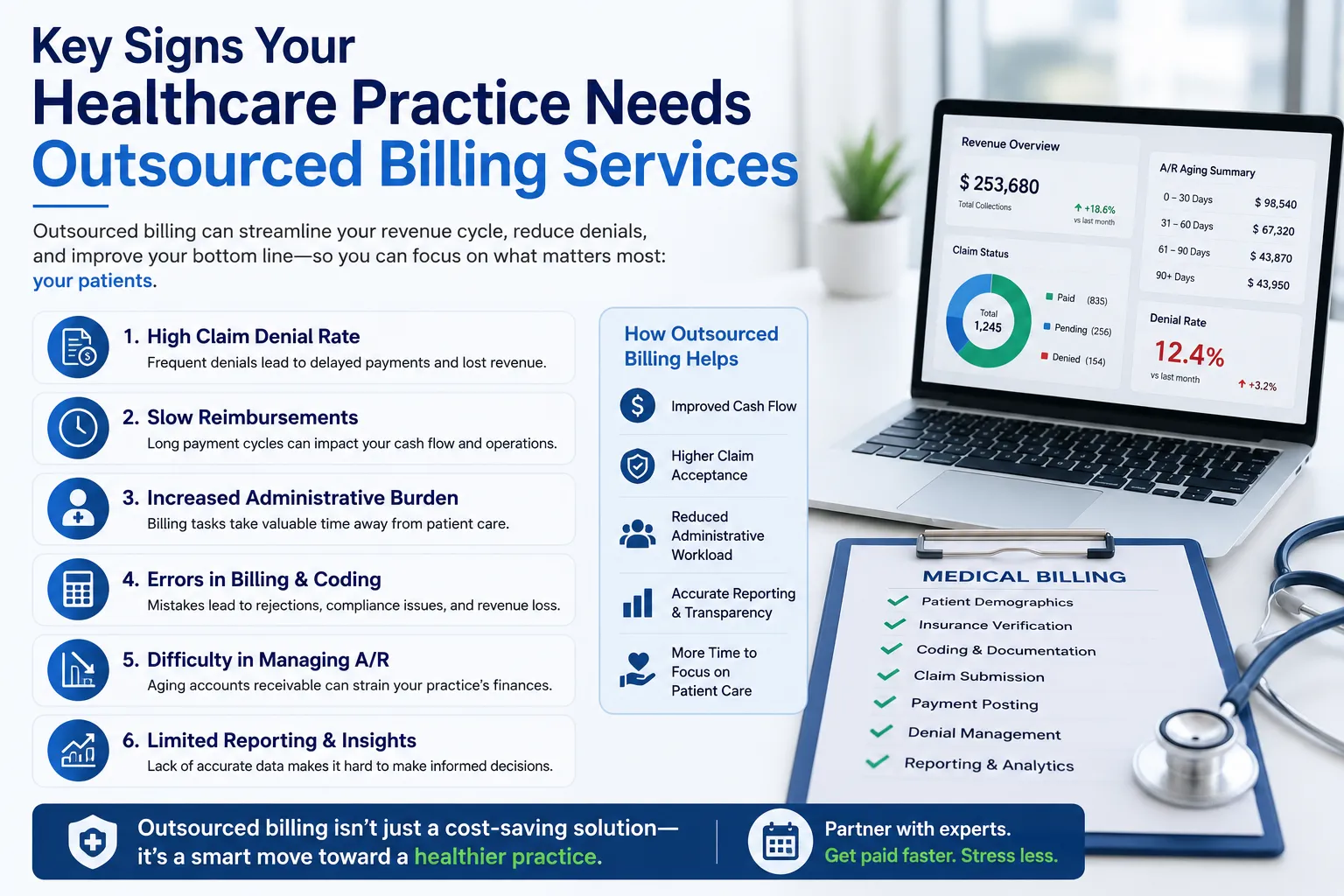
Key Signs Your Practice May Need External Billing Support
Not every healthcare organization requires external revenue cycle assistance. However, several recurring operational indicators often suggest internal systems are struggling to scale effectively.
Rising Claim Denials
A growing denial rate is often one of the earliest warning signs of operational inefficiency.
Denied claims usually indicate problems involving:
- Coding accuracy
- Eligibility verification
- Documentation quality
- Authorization procedures
- Workflow coordination
When denials become frequent, internal billing teams may spend excessive time correcting old claims rather than processing new revenue efficiently.
In manufacturing terms, this resembles excessive production rework — a clear indicator that upstream quality control processes require improvement.
Slower Cash Flow and Delayed Payments
Consistent cash flow delays often point toward workflow bottlenecks inside the revenue cycle.
Common causes include:
- Incomplete claim submissions
- Delayed follow-up procedures
- Understaffed billing departments
- Poor payer communication
- Aging accounts receivable
Many healthcare practices underestimate how much operational inefficiency affects financial predictability.
External billing specialists often improve reimbursement turnaround times because they operate with dedicated workflows, specialized expertise, and stronger process standardization.
Administrative Staff Are Overwhelmed
Many front-office employees now manage responsibilities far beyond patient scheduling and registration.
Staff are often expected to handle:
- Insurance verification
- Authorization tracking
- Patient billing inquiries
- Payment collection
- Claim corrections
- Compliance documentation
Overloaded administrative teams frequently experience rising error rates and declining productivity.
Operationally mature organizations understand that excessive multitasking often weakens workflow reliability.
Physicians Spend Too Much Time on Billing Problems
When physicians regularly intervene in administrative billing issues, operational imbalance usually exists somewhere within the system.
Clinical providers should focus primarily on patient care rather than navigating payer disputes or correcting reimbursement errors.
If physicians repeatedly become involved in:
- Denial appeals
- Documentation disputes
- Coding clarification
- Billing complaints
the organization may lack sufficient administrative infrastructure.
High Employee Turnover in Billing Departments
Revenue cycle operations can become highly stressful when workflows are disorganized or understaffed.
High turnover rates often indicate:
- Excessive workload pressure
- Poor workflow design
- Inadequate training
- Limited operational support
Replacing experienced billing employees repeatedly can create additional instability and increase training costs.
External billing partners often reduce staffing volatility because they maintain specialized teams focused solely on revenue cycle performance.
Limited Visibility Into Financial Performance
Many healthcare practices struggle because leadership lacks clear operational data.
Without strong reporting systems, organizations may not fully understand:
- Denial trends
- Reimbursement delays
- Collection performance
- Aging receivables
- Workflow bottlenecks
- Coding accuracy rates
Operational visibility is essential for effective decision-making.
Manufacturing organizations have long relied on performance dashboards and production metrics to improve industrial productivity. Healthcare organizations increasingly benefit from similar operational monitoring systems.
Lessons Healthcare Can Learn From Manufacturing Operations
Healthcare revenue cycle management shares many operational similarities with industrial production systems.
Several manufacturing principles apply directly to billing optimization.
Lean Workflow Design
Lean manufacturing focuses heavily on reducing waste and simplifying workflows.
Healthcare billing systems often contain unnecessary inefficiencies such as:
- Duplicate data entry
- Repeated claim corrections
- Manual tracking systems
- Excessive approval steps
- Fragmented communication
Organizations that streamline these processes generally improve both productivity and reimbursement reliability.
Quality Control Improves Financial Stability
Manufacturing facilities prioritize early-stage quality inspections because correcting defects later becomes significantly more expensive.
Healthcare organizations benefit from similar preventive strategies.
Strong quality control may include:
- Claims scrubbing systems
- Coding audits
- Eligibility verification checkpoints
- Documentation reviews
- Automated workflow validation
Preventing billing errors early reduces downstream reimbursement problems.
Continuous Improvement Creates Long-Term Efficiency
High-performing industrial operations rarely treat efficiency improvements as one-time projects.
Healthcare organizations that continuously evaluate and refine revenue cycle workflows often achieve stronger long-term financial performance.
Common Challenges When Transitioning to External Billing Support
Although outsourcing can improve operational performance, implementation still requires careful planning.
Resistance to Change
Internal teams may initially worry about workflow disruptions or job security concerns.
Clear communication and leadership involvement are essential during transitions.
Data Integration Issues
Older software systems sometimes create compatibility challenges during onboarding.
Organizations should evaluate technical integration capabilities carefully before selecting a billing partner.
Maintaining Communication Standards
Successful outsourced billing relationships depend heavily on consistent communication between providers, coders, administrative staff, and billing specialists.
Strong collaboration structures improve long-term operational reliability.
How Technology Is Reshaping Billing Operations
Modern billing systems increasingly rely on digital technologies to improve operational efficiency.
Automation and Workflow Optimization
Automated systems now assist with:
- Eligibility verification
- Claims scrubbing
- Payment posting
- Denial tracking
- Authorization management
Automation reduces repetitive manual tasks while improving consistency.
Artificial Intelligence and Predictive Analytics
AI-powered systems can identify billing risks before claims are submitted.
Predictive tools now help organizations:
- Forecast denial trends
- Detect coding inconsistencies
- Identify reimbursement delays
- Improve claim prioritization
These capabilities support stronger financial planning.
Cloud-Based Revenue Cycle Platforms
Cloud infrastructure improves operational scalability and allows healthcare organizations to access billing data more efficiently across locations.
Actionable Strategies Healthcare Practices Can Apply Immediately
Healthcare organizations evaluating their billing operations should consider several practical steps.
Conduct a Revenue Cycle Assessment
Review denial rates, reimbursement timelines, aging receivables, and operational bottlenecks regularly.
Standardize Internal Workflows
Consistent procedures improve workflow reliability and reduce administrative variation.
Invest in Staff Training
Ongoing education improves coding accuracy and billing consistency.
Improve Front-End Verification Processes
Many claim problems originate during patient intake and insurance verification.
Evaluate Outsourcing Readiness Carefully
Organizations should assess whether internal resources can realistically support long-term operational demands.
Future Trends in Healthcare Billing Operations
Healthcare financial systems will continue evolving rapidly over the next decade.
Several trends are shaping future operational strategies.
Greater Automation Adoption
Administrative workflows will become increasingly digitized to improve efficiency and reduce manual errors.
Real-Time Insurance Processing
Future payer systems may support faster claim approvals and reimbursement validation at the point of care.
Increased Specialization
Revenue cycle operations are becoming more technically complex, increasing demand for specialized billing expertise.
Stronger Data-Driven Decision-Making
Healthcare organizations will rely more heavily on analytics to improve operational performance and financial forecasting.
FAQ Section
What are outsourced billing services?
These services involve external specialists managing healthcare billing operations, including claims submission, payment tracking, denial management, and reimbursement processing.
Why do healthcare practices outsource billing?
Many practices outsource billing to improve operational efficiency, reduce administrative burdens, accelerate cash flow, and improve reimbursement accuracy.
How can outsourcing improve cash flow?
External billing teams often reduce claim delays, improve denial management, and accelerate reimbursement cycles through specialized workflows and expertise.
Is outsourcing suitable for small healthcare practices?
Yes. Smaller practices often benefit significantly because outsourcing reduces staffing pressure and provides access to experienced revenue cycle specialists.
What should healthcare organizations evaluate before outsourcing?
Practices should assess reporting capabilities, communication standards, technology integration, compliance expertise, and operational transparency before selecting a billing partner.
Conclusion
Healthcare organizations cannot maintain long-term financial stability while relying on inefficient administrative systems that struggle to keep pace with industry complexity.
Billing operations now require the same level of operational discipline found in advanced industrial environments — standardized workflows, quality control systems, continuous improvement strategies, and strong process visibility.
Outsourced billing services are no longer viewed solely as cost-management tools. Increasingly, they function as strategic operational partnerships that help organizations strengthen cash flow, reduce administrative strain, improve workflow reliability, and support long-term growth.
Practices that recognize operational warning signs early are far better positioned to adapt successfully in an increasingly demanding healthcare environment.
In the years ahead, organizations that combine operational efficiency with specialized financial expertise will likely maintain the strongest competitive advantage.