Key Considerations for Custom IoT Application Development
20 Views
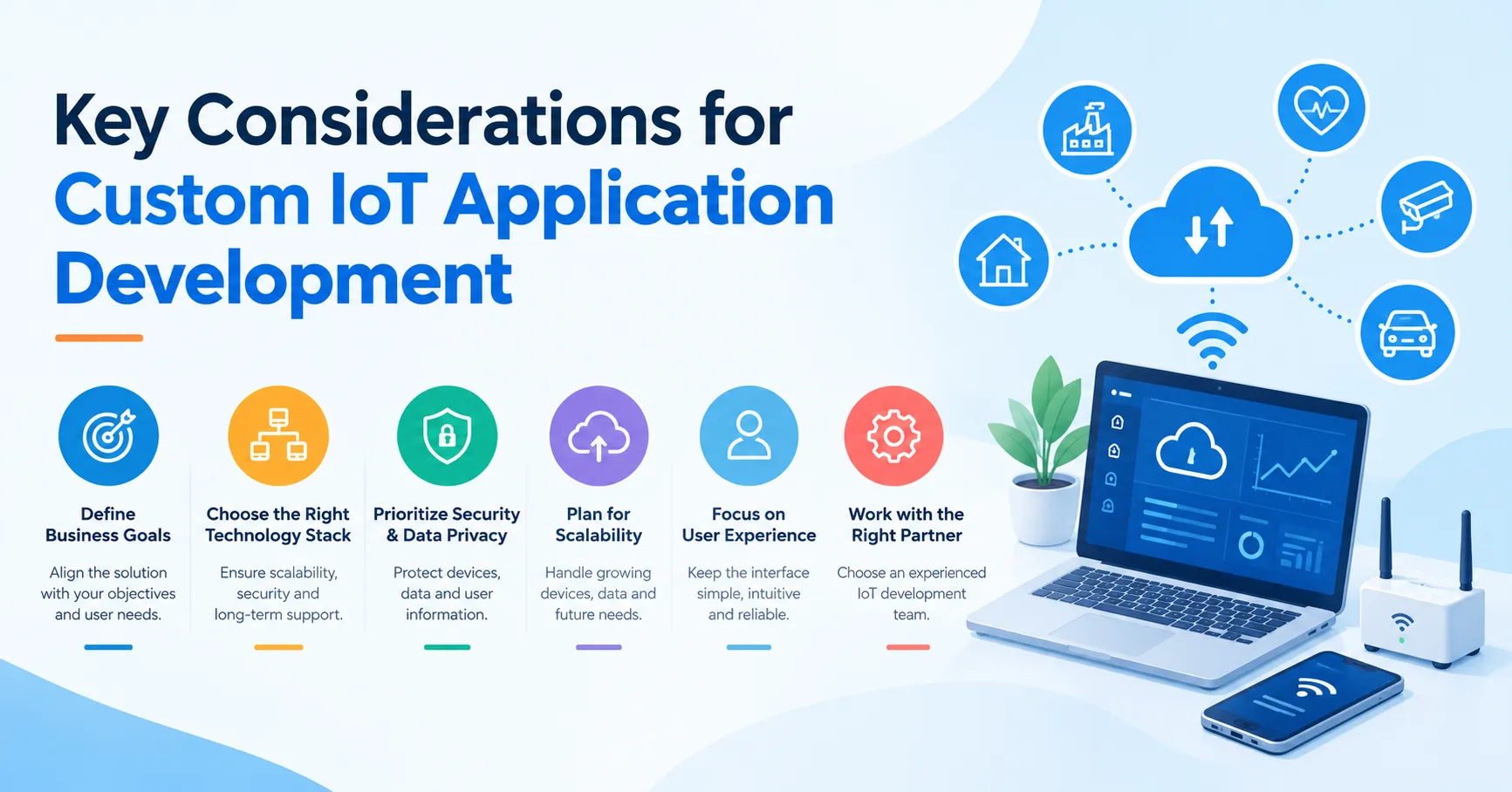
IoT has moved into the boardroom. Eseye's 2026 State of IoT Adoption Report, based on 1,200 enterprise decision-makers in the UK and US, found that 75.6% rank IoT connectivity as a board-level priority and 78% expect their IoT estates to grow over the next 18 months. The same report shows what weak foundations cost. Almost a third of enterprises (29.3%) named an inability to operationalise AI effectively because IoT data lacks reliability as a risk of poor connectivity.
Omdia's 2026 edge research adds detail. Among respondents with edge environments, 31% named security as the top obstacle and 28% pointed to legacy IT integration. A custom application sits at the center of every one of these issues. Its design choices decide whether a connected product scales or stalls. The sections below cover the considerations that matter most.
Define Users and Jobs Before You Choose Features
Feature lists grow fast and ship slowly. A list of user jobs keeps scope honest.
Name every user type, such as operators, technicians, managers, customers, and partner service teams. Write the three to five jobs each one must finish, for example, acknowledging an alarm or approving a firmware release. Build screens and APIs around those jobs. Role-based access then follows naturally, and it prevents one customer from seeing another customer's devices, a costly mistake in multi-tenant products.
Design for Weak Networks and Messy Data
Field networks drop, sensors drift and clocks disagree. Your application should expect all three.
- Buffer readings on the device or gateway and upload in batches when the link returns.
- Make message handling idempotent, so retries never create duplicate records.
- Timestamp data at the source, because cloud arrival time misleads analytics.
- Validate ranges at ingestion and flag sensor drift early.
- Decide what the device does on its own when the cloud is unreachable.
Reliable data feeds analytics and AI, as the Eseye figure above suggests. Treat data quality as a product requirement with its own tests.
Pick Protocols and Platforms You Can Leave
Protocol and platform choices last for years. Pick ones that you could swap without rewriting the product.
MQTT suits lightweight telemetry. OPC UA fits industrial equipment. LwM2M suits constrained devices that need remote management. Managed services such as AWS IoT Core and Azure IoT Hub remove months of broker engineering, and one vendor guide credits a managed platform with saving three to six weeks of backend work. Keep a thin abstraction layer between business logic and cloud-specific services. A later move to another provider then becomes a configuration project instead of a rewrite. Check message-volume pricing too, because costs grow with fleet size.
Build Security Into Every Layer
Security added late costs more and protects less. Plan these controls from the first sprint.
- Unique credentials and a hardware-backed identity for each device.
- Encrypted transport on every connection.
- Signed and encrypted firmware updates.
- Least-privilege cloud roles and managed secrets.
- Audit logs and anomaly alerts.
- A tested patch process for devices already in the field.
Microsoft's 2019 IoT Signals report found that 97% of adopters had security concerns, and Omdia's 2026 numbers show the worry has not faded. One vendor cost guide suggests allocating 15% to 25% of budget to security. Cutting it early usually forces expensive fixes after launch.
Plan Integrations Before the First Release
IoT data earns its keep when it reaches the system that acts on it. That might be a work order in a CMMS, a stock update in an ERP or a service case in Salesforce.
Define APIs, event formats and versioning rules early. Omdia found that 29% of edge adopters struggle to connect deployments with operational technology and business processes. A written integration contract saves weeks of debugging between teams.
Evaluate an IoT App Development Company on Evidence
Polished demos hide weak engineering. Ask for proof instead.
Any IoT app development company should show shipped products in your domain, architecture diagrams that include security, a test strategy with hardware in the loop, a support model for after launch and clear terms on code and IP ownership. Real IoT application development services cover discovery, firmware or gateway integration, cloud, the application itself, quality assurance and operations. A provider that only builds mobile screens will leave gaps in firmware and cloud work, and those gaps are where projects slip.
How Tetra Pak Protected Production Networks With Edge Design
Tetra Pak's connected factory work shows how architecture choices serve security goals.
According to a Microsoft customer story summarized by ITMagination, Tetra Pak used Azure IoT Hub and Azure IoT Edge to collect data from thousands of devices. Nested IoT Edge devices kept production networks isolated from the cloud while data still flowed upward, and Power BI dashboards gave teams a clear view. The summary reports fewer unexpected equipment failures and steadier production schedules. The design lesson applies to any custom build. Put network isolation into the application architecture at the start, because retrofitting it is harder.
Cost and Business Impact
Budgets vary widely, so tie spending to a metric.
- Deloitte's 2025 survey of 600 manufacturing executives reports 10% to 20% output gains from smart technology.
- Omdia reports that 87% of respondents with edge deployments say results meet or exceed expectations.
- One vendor guide estimates that software takes 40% to 50% of an enterprise IoT budget, with hardware, security and operations sharing the rest. Treat that as a rough guide and confirm it with quotes.
Link each feature to a measurable outcome, such as fewer site visits or faster fault resolution. Features without a metric are the first to cut.
Key Takeaways for Teams Planning a Custom IoT Application
A sound IoT application starts with users and data quality, not with a feature wishlist. Design for bad networks, protect every layer, plan integrations early, and choose partners who can show evidence.
- Write user jobs before features.
- Expect dropped connections and messy sensor data.
- Keep platform choices reversible.
- Fund security from the first sprint.
- Measure every feature against a business outcome.