Industrial Product Inspection Systems for Modern Manufacturing
62 Views
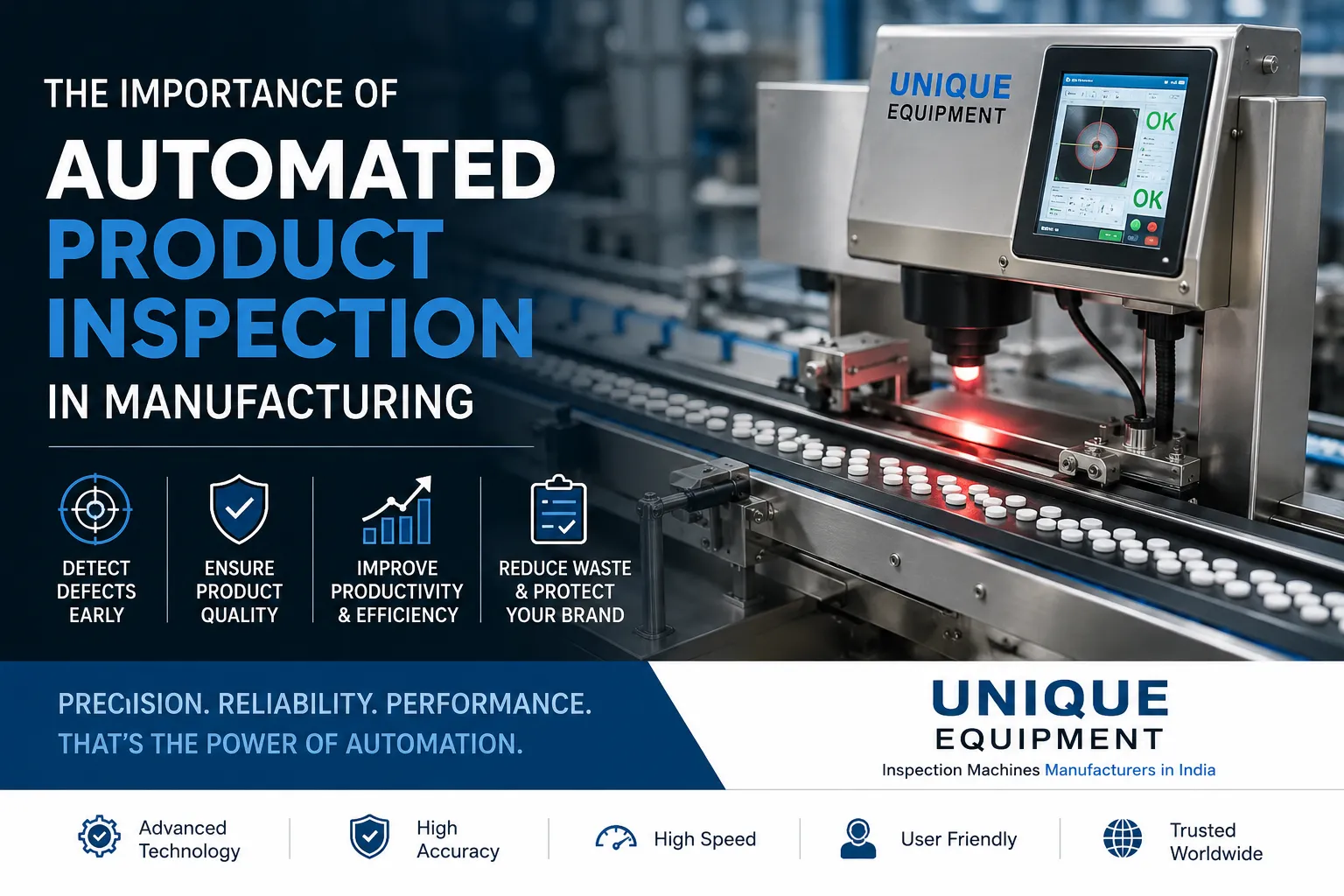
A chemical packaging plant in Vadodara ran its inspection process on the same basic visual checkpoint for eleven years — a single operator glancing at filled containers as they passed — right up until a client audit asked for inspection data the plant simply didn't have. The equipment hadn't changed because nobody had questioned whether it still matched the plant's actual production volume. That's the quiet risk with Inspection Machines across industrial manufacturing broadly, not just pharma and food: the checkpoint that worked fine at yesterday's scale quietly becomes inadequate as volume grows, and nobody notices until an outside party asks for proof.
Industrial inspection needs vary more than most buyers assume. A chemical packaging line has different defect priorities than a food processing conveyor, which differs again from a pharmaceutical tablet line. Modern manufacturing has also raised the bar on what "inspection" means — it's not just catching a bad unit anymore, it's generating the data trail that proves your process is under control, across whichever industry you're operating in.
Specification
What Modern Manufacturing Actually Demands From Inspection
Beyond basic defect detection, current Inspection Machines increasingly need to integrate data output with broader plant quality systems — feeding defect logs into a central QA database rather than existing as an isolated checkpoint. This integration matters more in industries with tighter documentation requirements, like pharma and chemical manufacturing, but it's becoming standard expectation across food and packaging sectors too.
The Detail Most Buyers Skip
Cross-industry configuration confusion. Buyers in chemical or packaging industries sometimes default to inspection specifications built for pharma applications, assuming stricter is always safer. That mismatch usually means paying for precision your product doesn't need, or worse, a configuration tuned for the wrong defect priorities entirely — dimensional tolerance for a chemical drum fill line looks nothing like tablet surface inspection.
Core Configuration Elements Across Industries
- Chemical and industrial packaging — larger-format inspection for fill level, seal integrity, and label placement, generally at lower throughput speed than pharma tablet lines.
- Food processing — surface and color inspection tuned for variable, non-uniform products, often requiring more flexible defect tolerance than pharma applications.
- Pharmaceutical — high-speed, tight-tolerance dual-face inspection for tablets and capsules, where defect tolerance is narrowest.
- Data integration — output formats compatible with plant-wide QA systems, not just standalone unit logs.
Objective: Five Criteria to Evaluate Any Supplier
1. Do they understand your specific industry's defect priorities, or default to a generic configuration? A bad answer applies the same base configuration regardless of whether you're inspecting tablets, filled chemical drums, or packaged food. Each industry's real risk profile is different.
2. Can their inspection data integrate with your existing QA or plant management systems? If a supplier only offers isolated unit-level logging with no export or integration capability, you're building a data silo that limits how useful that information actually is.
3. What's their experience across multiple industries, not just one? A bad answer is narrow industry experience presented as universal expertise. A supplier who's only worked with pharma clients may not understand chemical packaging's different tolerance and throughput needs.
4. How do they handle inspection scaling as production volume grows? A bad answer sells you equipment sized for today's volume with no discussion of scalability. Ask directly how their systems handle a throughput increase without a full replacement.
5. Do they offer a genuine assessment of whether your current inspection process is inadequate, or do they just push new equipment regardless? A bad answer recommends replacement without first understanding whether your existing process has an actual gap. A supplier who always recommends buying isn't giving you an honest evaluation.
Benefits
- Reduces industry-specific defect risk. Configuration matched to your actual product category — chemical, food, or pharma — catches what matters for your specific risk profile, not a generic checklist.
- Supports scalable production growth. Properly specified systems handle volume increases without requiring a full equipment replacement every few years.
- Improves cross-departmental data visibility. Integrated inspection data feeding into plant QA systems gives management real visibility into quality trends, not isolated unit reports.
- Reduces audit preparation time. Centralized, accessible inspection records cut the scramble to compile documentation when a client or regulatory audit request comes in.
- Lowers long-term equipment cost through correct initial sizing. Avoiding over-specification (pharma-grade precision for a chemical line that doesn't need it) or under-specification protects capital budget.
- Strengthens multi-industry supplier relationships. A single equipment partner who understands inspection needs across your full product range simplifies procurement and service coordination.
Availability
Buyers researching Inspection Machines Manufacturers in India across chemical, food, and pharmaceutical sectors should weigh cross-industry experience alongside location. Manufacturers based near Goa's Marmagao industrial corridor benefit from Mormugao Port proximity, supporting faster delivery and documentation turnaround for buyers exporting internationally across multiple product categories, where inspection requirements often differ by destination market as much as by industry.
Domestic buyers across Maharashtra, Karnataka, and Gujarat — regions with concentrated chemical, food, and pharma manufacturing — benefit from the same location through predictable road and rail delivery without metro congestion delays. When comparing Inspection Machine Suppliers in India for a diversified manufacturing operation, ask directly whether they've configured systems across the specific industries you operate in, not just one.
About Us
We've manufactured inspection, detection, and weighing equipment from our Chicalim, Goa facility since 1999. Our director, Pravin Parker, built the business to serve pharmaceutical, food, and chemical clients from early on, which meant our inspection product line had to flex across genuinely different defect priorities rather than specializing narrowly in one industry.
Here's something that shaped how we quote inspection systems: a chemical packaging client once asked us to match a pharma-grade tolerance spec they'd seen on a competitor's brochure, assuming tighter meant better. We talked them out of it. Their actual fill-level and seal-integrity requirements didn't need that precision, and the pharma-grade configuration would have cost nearly double for capability they'd never use. We'd rather lose a bit of margin on that quote than sell equipment mismatched to what a client actually needs.
We manufacture, supply, and export Inspection Machines, Micro Scan Metal Detectors, Dedusting Machines, and weighing machines across pharmaceutical, food, and chemical manufacturing sectors, and our configuration process starts with your industry's actual defect priorities, not a generic template.
If you're evaluating an Inspection Machine for a chemical, food, or pharmaceutical production line, send us your product type, current inspection process, and target throughput. We respond within 24 to 48 hours with a configuration recommendation matched to your industry's actual defect priorities and an honest assessment of whether an upgrade is genuinely needed. Minimum order quantity is one unit. Call +91 80 4547 7017 or send your details through our site before finalizing a spec elsewhere.
Conclusion
Modern manufacturing has raised what's expected from Inspection Machines across every industry — not just catching a defective unit, but generating documented, integrated data that proves your quality process holds up under scrutiny. What that requires varies meaningfully between chemical packaging, food processing, and pharmaceutical production, and buyers who treat inspection as a single generic category end up either overpaying for unnecessary precision or under-protecting a genuine risk. Getting that match right, for your specific industry, is what actually protects your production going forward.
FAQs
Q1: How does inspection configuration differ between chemical, food, and pharma manufacturing? Pharmaceutical lines generally need the tightest tolerance and highest-speed dual-face inspection, food processing needs flexibility for naturally variable products, and chemical packaging often prioritizes fill level and seal integrity over fine surface defect detection. Applying one industry's standard to another usually means a poor match.
Q2: Can Inspection Machines Manufacturers in India configure one system to serve multiple product lines across different industries? Sometimes, if the defect categories overlap closely enough, but it's not automatic. We evaluate this case by case rather than assuming a single configuration will serve genuinely different product types well.
Q3: What's the risk of over-specifying an Inspection Machine for a lower-tolerance application? Beyond unnecessary cost, over-specified systems sometimes run at reduced throughput relative to their rated capacity because tighter tolerance settings require more inspection dwell time than your product actually needs.
Q4: How do Inspection Machine Suppliers in India handle data integration with existing plant QA systems? This varies significantly by supplier, and it's worth confirming directly rather than assuming standard compatibility. We configure output formats to integrate with common plant QA systems, but not every supplier prioritizes this by default.
Q5: Is it worth upgrading an inspection system that's been reliable for over a decade? Not automatically — reliability isn't the only factor. If your production volume or documentation requirements have grown since installation, an older system may no longer generate the data trail modern audits expect, even if it's still catching defects fine.
Q6: What should a chemical manufacturer specifically ask an Inspection Machine Exporter about export documentation? Ask whether their export documentation process accounts for chemical industry-specific regulatory requirements, which often differ from pharma or food export paperwork. A supplier with only pharma export experience may not have this covered by default.
Q7: How often should industrial inspection configuration be reassessed as production scales? We recommend a review whenever throughput increases meaningfully or product formulation changes, rather than waiting for a fixed interval. Volume growth is usually gradual enough that inadequacy creeps in unnoticed until an external audit or client complaint forces the issue.
Related Reading
Top 10 Hidden Secrets About Business & Finance You Need to Know
Welcome to our in-depth exploration of Business & Finance. In an era defined...
Why Business & Finance is Transforming the Global Industry Landscape
Welcome to our in-depth exploration of Business & Finance. In an era defined...