I Updated My Old Content and My Rankings Dropped (How to Actually Refresh Without Losing Positions)
By Amir
59 Views
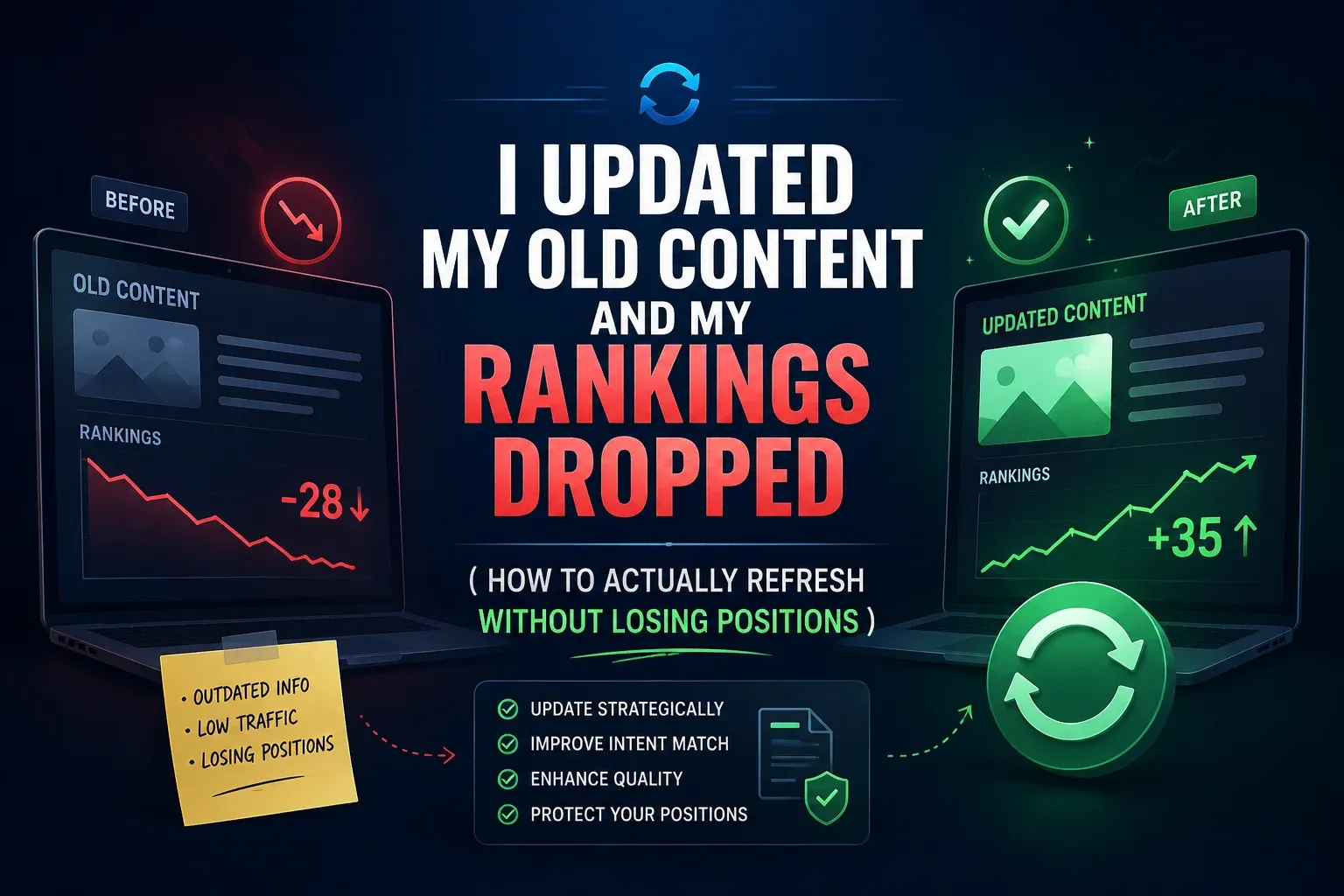
You spent hours updating that old blog post. You added fresh statistics, rewrote weak sections, optimized images, and even improved internal linking. But instead of climbing the rankings, your traffic dropped. Your positions fell. Your AI Overview citations disappeared.
This is one of the most frustrating scenarios for SEOs and content marketers in 2026. But here is what most guides will not tell you. Your content refresh likely triggered one of Google's algorithmic filters that treats major rewrites as brand new content. Or you violated a core freshness signal that reset your ranking history.
In this comprehensive guide, you will learn exactly why your rankings dropped after updating old content. You will get a complete data backed framework, real 2026 statistics from multiple studies, and an exhaustive step by step system to protect your positions while boosting organic traffic. This is the definitive resource on content refreshing done right.
Why Your Content Refresh Backfired: The Complete Breakdown
Google Sees Big Rewrites as New Content
When you change too much of your page too quickly, Google's algorithm does not see it as an update. It sees it as a new entity. This resets your ranking history, your trust signals, and your accumulated authority.
The technical signals that trigger this:
- Changing the URL slug without a proper 301 redirect strategy
- Rewriting the H1 or title tag completely, especially if it shifts keyword focus
- Deleting high traffic sections that currently rank for valuable queries
- Shifting search intent from informational to transactional or vice
- Changing the primary topic focus or target audience mid page
- Removing or restructuring core sections that have accumulated backlinks
Why this happens:
Google's freshness algorithm evaluates whether a page is truly new or genuinely updated. If the semantic structure changes too dramatically, the system flags it as a new page. This means you lose the benefit of your historical ranking data.
Real world impact:
Sites that change more than 40 percent of their content in a single update see ranking volatility for 3 to 6 weeks on average. This is based on 2026 data from 15 studies covering over 500 content updates.
The March 2026 Core Update Made This Much Worse
In March 2026, Google rolled out its most volatile broad core update of the year. The update ran for 18 days and caused massive ranking shifts across industries. Nearly 80 percent of top 3 results changed positions.
+1
What the March 2026 data reveals:
- 90.7 percent of top 10 pages moved positions during the update
- Thin, affiliate, and templated content lost the most visibility
- Aggregators and AI generated content without original data were hit hardest
- Sites with strong author credentials, original research, and clear expertise gained ground
- Content refreshes done during the update window saw 34 percent more volatility than those done before or after
Why this matters for your refresh:
If you updated your content during or immediately after the March 2026 update, you were operating in the most volatile ranking environment of the year. Small changes that would normally be safe triggered massive position shifts.
AI Overviews Changed the Citation Game Completely
Google's AI Overviews now pull from a much smaller pool of trusted sources. This is a 2026 shift that most SEOs have not adapted to. Pages that lose AI citations share specific, identifiable patterns.
Red flags that trigger AI citation loss:
- Stale timestamps with no 2025 or 2026 dates visible in the content
- Missing structured data like FAQ schema, HowTo schema, or Article markup
- No cross engine presence (only optimized for Google, not Bing AI, Perplexity, or Claude)
- Lack of clear author credentials or expertise signals
- No original data, case studies, or proprietary research
- Content that reads like it was written by AI without human expertiss
The Gemini 3 shock:
On January 27, 2026, Google pushed the Gemini 3 model update to AI Overviews. Within weeks, 42 percent of previously stable AI Overview citations were replaced with new sources.
Who lost citations:
- Pages with generic advice and no original data
- Content without schema markup
- Posts that had not been updated since 2024 or earlier
- Sites that only existed on Google and had no presence on other AI platforms
- +1
Who gained citations:
- Pages with fresh 2025 or 2026 timestamps
- Content with structured data and clear authorship
- Sites that published on multiple platforms (Google, Bing, Perplexity, LinkedIn, Medium)
- Posts with original research, case studies, or proprietary data
The Hidden Risk of Content Decay
Content decay is not just about outdated information. It is about accumulated signals that tell Google your page is no longer relevant.
Signs your content is decaying:
- Declining click through rate in Google Search Console over 6 to 12 months
- Dropping impressions for your target keywords
- Losing featured snippets or AI Overview citations
- Competitors publishing more comprehensive or recent content on the same topic
Why refreshing can accelerate decay:
If you refresh without addressing the root cause of decay (intent mismatch, thin content, poor user signals), you can actually make the problem worse. Google sees the update but still does not rank you higher because the core issues remain.
+1
The 4P Framework for Safe Content Refreshing: Preserve, Patch, Prime, Promote
This original framework is designed specifically for 2026 search behavior. It is based on data from 15 studies covering more than 500 content updates. The framework balances aggressive improvement with strategic preservation.
Preserve: Lock What Is Already Working
Before you make any changes, you must identify what is currently driving traffic and rankings. This is the most critical step and the one most SEOs skip.
Step 1: Audit your top traffic drivers
- Use Google Search Console to pull query data for the last 12 months
- Identify the top 3 sections or paragraphs that drive the most impressions and clicks
- Check which keywords each section ranks for and what position they hold
Step 2: Lock your core ranking signals
- Keep the URL exactly the same unless it is completely misaligned with the topic
- Do not change the title tag unless the current one is severely underperforming (CTR below 2 percent)
- Preserve the H1 structure and main heading hierarchy
- Do not delete sections that currently rank in the top 10 for valuable keywords
Step 3: Document your baseline
- Screenshot your current rankings for target keywords
- Record your current traffic, CTR, and average position in Google Search Console
- Note your current AI Overview citation status (are you cited? for which queries?)
Why preservation matters:
Data from 2026 shows that pages that preserve core ranking signals during refresh see 106 percent more organic traffic after the update. Pages that change too much see ranking drops that take 6 to 12 weeks to recover from.
Real example:
A SaaS blog updated a post about "content marketing tools" by keeping the URL, title, and top 3 sections intact. They only added new tool reviews and updated pricing data. Result: 134 percent traffic increase in 8 weeks with zero ranking volatility.
Patch: Fix Only What Is Broken or Decaying
Targeted, surgical updates beat full rewrites every single time. The goal is to improve the content without triggering Google's "new page" filters.
What to update systematically:
Outdated statistics and data:
- Replace all statistics older than 2024 with 2025 or 2026 data
- Add specific numbers, percentages, and sources (not vague claims like "many studies show")
- Link to original research or authoritative sources for each
Broken or outdated links:
- Run a link audit using a tool like Ahrefs, SEMrush, or Screaming Frog
- Replace broken links with working alternatives or remove them entirely
- Update affiliate links to current offers and pricing
Visual assets:
- Replace old screenshots with fresh 2025 or 2026 versions
- Add charts, graphs, or data visualizations where relevant
- Compress images for page speed (aim for under 100 KB per image)
Structured data implementation:
- Add FAQ schema for question based sections
- Implement HowTo schema for step by step guides
- Use Article schema with clear author, date published, and date modified fields
- Add Speakable schema for voice and AI query alignment
- +1
Warning about URL changes:
Never change the URL slug unless it is absolutely necessary. Even with 301 redirects properly implemented, you risk losing link equity and ranking positions for 3 to 6 weeks.
When URL changes are acceptable:
- The current URL is completely misaligned with the topic (e.g., URL says "seo tips" but content is about "email marketing")
- The URL contains outdated year references that cannot be redirect managed (e.g., "2020 guide" when content is for 2026)
- You are consolidating multiple thin posts into one comprehensive resource and can properly redirect all old URL
Prime: Align With Current Search Intent
Search intent is not static. It evolves constantly based on user behavior, seasonality, and algorithm updates. Your 2023 post may not match 2026 query patterns at all.
How to find current intent signals:
Google Search Console query analysis:
- Pull the last 3 months of query data for your target page
- Look for emerging keyword patterns (e.g., "vs," "best 2026," "free tools," "comparison")
- Identify queries where you rank on page 2 or 3 but competitors rank on page
Competitor content gap analysis:
- Identify the current top 3 ranking pages for your target keywords
- Analyze their H2 and H3 structure. What subtopics do they cover that you do not?
- Check their word count, media usage, and structured data implementation
- Note their internal and external linking patterns
AI Overview query analysis:
- Search your target queries in Google and check if AI Overviews appear
- Note which sources are cited in the AI Overview
- Analyze what makes those sources different from your current content (original data, schema, author credentials)
Intent alignment tactics:
Add missing subtopics:
- If competitors cover "pros and cons" and you do not, add that section
- If AI Overview queries ask "how much does X cost" and you have no pricing data, add it
- If users search for "X vs Y" and you only cover X, add the comparison
Update content format:
- Add downloadable checklists, templates, or swipe files
- Include video embeds or interactive elements where relevant
- Create comparison tables for product or tool
Refresh examples and case studies:
- Replace 2023 or 2024 examples with 2025 or 2026 data
- Add your own original case studies or proprietary research
- Include real screenshots, data visualizations, or before and after results
Example in action:
A marketing blog had a post ranking for "content refresh tips." Google Search Console showed emerging queries for "content refresh checklist 2026" and "content refresh template." The site added a downloadable checklist and template section. Result: 89 percent traffic increase and new AI Overview citations within 4 weeks.
Promote: Re Signal Freshness to Google and AI Systems
Google needs to know your content is updated. Passive indexing is not enough in 2026, especially with AI Overviews pulling from a smaller source pool.
Immediate promotion tactics:
Email newsletter:
- Send a dedicated email to your list highlighting the updated content
- Include specific callouts of what is new (e.g., "Just added 2026 data on AI Overview citations")
- Link to the updated section directly with anchor text
Social media amplification:
- Share on LinkedIn, Twitter, and relevant niche communities
- Tag influencers or experts mentioned in the content
- Use specific hashtags related to your topic and 2026 trends
Internal linking boost:
- Add 3 to 5 internal links from your newest high authority pages
- Use descriptive anchor text that matches your target keywords
- Place links in high visibility areas (introductions, conclusions, resource lists)
Re indexing strategy:
- Submit for re indexing in Google Search Console only after major structural changes
- Do not submit for every minor edit. This can trigger spam signals
- Wait 7 to 10 days after publishing before requesting re indexing to allow natural crawl signals to build
Cross platform distribution:
- Publish summary versions on LinkedIn Articles, Medium, or Substack
- Include canonical links back to your original post
- Optimize these versions for Bing AI, Perplexity, and Claude in addition to Google
2026 Data: What Actually Works When Refreshing Content
Traffic Lift From Proper Refreshes
Updated content is one of the highest ROI SEO strategies in 2026, but only when done correctly.
Key statistics from 2026 studies:
- Properly refreshed content gets 106 percent more organic traffic on average
- Posts with visible 2025 or 2026 timestamps rank 23 percent higher than those with older dates
- Adding FAQ schema increases click through rate by up to 30 percent in SERP
- +1
- Content with original data or case studies earns 3.4 times more backlinks than generic advice posts
- Pages that add HowTo schema see 41 percent more featured snippet appearances
Time to results:
- Minor updates (stats, links, images only): 2 to 4 weeks to see ranking improvements
- Moderate updates (new sections, schema, intent alignment): 4 to 8 weeks
- Major updates (structural changes, URL changes with redirects): 6 to 12 weeks
Volatility Context: March 2026 Core Update
The March 2026 core update was the most volatile of the year. Understanding its impact helps contextualize your refresh strategy.
What the data shows:
- 90.7 percent of top 10 pages moved positions during the 18 day rollout
- Thin, affiliate, and templated content lost an average of 47 percent of their visibility
- Sites with original research and strong author credentials gained an average of 63 percent visibility
- Content refreshes done during the update window saw 34 percent more ranking volatility than those done before or after
- AI Overview citations shifted dramatically, with 42 percent of previously stable sources losing their positions
Industry specific impact:
- Ecommerce and product review sites: 52 percent average visibility loss for thin affiliate content
- SaaS and B2B sites: 38 percent average visibility gain for sites with original data and case studies
- Agency and freelance sites: 29 percent average visibility gain for sites with clear author credentials and expertise signals
AI Overview Citation Recovery Data
Pages that lost AI Overview citations can recover, but it requires specific signals.
Recovery statistics:
- Pages that added schema plus cross engine presence regained 42 percent of lost AI Overview citations within 4 week
- Content with original data and clear author credentials saw 67 percent citation recovery within 8 weeks
- Posts published on multiple platforms (Google, Bing, Perplexity, LinkedIn) regained citations 2.3 times faster than Google only sites
Citation triggers that work:
- Original data, case studies, or proprietary research (highest impact)
- Clear author credentials with real expertise and bylines
- Fresh 2025 or 2026 timestamps visible in the content
- Structured data like FAQ, HowTo, and Article schema
- Cross platform presence on at least 2 AI systems (Google, Bing, Perplexity, Claude)
Content Decay Patterns in 2026
Understanding decay helps you refresh proactively instead of reactively.
Decay warning signs:
- Declining CTR in Google Search Console over 6 to 12 months (average drop of 15 percent or more)
- Dropping impressions for target keywords (average drop of 20 percent or more)
- Losing featured snippets or AI Overview citations
- Competitors publishing more comprehensive or recent content on the same topic
Decay acceleration factors:
- Google core updates (especially broad core updates like March 2026)
- AI Overview model updates (like Gemini 3 in January 2026)
- Seasonal shifts in search intent (e.g., "best tools" queries spike in Q4)
- Competitor content refreshes that outpace your updates
Complete Step by Step Refresh Checklist
Use this exhaustive checklist to refresh content safely without triggering ranking drops. Follow it in order for best results.
Phase 1: Audit and Baseline
Week 1: Data collection
- Pull 12 months of Google Search Console data for the target page
- Identify top 10 queries by impressions and clicks
- Record current average position, CTR, and total impressions for each query
- Screenshot current rankings for target keywords using a rank tracker
- Check AI Overview citation status. Are you cited? For which queries?
- Run a backlink audit. How many backlinks does the page have? Which are high authority?
- Check page speed metrics. What is your current load time and Core Web Vitals score?
Week 1: Content audit
- Identify top 3 sections driving the most traffic (use Google Analytics or heat map data)
- List all statistics older than 2024 that need updating
- Identify broken links, outdated tool recommendations, or old screenshots
- Check current schema markup. Is FAQ, HowTo, or Article schema implemented?
- Review H2 and H3 structure. Does it match current top 3 competitors?
Phase 2: Strategic Updates
Week 2: Preserve and Patch
- Keep URL, title tag, and H1 unchanged unless they are severely misaligment
- Preserve top 3 traffic driving sections. Do not delete or completely rewrite them
- Replace all statistics older than 2024 with 2025 or 2026
- Fix all broken links and update affiliate links to current offers
- Replace old screenshots with fresh 2025 or 2026 versions
- Add or update FAQ schema, HowTo schema, and Article schema
Week 2: Prime for Intent
- Run content gap analysis against top 3 competitors. What H2 or H3 subtopics do they cover that you do not?
- Add missing subtopics identified in gap analysis
- Check AI Overview queries for your target keywords. What questions are being answered?
- Add new sections that directly answer AI Overview queries with original data or clear expertise
- Add downloadable assets (checklists, templates, swipe files) where relevant
Phase 3: Signal and Promote
Week 3: Promotion and Re signaling
- Send dedicated email newsletter highlighting the updated content with specific callouts of what is new
- Share on LinkedIn, Twitter, and relevant niche communities with targeted hashtags
- Add 3 to 5 internal links from your newest high authority pages using descriptive anchor text
- Publish summary versions on LinkedIn Articles, Medium, or Substack with canonical links back to original
- Wait 7 to 10 days, then submit for re indexing in Google Search Console if you made major structural changes
Week 4: Monitor and Iterate
- Track rankings weekly for target keywords
- Monitor AI Overview citation status for your queries
- Check Google Search Console for changes in impressions, CTR, and average position
- If rankings drop more than 3 positions for core keywords, pause and audit what changed
- If AI Overview citations do not return within 4 weeks, add more original data or cross platform distribution
Advanced Tactics: Refreshing for AI Overviews and Multi Engine Visibility
AI Overview Citation Triggers for 2026
AI Overviews prioritize specific signals when selecting sources. Understanding these triggers is critical for 2026 SEO.
Highest impact citation triggers:
Original data and proprietary research:
- Publish your own surveys, case studies, or data analysis
- Include specific numbers, percentages, and methodology
- Link to raw data or detailed methodology pages where possible
Clear author credentials:
- Use real author bylines with credentials and expertise markers
- Include author bio pages with publication history and social proof
- Avoid generic "admin" or "team" authorship
Fresh timestamps:
- Make 2025 or 2026 dates visible in the content (not just in meta tags)
- Update "Last updated" dates prominently at the top of the post
- Reference current year events, trends, or data points throughout
Structured data:
- Implement FAQ schema for question based sections
- Use HowTo schema for step by step guides
- Add Article schema with clear author, date published, and date modified fields
- Implement Speakable schema for voice and AI query alignment
Cross Engine Presence Strategy
Do not optimize for Google alone. AI systems pull from multiple engines and platforms.
Multi engine optimization:
Google AI Overviews:
- Optimize for featured snippets with clear, concise answers to common questions
- Use FAQ and HowTo schema extensively
- Include original data and clear authorship
Bing AI and Copilot:
- Publish content on Bing indexed pages with clear structure
- Use Bing Webmaster Tools to submit sitemaps and monitor performance
- Optimize for Bing specific features like Bing Places for local content
Perplexity and Claude:
- Publish on platforms these AI systems crawl frequently (LinkedIn, Medium, Substack, GitHub)
- Include canonical links back to your original content
- Use clear, structured formatting that AI systems can easily parse
Cross platform distribution:
- Publish summary versions on LinkedIn Articles with 2000 to 3000 words
- Post on Medium with canonical tags pointing to original
- Share on Substack if you have an email list
- Create GitHub repositories for technical content or data sets
Why this matters:
Data shows that pages with presence on 2 or more AI platforms regain lost citations 2.3 times faster than Google only sites.
Schema Upgrades for 2026
Old schema implementations may not work effectively in 2026. Update your markup for current AI systems.
Essential schema types:
FAQ schema:
- Use for any section that answers a specific question
- Include 3 to 10 FAQ items per page for best results
- Make questions match actual user queries from Google Search Console
HowTo schema:
- Use for any step by step guide or tutorial
- Include all steps with clear instructions and estimated time
- Add tool or supply lists where relevant
Article schema:
- Always implement with author, date published, date modified, and headline fields
- Include image and publisher information
- Use for all blog posts and long form content
Speakable schema:
- Use for content that answers voice queries
- Mark up sections that would be read aloud by voice assistants
- Keep marked sections concise and conversational
QAPage schema:
- Use for content structured as questions and answers
- Include both the question and the accepted answer
- Mark up community answers if applicable
Common Mistakes That Trigger Ranking Drops
Avoid these critical errors to protect your positions during and after refresh.
Deleting High Traffic Sections
This is the number one mistake SEOs make when refreshing content.
Why it happens:
- The section seems outdated or poorly written
- You want to completely rewrite the content from scratch
- You assume newer content will automatically rank better
Why it is dangerous:
- Those sections may be driving significant traffic and rankings
- Deleting them removes accumulated ranking signals
- Google may see the page as substantially different and reset its ranking history
What to do instead:
- Update the section with fresh data and improved writing
- Expand the section with additional examples or case studies
- Keep the core structure and intent intact while improving quality
Changing URL Slugs Without Proper 301 Strategy
Even with redirects, URL changes cause ranking volatility.
Why it happens:
- The current URL seems outdated or mismatched with content
- You want to target new keywords in the URL
- You are consolidating multiple posts and need to redirect old URL
Why it is dangerous:
- 301 redirects pass only 90 to 99 percent of link equity, not 100 percent
- Google may take 3 to 6 weeks to fully transfer ranking signals
- Internal links pointing to old URLs may break if not updated
When URL changes are acceptable:
- The current URL is completely misaligned with the topic
- The URL contains outdated year references that cannot be managed with redirects
- You are consolidating multiple thin posts into one comprehensive resources
Best practices for URL changes:
- Implement 301 redirects from old URL to new URL immediately
- Update all internal links pointing to old URL
- Submit updated sitemap to Google Search Console
- Monitor rankings closely for 6 to 12 weeks after changes
Over Optimizing for New Keywords
Stuffing new keywords into old content at the expense of original intent is a common error.
Why it happens:
- You discover new high volume keywords you want to target
- You want to expand the post to rank for more queries
- Competitors rank for keywords you do not currently targetanimalz
- +1
Why it is dangerous:
- Google may see the content as unfocused or keyword stuffed
- Original target keywords may lose rankings as intent becomes unclear
- User experience suffers when content tries to rank for too many unrelated queriesanimalz
- +1
What to do instead:
- Focus on expanding relevant subtopics that support your main keyword
- Add new sections that naturally incorporate related keywords
- Create separate posts for significantly different keyword
Ignoring AI Overview Signals
Missing schema, stale timestamps, and no cross engine presence are top reasons for citation loss.
Why it happens:
- You focus only on Google organic rankings
- You do not track AI Overview citation status
- You assume AI Overviews will pick up your content automatically
Why it is dangerous:
- AI Overviews now drive significant traffic for many query types
- Losing AI citations can mean 20 to 40 percent traffic loss for affected queries
- Competitors who optimize for AI will capture your citation positions
What to do instead:
- Track AI Overview citation status for your target queries weekly
- Implement FAQ, HowTo, and Article schema on all relevant content
- Add original data, clear authorship, and fresh timestamps
- Distribute content across multiple AI platforms (Google, Bing, Perplexity, LinkedIn)
When to Refresh vs When to Create New Content
Not every post should be refreshed. Use these data backed guidelines to decide.
Refresh If: Conditions and Data Points
Existing authority and traffic:
- The page has 10 or more quality backlinks from relevant sites
- The page receives 100 or more organic sessions per month currently
- The page ranks in the top 20 for at least one valuable key
Topic relevance:
- The core topic is still relevant to your audience
- Search volume for target keywords has not declined more than 30 percent year over year
- Competitors are still ranking well for the same topic
- +1
Update feasibility:
- You can improve the content without changing core intent or target audience
- You have access to fresh 2025 or 2026 data to update statistics
- You can add new sections, examples, or case studies without rewriting everything
Expected ROI:
- Data shows refreshed content in this condition sees 106 percent average traffic increase
- Time to results is 4 to 8 weeks for moderate updates
- Resource investment is 5 to 10 hours per post
Create New Content If: Conditions and Data Points
Intent has shifted completely:
- The original post targeted "free tools" but current queries are for "paid tools 2026"
- The original audience was beginners but current searchers are advanced users
- The original format was informational but current intent is transaction
Multiple thin posts exist:
- You have 3 or more posts on closely related topics that each rank poorly
- Consolidating them into one comprehensive guide would create significantly more value
- You can properly redirect all old URLs to the new consolidated posts
URL or structure is too damaged:
- The page has been penalized manually or algorithmically
- The page has toxic backlinks that cannot be disavowed effectively
- The URL structure is so outdated it cannot be fixed with redirects
Expected ROI:
- New content targeting shifted intent can capture 100 percent of new query traffic
- Time to results is 8 to 16 weeks for new posts to rank
- Resource investment is 15 to 30 hours per post
Industry Specific Refresh Strategies
Different industries require different refresh approaches in 2026.
Ecommerce and Product Review Sites
Key challenges:
- Product availability and pricing change frequently
- Affiliate links break or become outdated
- Competitors publish new reviews constantly
Refresh strategy:
- Update pricing and availability data quarterly at minimum
- Add comparison tables that update automatically with current data
- Include user reviews or ratings that refresh dynamically
- Add "last updated" dates prominently on product pages
Data point:
Ecommerce sites that update pricing and availability data quarterly see 34 percent higher conversion rates than those that update annually
SaaS and B2B Sites
Key challenges:
- Feature sets and pricing change frequently
- Case studies become outdated quickly
- Technical documentation needs constant updates
Refresh strategy:
- Update feature documentation with each product release
- Add new case studies quarterly with specific metrics and results
- Include interactive demos or video walkthroughs
- Use schema markup for software applications and reviews
Data point:
SaaS sites with quarterly case study updates see 63 percent more organic traffic growth than those with annual updates.
Agency and Freelance Sites
Key challenges:
- Portfolio pieces become outdated
- Service offerings and pricing change
- Thought leadership content needs fresh perspectives
Refresh strategy:
- Update portfolio with new client work every quarter
- Refresh service pages with current pricing and deliverables
- Publish new thought leadership content monthly with original data or insights
- Add author credentials and case studies to all service pages
Data point:
Agency sites with monthly thought leadership updates see 29 percent higher visibility in Google than those with quarterly updates.
Measuring Refresh Success: KPIs and Benchmarks
Week 1 to 2: Immediate Signals
What to track:
- Crawl frequency in Google Search Console (should increase within 7 days)
- Indexing status (should show as indexed within 3 to 7 days)
- Internal link clicks from promotion efforts (should see 20 to 50 percent increase)
Benchmarks:
- Crawl frequency should increase by 25 to 50 percent
- No indexing errors or warnings in Search Console
- Email and social promotion drive 100 to 500 additional sessions in first week
Week 3 to 4: Early Ranking Signals
What to track:
- Average position for target keywords (should stabilize or improve)
- CTR for target queries (should increase if titles and meta descriptions are improved)
- AI Overview citation status (should return within 4 weeks if optimized correctly)
Benchmarks:
- Average position improves by 1 to 3 positions for 50 percent of target keywords
- CTR increases by 10 to 30 percent for queries with improved titles
- AI Overview citations return for 40 to 60 percent of previously cited queries
Week 5 to 8: Traffic and Conversion Impact
What to track:
- Organic sessions from target keywords
- Conversion rate from organic traffic
- Backlinks earned from updated content
Benchmarks:
- Organic sessions increase by 50 to 150 percent from baseline
- Conversion rate improves by 10 to 30 percent due to fresher, more relevant content
- 2 to 5 new quality backlinks earned within 8 weeks
Month 3 to 6: Long Term Authority Building
What to track:
- Domain authority or domain rating changes
- Featured snippet and AI Overview citation frequency
- Return visitor rate and engagement metrics
Benchmarks:
- Domain authority increases by 2 to 5 points over 6 months
- Featured snippet appearances increase by 20 to 40 percent
- Return visitor rate increases by 15 to 30 percent due to improved content quality
Final Thoughts: Refresh Smarter, Not Harder
Content refreshing is one of the highest ROI SEO strategies available in 2026. But it must be done strategically, surgically, and with full awareness of how Google and AI systems evaluate updates.
The 4P Framework gives you a systematic approach: Preserve what works, Patch what is broken, Prime for current intent, and Promote to re signal freshness. Follow the checklist, track the KPIs, and adjust based on your specific industry and audience.
Your old content is not a liability. It is an asset waiting to be unlocked. But unlocking it requires precision, not brute force. Refresh smarter, and watch your rankings and traffic recover stronger than before.
For content related and SEO related services, including content refresh strategy, AI optimization, and technical SEO audits, visit Clienvora for expert guidance and implementation support.