Hybrid App Development Services with Seamless User Experience
By 10turtle
132 Views
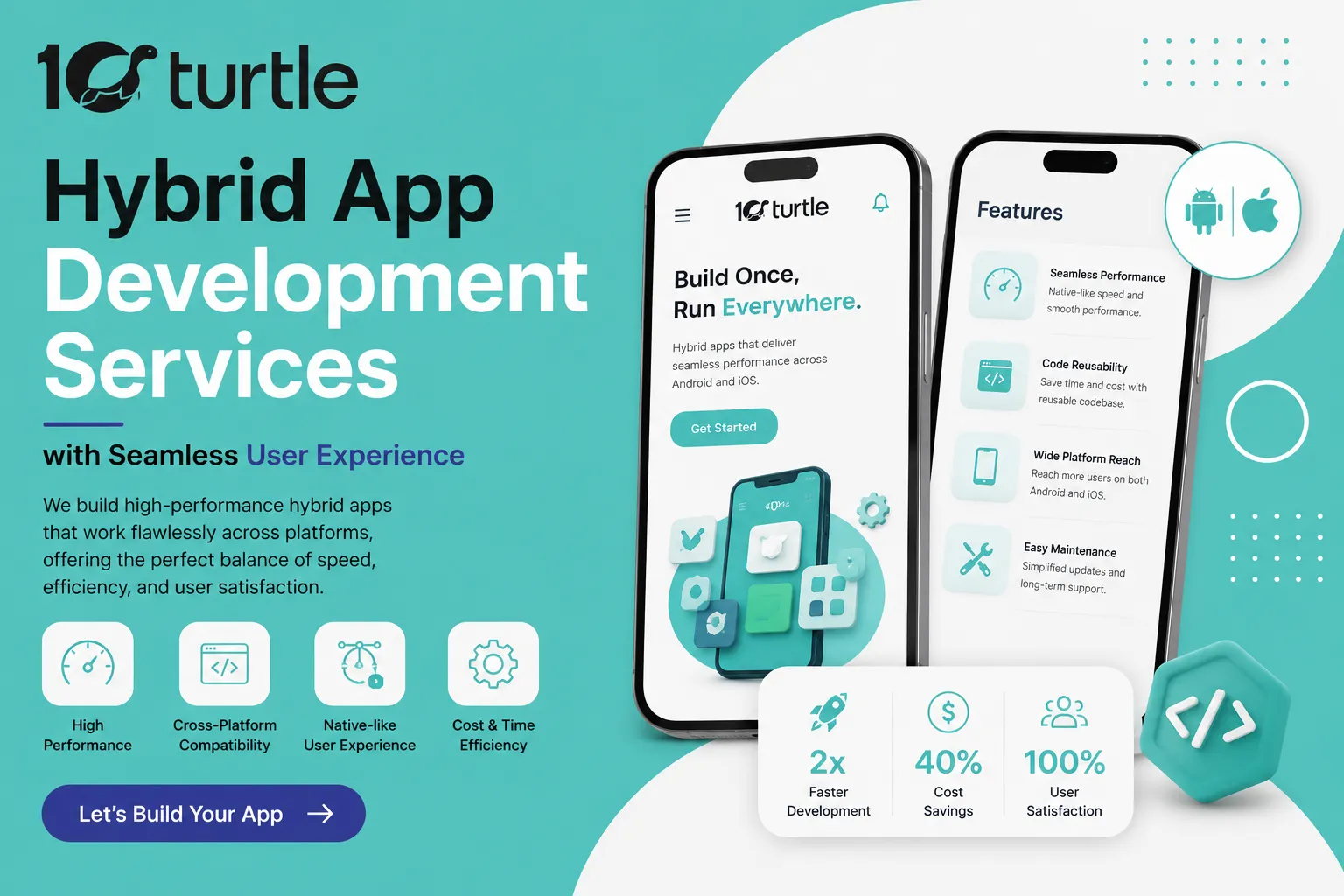
The American mobile app market generates hundreds of billions of dollars annually, and the competition for user attention is fiercer than ever. Whether you are running a retail brand in New York, a healthcare startup in Austin, or a fintech company in San Francisco, your customers expect a smooth, fast, and visually polished app experience on every device they own.
This is precisely where hybrid mobile app development services step in as a game-changer. Instead of building a native iOS app and a separate native Android app from scratch, businesses are now turning to cross-platform development frameworks that deliver a near-native experience at a fraction of the time and cost.
At 10Turtle, we have helped dozens of US-based businesses launch powerful digital products using modern hybrid technologies. In this blog, we break down everything you need to know about hybrid app development from what it is, why the US market is embracing it, and what makes a great hybrid app experience.
What Is Hybrid Mobile App Development?
Before diving into the benefits, let's answer the most fundamental question: what is hybrid mobile app development? Simply put, hybrid apps are a blend of both native and web solutions. They are built using web technologies such as HTML5, CSS, and JavaScript, then wrapped inside a native container that allows them to be installed and run on any mobile device just like a fully native app.
Popular frameworks driving this approach include React Native, Flutter, Ionic, and Xamarin. These tools allow developers to write a single codebase and deploy it across iOS, Android, and even web browsers without sacrificing the fluid animations, device integrations, and performance that users have come to expect in 2025.
Why US Businesses Are Embracing Cross-Platform Development
The demand for cross platform hybrid apps development services has exploded across the United States, and for good reason. American businesses operate in one of the most competitive digital markets in the world. Speed, budget efficiency, and scalability all play critical roles in determining which companies thrive and which fall behind.
- Faster Launch Cycles: A unified codebase means developers push updates simultaneously across iOS and Android, cutting release timelines dramatically.
- Budget-Friendly Builds: Maintaining one team and one codebase reduces development and QA costs significantly compared to parallel native projects.
- Consistent Brand Experience: With hybrid app design services, your UI, colors, and interactions remain pixel-perfect and consistent whether the user is on an iPhone 16 or a Samsung Galaxy device.
- Wider Market Reach: A single app that works on all platforms means you capture both Apple and Android audiences right from day one.
- Easier Maintenance: Bug fixes, feature additions, and performance improvements are applied once and rolled out everywhere no duplication of effort.
Hybrid App Development Services Revolutionizing the Digital Landscape
It is not an exaggeration to say that hybrid app development services are revolutionizing the digital landscape especially in tech-forward regions like Silicon Valley, Austin, Seattle, and New York. The ability to deliver enterprise-grade apps quickly and economically has shifted the entire conversation around mobile strategy.
Industries leading this shift in the US include healthcare (telemedicine apps, patient portals), retail and e-commerce, logistics and supply chain, real estate platforms, and on-demand service marketplaces. Each of these sectors has found that hybrid development allows them to iterate quickly based on real user feedback, a capability that is critical in today's product-led growth environment.
At 10Turtle, our team has observed firsthand how businesses that invest in the best hybrid app development services tend to outpace competitors who are still locked into slow, expensive native development cycles. The edge comes not just from speed, but from the data-driven design decisions that become possible when your app is deployed faster and feedback comes in sooner.
What Makes a Great Hybrid App Experience?
Technology is only half the equation. The other half is design and user experience. Great hybrid app design services go beyond picking a color palette they involve deep research into user behavior, accessibility standards, and platform-specific interaction patterns that make an app feel intuitive the moment someone opens it.
When our team at 10Turtle approaches a new project, we focus on several core pillars that define a truly seamless experience:
Performance Optimization
Hybrid apps have historically been criticized for feeling "laggy" compared to native apps. Modern frameworks like Flutter and React Native have largely eliminated this gap. However, skilled development practices such as lazy loading, efficient state management, and native module bridging are still essential to achieving a buttery-smooth 60fps experience.
Adaptive UI Design
A well-crafted hybrid app adapts its interface to each platform's conventions. Buttons, navigation patterns, and gestures should feel natural on iOS while equally intuitive on Android. This balance is the hallmark of professional hybrid mobile app development services.
Offline Capability & Sync
US users expect apps to work even with spotty connectivity on the subway in Manhattan or during a rural road trip in Montana. Robust offline data sync is a feature that separates good hybrid apps from great ones.
Choosing the Best Hybrid App Development Service in the USA
If you are looking for a hybrid app development service in USA, the options are plentiful but quality varies widely. Here is what to look for when vetting a development partner:
- Portfolio Diversity: Have they built apps across multiple industries? A versatile team adapts faster to your unique requirements.
- Framework Expertise: Do they have certified Flutter or React Native developers with proven production deployments?
- Design Capability: Does the team include dedicated UX/UI designers, or is design an afterthought bolted onto development?
- Post-Launch Support: App development does not end at launch. Look for teams that offer ongoing maintenance, monitoring, and updates.
- Transparent Communication: US-based clients often prefer partners with clear communication practices, structured sprints, and regular demos.
10Turtle checks all these boxes. Our team combines engineering depth with strong design sensibilities, which is why US businesses trust us to deliver polished, scalable hybrid applications from concept to the app store.
Frequently Asked Questions (FAQs)
Q1.What is the main difference between a hybrid app and a native app?
A native app is built exclusively for one platform (iOS or Android) using platform-specific programming languages like Swift or Kotlin. A hybrid app, on the other hand, is written once using web technologies and runs on multiple platforms. Since hybrid apps are a blend of both native and web solutions, they combine the broad reach of web apps with the device-access capabilities of native apps making them a highly practical choice for most modern businesses.
Q2.Are hybrid apps slower than native apps?
This was a valid concern several years ago. Today, frameworks like Flutter compile directly to native ARM code, while React Native uses native UI components. In most everyday use cases browsing, forms, transactions, animations users cannot tell the difference. Performance-critical apps like 3D games still benefit from fully native builds, but for the vast majority of business applications, hybrid performance is more than sufficient.
Q3.How long does it take to build a hybrid mobile app?
A straightforward hybrid app with a defined scope typically takes 3 to 6 months from kickoff to app store launch. More complex platforms with custom backend systems, third-party integrations, and advanced design can take 6 to 12 months. One of the core advantages of working with a specialized team is that a single unified codebase significantly compresses the development and testing timeline compared to building two separate native apps.
Q4.Which framework is best for cross-platform hybrid app development?
Flutter (by Google) and React Native (by Meta) are the two leading frameworks in 2025. Flutter offers superior UI consistency and performance, while React Native benefits from its close relationship with the JavaScript ecosystem. The "best" choice depends on your team's existing skill set, your app's design complexity, and long-term maintenance requirements. At 10Turtle, we evaluate each project individually and recommend the framework that best serves your specific goals.
Q5.Can hybrid apps access device hardware like the camera and GPS?
Absolutely. Modern cross platform hybrid apps development services leverage plugins and native bridges that grant full access to device hardware including camera, GPS, Bluetooth, biometrics, push notifications, accelerometer, and more. This makes hybrid apps a viable solution for feature-rich applications in sectors like healthcare, logistics, and fintech.