How to Practice Crypto Trading Without Risking Real Money
By Abdus Salam
64 Views
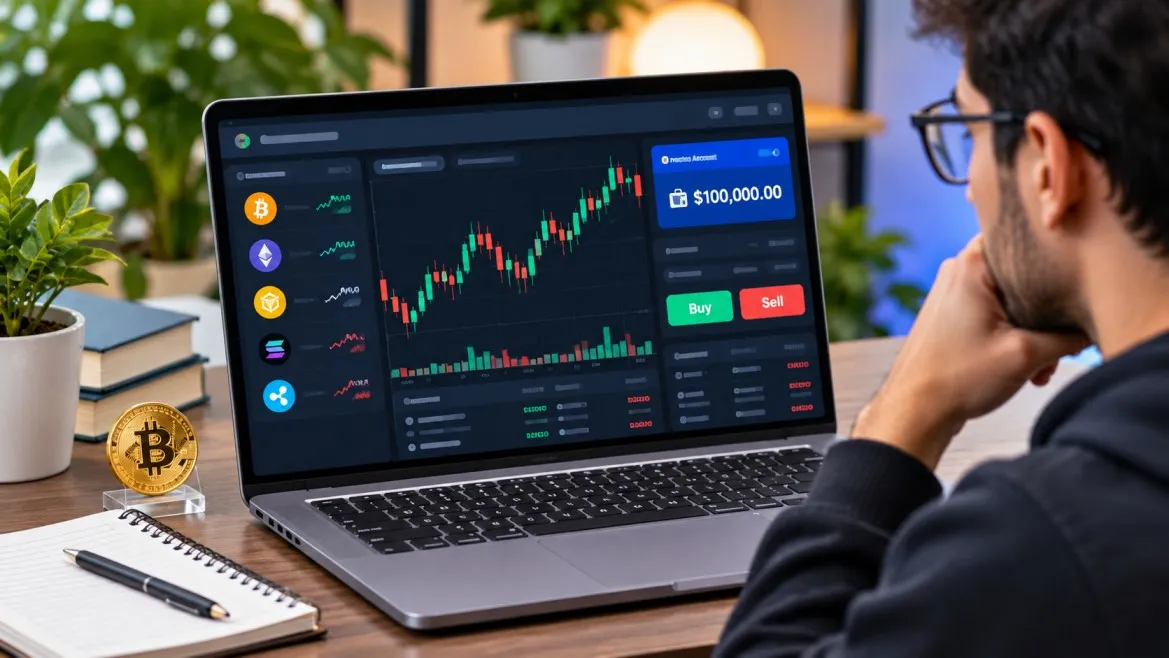
Watching Bitcoin move hundreds of dollars in a matter of minutes can make cryptocurrency trading look exciting. But placing a trade is only one part of the process. Knowing when to enter, where to set a stop loss, how much capital to allocate, and when to exit requires practice.
For beginners, learning these skills with real money can become expensive. That is why many traders start with crypto paper trading, using virtual funds to test their decisions before entering live markets.
What Is Crypto Paper Trading?
Crypto paper trading is a way to simulate cryptocurrency trades without depositing or risking actual funds.
A trading simulator allows users to open and close virtual positions while observing market price movements. Depending on the platform, traders may be able to practice with Bitcoin, Ethereum, and other digital assets.
The idea is simple: learn how trading works, make mistakes in a controlled environment, and evaluate the results without putting personal savings at risk.
Paper trading is useful for people who are completely new to cryptocurrency, but experienced traders also use it when testing unfamiliar strategies.
Learning More Than Just Buy and Sell
One of the biggest mistakes beginners make is focusing only on predicting price direction.
A trader might correctly expect Bitcoin to rise but still lose money because of poor timing, excessive leverage, or an unsuitable stop-loss level.
Good trading practice involves several decisions:
- Identifying the broader market trend before entering.
- Choosing a clear entry price rather than chasing sudden movements.
- Setting a stop loss to define the intended risk.
- Establishing a realistic take-profit target.
- Reviewing the outcome after closing a position.
A simulator provides an opportunity to repeat this process under different market conditions.
For example, a trader could practice a trend-following strategy on a 15-minute Bitcoin chart, record the results, and compare them with trades taken during sideways markets.
Over time, these observations may help reveal whether a strategy has consistent rules or relies too heavily on guesswork.
Practicing With AI Trading Tools
Modern trading simulators are beginning to offer more than basic manual order entry.
Some platforms combine market analysis with automated strategy testing, allowing users to observe how a predefined trading approach behaves as prices change.
XPERTRAX offers a TradePilot AI simulation environment alongside cryptocurrency market analysis tools.
Its simulation features allow users to practice manual trading or observe AI-driven position management using virtual funds. Within the simulated account, TradePilot AI can open and close positions and execute strategies automatically.
This is different from allowing software to trade real funds on a live exchange.
The Xpertrax paper trading guide explains the fundamentals of simulated cryptocurrency trading and how TradePilot AI fits into the practice process.
For traders interested in automation, observing simulated trades can be a useful way to understand how entry conditions, exit rules, and risk settings influence results.
What Should You Track During Practice?
A virtual profit balance alone does not provide enough information to judge a trading strategy.
Traders should also pay attention to their win rate, average gain, average loss, and maximum drawdown.
A strategy that wins seven out of ten trades can still perform poorly if the three losing trades are much larger than the profitable ones.
Keeping a trading journal can help identify these problems.
Each entry might include the asset, trade direction, entry price, stop-loss level, take-profit target, and reason for entering the position.
Reviewing this information regularly makes it easier to identify repeated mistakes and determine whether the strategy follows a consistent process.
The Difference Between Simulation and Live Trading
Paper trading is a learning tool, not proof that a strategy will be profitable with real money.
Live trading introduces additional factors such as execution delays, slippage, exchange fees, changing liquidity, and emotional pressure.
A trader who calmly accepts a simulated loss may react differently when actual savings are involved.
Market conditions can also change, meaning a strategy that worked during one period may not perform the same way later.
For these reasons, simulated results should be treated as practice data rather than a guarantee of future performance.
Building Better Trading Habits
The most effective use of crypto paper trading is to develop a repeatable decision-making process.
Instead of changing strategies after every losing trade, traders can choose a clear set of rules, test those rules over multiple sessions, and review the results.
They can also compare different market conditions, such as trending markets, sideways price movements, and periods of high volatility.
AI-assisted simulation adds another way to explore trading behavior, but it does not remove uncertainty or the need for risk management.
Final Thoughts
Crypto paper trading gives beginners a practical way to understand cryptocurrency markets without risking real money.
It can also help experienced traders evaluate new strategies and become familiar with automated trading concepts.
Whether using manual trades or AI-driven simulations, the goal should be to improve decision-making, understand risk, and build a disciplined trading process before considering live trading.
Related Reading
Expert Insights: Navigating the Complex World of Cryptocurrency & Web3
Welcome to our in-depth exploration of Cryptocurrency & Web3. In an era defi...
The Ultimate Guide to Understanding Cryptocurrency & Web3 in 2026
Welcome to our in-depth exploration of Cryptocurrency & Web3. In an era defi...