How to Pick Cushioning That Actually Matches the Fragility of What You Ship
By alexjoe
76 Views
Every damage claim starts with a mismatch. The product was more fragile than the packer assumed, or the cushioning around it was thinner than the shipment’s drop-and-vibration profile required. Cushioning is not a single product; it is a category with mil thicknesses, bubble sizes, envelope styles, and roll widths, each suited to a specific fragility level. Getting the match right stops damage claims before they start. Getting it wrong shows up in refunds, chargebacks, and lost customer lifetime value. The good news is that fragility ratings and cushioning specs are quantifiable, so there’s no guesswork. What follows is a practical framework for matching cushioning to product, from fragility rating down to bubble size and envelope grade.
Start With the Fragility Rating of Your Product
Every product has a fragility rating, which is the G-force the item can absorb before something breaks. Electronic components with soldered connections rate as extremely fragile at 15 to 25 G. Ceramics and glass tableware rate as very fragile at 40 to 60 G. Small consumer electronics like phone accessories rate as fragile at 60 to 85 G. Hard-goods items like tools and hardware rate as moderately fragile at 85 to 110 G. The rating drives the cushioning choice. Extremely fragile items require multiple layers of small-bubble material plus corner protection. Moderately fragile items may only need one wrap of medium-bubble cushioning inside a right-sized carton.
Bubble Sizes Matter More Than Total Thickness
Cushioning thickness gets more attention than bubble size, but bubble size is what actually determines protection. Small 3/16-inch bubbles provide surface cushioning for light products like books, apparel accessories, and jewelry. Medium 5/16-inch bubbles provide impact absorption for consumer electronics, mid-weight glassware, and mid-size products. Large 1/2-inch bubbles provide void fill and shock absorption for heavier items and long-distance freight. Buyers ordering bubble wrap rolls online should keep at least two bubble sizes on hand. A small-bubble roll for surface wrapping and a large-bubble roll for cushioning between layers of stacked product in the same carton is a workable minimum for most fulfillment rooms.
Envelopes for Small Cushioned Shipments
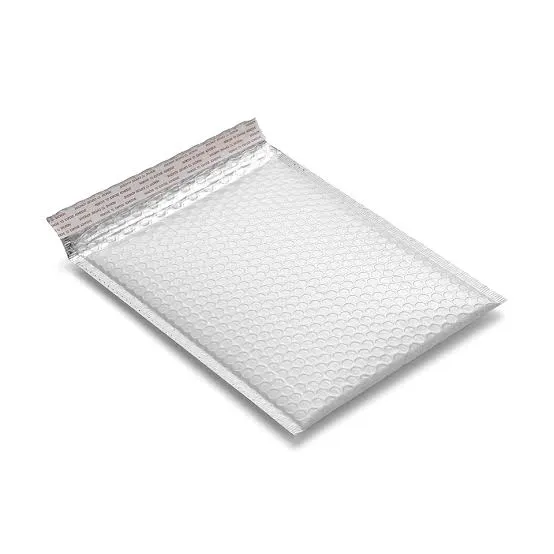
Not every fragile shipment requires an outer carton. Small products like phone cases, phone accessories, jewelry, cosmetics, and small electronics ship well in bubble wrap envelopes, which combine the bag and the cushioning in one product. Envelope sizes run from small (4x8 inches) for jewelry up to large (14x20 inches) for tablet-sized products. Kraft-lined envelopes protect against surface scratches and light drops. Poly-lined envelopes add water resistance for shipments moving through outdoor delivery hubs or in wet weather.
Match Envelopes to Product Weight, Not Just Size
The most common envelope mistake is choosing size correctly and mil grade incorrectly. A small envelope that fits the product but has thin puncture resistance still fails when the product inside is heavy or has hard edges. Heavy jewelry, small hand tools, and phone accessories with hard plastic corners all warrant a heavier-grade bubble envelope style even when the product itself is small.
- Light products under 4 ounces: standard kraft or poly padded envelopes
- Products 4 to 12 ounces: heavier padded envelopes with wider bubble backing
- Products 12 ounces to 2 pounds: rigid padded mailers with corner reinforcement
Rolls for Anything That Ships Boxed
Products that ship inside a carton benefit from bubble-roll cushioning. Rolls cut on the packing table let the packer wrap the product to fit, rather than forcing the product to fit a pre-cut size. This matters most on odd-shaped products where a fixed-size envelope would leave gaps. Buying bubble rolls online in perforated form saves labor at the packing table. Perforated rolls tear every 12 inches, so the packer does not need to reach for scissors between wraps. Widths of 12, 24, and 48 inches cover most product footprints. Roll lengths of 300 to 700 feet balance storage space against reorder frequency.
A Quick Fragility Test That Works
The simplest fragility test on any product is to drop it from three feet onto a hard floor, still in its shipping carton with normal cushioning. If it survives clean, the cushioning is right. If it breaks, upgrade one bubble size or add a layer. If it survives with room to spare, one size down or one layer removed usually saves material cost without adding damage claims. Cushioning that actually matches product fragility saves margin on the front end and cuts damage claims on the back end.
Related Reading
Why Lifestyle & Culture is Transforming the Global Industry Landscape
Welcome to our in-depth exploration of Lifestyle & Culture. In an era define...
Expert Insights: Navigating the Complex World of Lifestyle & Culture
Welcome to our in-depth exploration of Lifestyle & Culture. In an era define...