How to Choose the Right AI Application Development Company in 2026: A Complete Guide
106 Views
Artificial intelligence has moved from boardroom buzzword to business necessity. By the end of 2026, Gartner expects around 40% of enterprise applications to include task-specific AI agents — a dramatic jump from less than 5% just a year earlier. That shift has created a crowded market of vendors, all claiming to be AI experts. For business leaders, the challenge is no longer deciding whether to build an AI application. It is deciding who should build it.
Choose well, and you get a partner who translates your business problem into a working product that pays for itself. Choose poorly, and you inherit missed deadlines, inflated budgets, and a model that never quite works in production. Many companies discover this the hard way: industry surveys consistently show that a large share of AI initiatives stall not because the technology fails, but because the execution partner lacked real depth. Established firms like Quytech have seen this pattern repeatedly — clients arriving with half-finished projects that need rescuing. This guide walks you through a practical framework for evaluating an AI development partner in 2026, so your project lands in the first category, not the second.
Why Businesses Are Investing in AI Application Development
The economics have changed. AI-assisted workflows now deliver measurable gains — McKinsey reports that top-performing organizations using AI in software delivery see 16–30% improvements in productivity and time-to-market. On the customer side, users increasingly expect apps to anticipate their needs: predictive recommendations, conversational interfaces, and intelligent automation are becoming baseline features rather than differentiators.
This is why demand for a capable ai application development company has surged across industries. Healthcare firms want AI that summarizes patient records in seconds. Retailers want engines that personalize every interaction. Manufacturers want predictive maintenance that prevents downtime before it happens. The common thread is that none of these are off-the-shelf purchases — they require a partner who understands both the technology and the business context.
Common Challenges Companies Face When Selecting a Partner
Most selection mistakes fall into three buckets. The first is the expertise illusion: many agencies added "AI" to their websites overnight, but their experience is limited to plugging a third-party API into an existing app. That works for a demo; it rarely survives production traffic, edge cases, or compliance review.
The second is the data blind spot. AI applications are only as good as the data behind them, yet many vendors skip data readiness assessments entirely. If a potential partner never asks about your data quality, storage, or governance, that silence is a warning sign.
The third is unclear ownership. Who owns the trained model? Who owns the code? What happens to your data after the engagement ends? Weak contracts in these areas have trapped companies in vendor lock-in that costs far more than the original project.
Key Criteria for Evaluating an AI Development Company
Start with proof, not promises. Ask for case studies with measurable outcomes — reduced processing time, increased conversion, lower operational cost — rather than vague claims about "cutting-edge solutions." A credible partner will happily connect you with past clients.
Next, examine team composition. A serious AI project needs more than developers: it needs data engineers, machine learning specialists, UX designers who understand AI interaction patterns, and QA engineers who know how to test non-deterministic systems. Ask directly who will work on your project and what their individual backgrounds are.
Then look at process maturity. Strong firms follow a structured path — discovery, data audit, proof of concept, iterative development, deployment, and post-launch monitoring. They set realistic milestones and communicate honestly when something needs to change. Finally, verify security and compliance credentials, particularly if you operate in healthcare, finance, or any regulated sector.
Matching the Company to Your Project Type
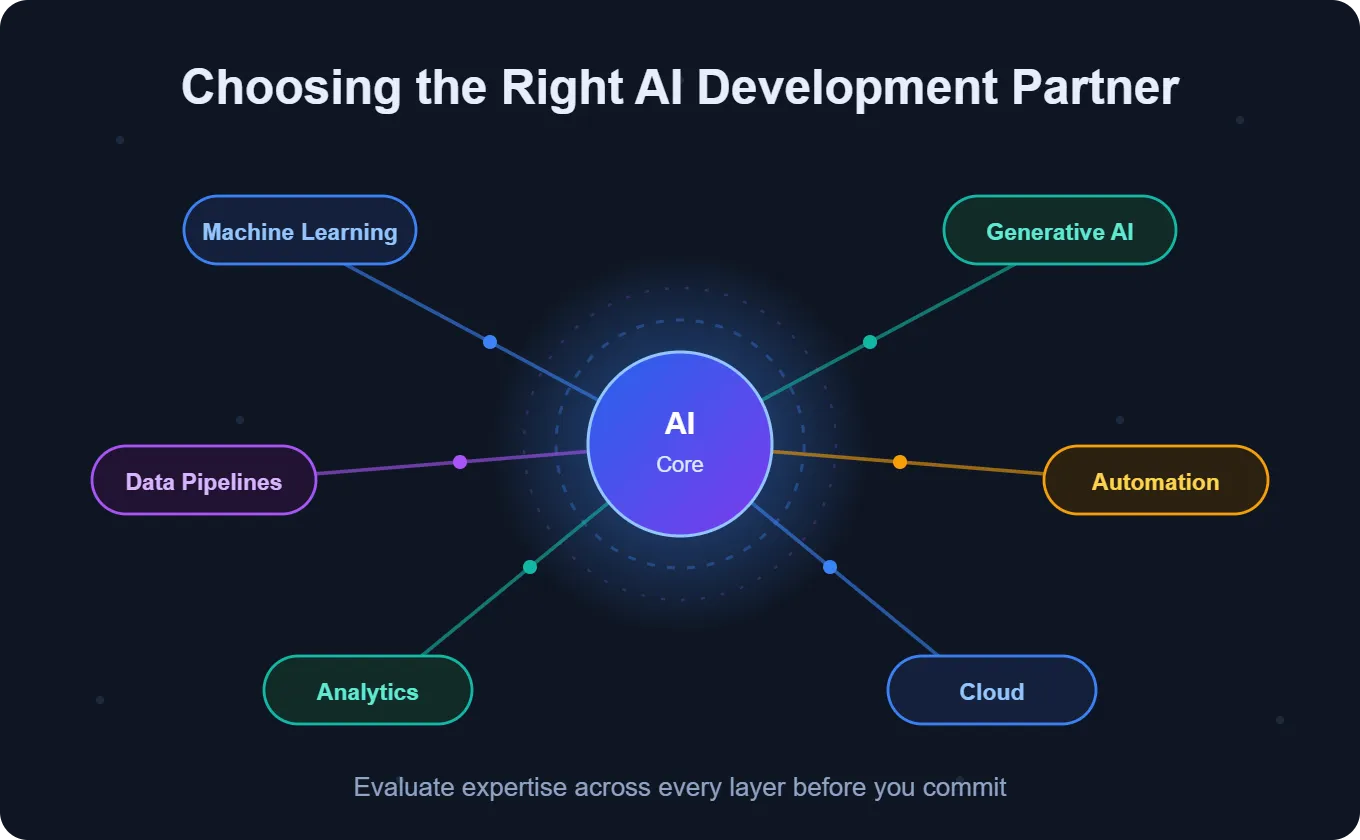
Not every AI project is the same, and neither are the firms that build them. If your goal is content generation, intelligent chatbots, or copilot-style assistants, you need a specialized generative ai app development company with hands-on experience in large language models, prompt engineering, retrieval-augmented generation, and hallucination control. If your project centers on computer vision, predictive analytics, or recommendation systems, the required skill set is different — deep expertise in model training, data pipelines, and MLOps.
During evaluation, describe your use case and listen carefully to the response. A strong partner will discuss trade-offs, suggest alternatives, and sometimes even tell you that a simpler non-AI solution would serve you better. That honesty is worth more than any sales pitch.
Understanding Costs and Engagement Models
In 2026, AI application development typically ranges from $40,000 for a focused MVP to $300,000 or more for enterprise-grade platforms with custom models. Beware of quotes dramatically below market rates — they usually signal inexperience or hidden costs later.
Equally important is the engagement model. Fixed-price contracts suit well-defined projects; dedicated teams suit evolving products; time-and-material models suit research-heavy work. A trustworthy company will explain which model fits your situation and why, including ongoing costs for model retraining, infrastructure, and support that many buyers forget to budget for.
Questions to Ask Before Signing
Before committing, put these questions on the table: How will you measure the success of this project in business terms? What is your approach if the model underperforms after launch? How do you handle data privacy and where will our data be processed? What does knowledge transfer look like at the end of the engagement? Can we start with a small paid pilot before a full contract?
The answers reveal more than any portfolio. Companies confident in their capabilities welcome pilots, define success metrics upfront, and document everything.
Why Choose Quytech
Quytech has spent over a decade building AI and mobile solutions for startups, enterprises, and Fortune-level clients across the USA, UK, and India. The team combines machine learning engineers, data scientists, and product designers who have delivered AI applications in healthcare, fintech, retail, real estate, and manufacturing — experience that shortens discovery and reduces costly trial-and-error.
What sets the company apart is its outcome-first approach. Projects begin with a business-value assessment, not a technology checklist, and clients retain full ownership of their code, models, and data. Transparent pricing, structured communication, and post-launch support have earned Quytech long-term relationships where most engagements extend well beyond the first release. For businesses that want an AI partner rather than just a vendor, that track record matters.
Conclusion
Choosing an AI application development company in 2026 comes down to disciplined evaluation: verify real project experience, scrutinize team depth, demand data-readiness thinking, match specialization to your use case, and clarify ownership before signing. The market is full of confident claims, but the right partner proves capability with case studies, honest trade-off discussions, and measurable success criteria.
AI is now a competitive requirement, and the cost of a wrong partnership is measured in lost quarters, not just lost budget. Take the time to evaluate properly, start with a pilot if you are unsure, and choose a team with a track record of shipping production AI — the way firms like Quytech have done for clients worldwide. Your future product will thank you.
Frequently Asked Questions
Q: What does an AI application development company actually do?
A: An AI application development company designs, builds, and deploys software powered by artificial intelligence — from chatbots and recommendation engines to computer vision and predictive analytics systems. It typically handles the full lifecycle: data preparation, model development, integration, and post-launch monitoring.
Q: How much does AI application development cost in 2026?
A: Most projects fall between $40,000 and $300,000+ depending on complexity, data readiness, and whether custom models are required. Simple AI integrations cost less, while enterprise platforms with proprietary models sit at the higher end.
Q: How long does it take to build an AI application?
A: A focused MVP usually takes 3–6 months, while full-scale enterprise applications can take 9–18 months. Timelines depend heavily on data quality and the amount of custom model training involved.
Q: What is the difference between a generative AI app development company and a traditional AI developer?
A: A generative ai app development company specializes in applications built on large language models — content generation, copilots, and conversational AI — while traditional AI development focuses on predictive models, computer vision, and classification systems. Many projects in 2026 combine both.
Q: How do I know if my business is ready for AI development?
A: You are ready if you have a clear business problem, accessible data related to it, and executive sponsorship. If your data is scattered or low-quality, a good partner will recommend a data-readiness phase before development begins.