How to Choose AI Workflow Automation Services in USA for Your Business
By visioninfo
12 Views
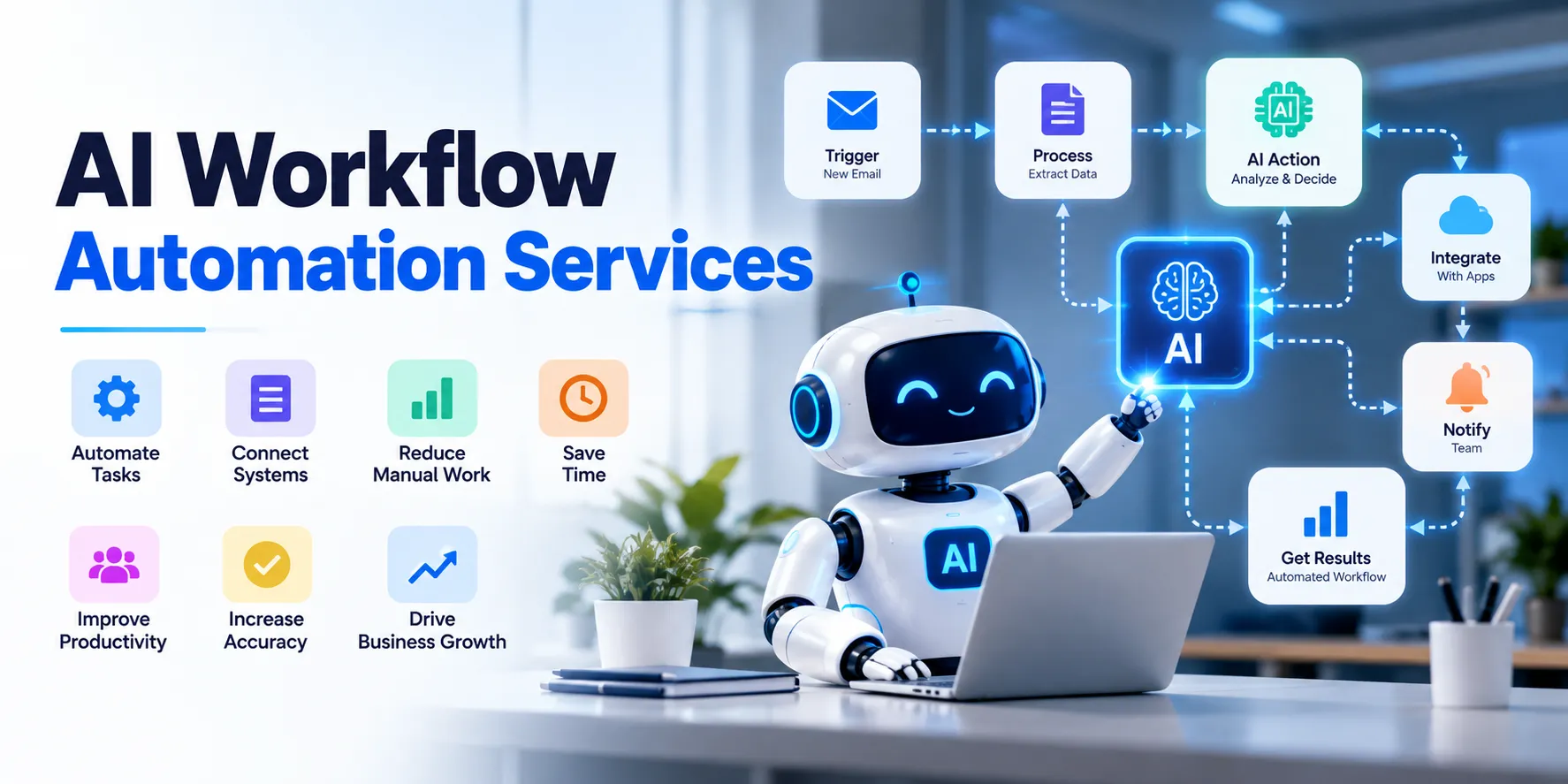
Businesses across the United States are looking for practical ways to save time, reduce operating costs, and improve productivity. Many companies still depend on manual tasks such as entering customer information, updating spreadsheets, processing invoices, responding to inquiries, and preparing reports. These activities may seem small individually, but they can consume valuable hours every week.
This is where AI Workflow Automation Services in USA can make a meaningful difference. These services help businesses automate repetitive processes, connect different software applications, and use artificial intelligence to handle tasks that previously required constant human involvement.
However, choosing the right automation provider is not always easy. Some companies need a simple solution for managing customer inquiries, while others want to automate complicated workflows across sales, finance, customer support, and operations. The right service depends on your business goals, existing technology, budget, and long-term plans.
In this guide, we will explain how to evaluate automation providers, identify the right features, compare costs, and avoid common mistakes. We will also discuss how Vision Infotech can help businesses explore workflow automation solutions that support their operational needs.
What Are AI Workflow Automation Services?
AI workflow automation involves using artificial intelligence, software integrations, and automated rules to complete business tasks with less manual effort. Unlike basic automation, which generally follows predefined instructions, AI-powered systems can also interpret information, classify requests, extract data, and support decisions within an established workflow.
For example, a traditional automation tool might send an email whenever a customer submits a form. An AI-powered workflow could analyze the customer's message, identify the type of inquiry, assign it to the appropriate department, and prepare a relevant response for review.
Businesses using AI Workflow Automation Services in USA can improve several areas of their operations without necessarily replacing their existing software systems.
Common Business Processes That Can Be Automated
AI-powered workflows can support different departments, including:
-
Sales: Capture leads, update CRM records, schedule follow-ups, and prioritize inquiries.
-
Customer support: Categorize support tickets, summarize conversations, and suggest responses.
-
Accounting: Extract invoice details, organize expense information, and route documents for approval.
-
Marketing: Organize customer segments, prepare campaign drafts, and manage lead-nurturing workflows.
-
Human resources: Sort application information, organize employee documents, and automate onboarding tasks.
-
Operations: Track requests, update records, send notifications, and monitor task progress.
The objective is not to automate every activity. It is to identify repetitive or time-consuming processes where automation can improve efficiency without compromising accuracy, security, or customer experience.
Why Should Businesses Consider AI Workflow Automation Services in USA?
Companies often introduce automation when their existing processes become difficult to manage manually. As the number of customers, transactions, and internal tasks increases, small inefficiencies can create larger operational problems.
Choosing the right provider can help businesses address these challenges systematically.
1. Reduce Repetitive Manual Work
Employees frequently spend time copying information between applications, updating records, sending routine emails, and preparing reports. These tasks can slow down more valuable work.
For example, a sales team may receive dozens of inquiries through its website every day. Without automation, employees might need to enter each inquiry into a CRM, assign it to a sales representative, and schedule a follow-up manually.
An automated workflow can collect the information, create the CRM record, assign ownership, and trigger a follow-up reminder.
2. Improve Data Accuracy
Manual data entry can lead to duplicate records, missing information, and inconsistent reporting. Automated workflows can apply validation rules, identify incomplete submissions, and reduce unnecessary data handling.
However, automation does not guarantee perfect accuracy. AI-generated classifications and extracted information should be checked when errors could affect financial records, customer commitments, or compliance.
3. Improve Customer Response Times
Customers often expect quick answers to questions about products, pricing, orders, and services. Automation can help businesses acknowledge inquiries, route requests to the correct team, and provide approved information more quickly.
This is particularly useful for businesses managing multiple communication channels.
4. Support Business Growth
When a business grows, its workload often increases faster than its existing processes can handle. Automation can help teams manage additional tasks without requiring the same increase in manual effort.
This makes AI Workflow Automation Services in USA worth considering for startups, growing companies, and established organizations that want to improve operational capacity.
How to Choose AI Workflow Automation Services in USA for Your Business
Selecting a provider requires more than comparing software features. You need a partner that understands your workflow, recommends a suitable approach, and can support the solution after implementation.
The following steps can help you make a more informed decision.
1. Identify Your Business Problems Before Choosing a Provider
Start by identifying the processes that consume the most time or regularly create problems.
Do not begin by purchasing an automation platform simply because it offers advanced features. First, understand what needs to improve.
Ask your team questions such as:
-
Which tasks are repeated every day?
-
Where do employees spend the most time entering or transferring information?
-
Which processes experience frequent delays?
-
Where do errors or missed follow-ups occur?
-
Which activities prevent employees from focusing on higher-value work?
For example, a small accounting firm may struggle with collecting invoices, organizing supporting documents, and reminding clients about missing information. Automating these processes could be more valuable than introducing an AI chatbot that the business does not need.
Create a shortlist of two or three workflows that offer a clear opportunity for improvement. This gives potential providers a specific problem to solve.
2. Check the Provider's Industry Experience
A provider may understand automation technology but still lack experience with your business processes. Look for a company that can explain how it approaches similar operational challenges.
When comparing AI Workflow Automation Services in USA, review the provider's relevant project experience, case studies, implementation process, and understanding of your industry.
Ask questions such as:
-
Have you automated similar business processes before?
-
How do you handle exceptions and incomplete data?
-
What happens when an integration fails?
-
How do you measure the success of an automation project?
-
Can you explain the proposed solution in simple terms?
A reliable provider should be able to describe the expected workflow, potential limitations, and practical benefits without making unrealistic promises.
If a company cannot explain how its proposed solution addresses your actual problem, continue evaluating other options.
3. Evaluate Integration With Your Existing Software
Most businesses already use several applications to manage daily operations. These might include CRM platforms, accounting software, project management tools, email systems, customer support applications, and cloud storage.
Your automation solution should work with the systems your team already depends on whenever practical.
For example, a business using Zoho CRM to manage leads and an accounting platform to process invoices may want to connect customer records, sales information, and billing activities.
Before selecting a provider, confirm whether the required applications support suitable integrations through APIs, approved connectors, or other reliable methods.
Also, ask how the system will handle duplicate records, failed data transfers, permission changes, and updates to connected applications.
Good integration planning is essential because a workflow that operates in isolation may create additional work instead of reducing it.
4. Understand Which AI Capabilities You Actually Need
Not every workflow requires artificial intelligence. Some tasks can be completed more reliably through simple rules and conventional automation.
For example, sending an invoice reminder three days before a due date usually requires a scheduled rule rather than an AI model.
AI becomes more useful when a workflow involves interpreting unstructured information, understanding customer messages, extracting details from documents, or categorizing requests that arrive in different formats.
When evaluating AI Workflow Automation Services in USA, ask the provider to explain which parts of the process require AI and which can be handled through standard automation.
This distinction can help you control costs and reduce unnecessary complexity.
Examples of AI-Powered Workflow Features
Depending on the use case, suitable solutions may include:
-
Document data extraction and classification.
-
Email and customer inquiry categorization.
-
Intelligent routing of service requests.
-
AI-assisted report summaries.
-
Natural-language processing for customer messages.
-
Automated information retrieval from approved business documents.
The provider should also explain how uncertain AI outputs are reviewed and when a task must be sent to a human employee.
5. Compare Pricing and the Total Cost of Ownership
The price of an automation project depends on its complexity, the number of connected applications, the volume of transactions, and the level of ongoing support required.
Some providers charge a fixed implementation fee. Others use hourly billing, monthly service agreements, or usage-based pricing.
Request a detailed proposal that separates implementation costs from recurring expenses.
Your evaluation should consider:
-
Initial setup and configuration.
-
Software subscriptions and licensing.
-
Third-party integration costs.
-
AI model or API usage charges.
-
Testing and employee training.
-
Maintenance and technical support.
-
Future changes and workflow expansion.
For instance, a low-cost solution may appear attractive initially but become expensive when transaction volumes increase or additional integrations are required.
Instead of selecting the cheapest provider automatically, compare the total expected cost with the operational benefits the solution may deliver.
A practical way to assess the investment is to estimate the time saved each month, the reduction in avoidable errors, and the potential improvement in response times. Treat these as estimates and validate them through a pilot project.
6. Prioritize Data Security and Privacy
Automation systems may process customer contact details, invoices, contracts, employee records, and other confidential information. Security should therefore be part of the selection process from the beginning.
Ask prospective providers how they protect business information and manage access to connected applications.
Important areas to review include:
-
Role-based access controls.
-
Encryption during data transfer and storage.
-
Secure API authentication.
-
Audit logs and activity monitoring.
-
Data retention and deletion policies.
-
Backup and recovery procedures.
-
Vendor access to sensitive information.
-
AI model data usage and retention terms.
Businesses operating in regulated industries may also need to consider applicable privacy, contractual, and industry-specific requirements.
Do not assume that a provider is secure simply because it uses a recognized cloud platform. Review the complete workflow, including third-party applications and AI services.
The right provider should explain the relevant safeguards clearly and identify any security responsibilities that remain with your business.
7. Check Scalability and Customization Options
Your business requirements may change as your company grows. You might begin by automating lead management and later introduce invoice processing, customer support routing, or reporting workflows.
Choose a solution that can accommodate reasonable future changes without requiring a complete redesign.
When evaluating AI Workflow Automation Services in USA, ask whether the provider can add new workflows, connect additional applications, adjust business rules, and manage higher transaction volumes.
Customization is also important because every business has different approval procedures, reporting requirements, and responsibilities.
However, excessive customization can increase maintenance costs. A good provider should balance your specific requirements with maintainability, reliability, and the use of established tools where appropriate.
8. Review Support, Maintenance, and Monitoring
Automation requires ongoing attention. Software updates, expired credentials, changed business rules, and third-party service interruptions can affect workflow performance.
Before signing an agreement, understand what happens after implementation.
Ask the provider whether it offers:
-
Post-launch monitoring.
-
Troubleshooting and technical support.
-
Workflow updates and improvements.
-
Error notifications and recovery procedures.
-
Documentation and employee training.
-
Defined response times for support requests.
Clarify which services are included in the contract and which require additional payment.
A provider that helps your team monitor performance and resolve issues can be more valuable than one that simply builds the workflow and leaves you to manage it independently.
9. Start With a Pilot Project
Avoid automating every department at once, especially if your business has never implemented AI-powered workflows.
Start with a limited project that has a clear objective and manageable risk.
For example, a company could begin by automating the assignment of incoming website inquiries. The pilot might capture lead information, identify the inquiry category, create a CRM record, and notify the appropriate sales representative.
Measure the results against the existing process.
Useful metrics include:
-
Average time required to complete the task.
-
Number of manual steps eliminated.
-
Error and duplicate-record rates.
-
Response time.
-
Percentage of workflows completed successfully.
-
Number of cases requiring human intervention.
A pilot gives you evidence of whether the solution works in your environment. It also helps identify integration issues and employee training needs before a wider rollout.
What Features Should You Look for in AI Workflow Automation Services?
Once you understand your requirements, compare providers using a consistent set of criteria.
|
Feature |
Why It Matters |
|---|---|
|
Workflow design |
Ensures automation matches actual business processes. |
|
Application integration |
Connects existing tools and reduces duplicate data entry. |
|
AI capabilities |
Helps interpret documents, messages, and unstructured information. |
|
Human approval controls |
Keeps important decisions under appropriate supervision. |
|
Error handling |
Helps identify failures and recover from interrupted workflows. |
|
Reporting and analytics |
Makes workflow performance easier to measure. |
|
Security controls |
Protects business information and limits unauthorized access. |
|
Scalability |
Supports future workflows and higher workloads. |
|
Ongoing support |
Helps maintain performance as requirements change. |
A provider does not need to offer every possible feature. The best choice is the one that meets your essential requirements without adding unnecessary complexity.
Common Mistakes to Avoid When Selecting an Automation Provider
Even a promising automation project can fail when the initial planning is incomplete.
Choosing Tools Before Defining the Workflow
Buying software without understanding the existing process can lead to unnecessary expenses. Map the current workflow first, identify bottlenecks, and establish the intended outcome.
Automating a Poorly Designed Process
Automation can make a process faster, but it cannot automatically fix unclear responsibilities or inconsistent business rules.
Simplify the workflow before implementing it.
Ignoring Human Oversight
AI systems can misinterpret information or produce incorrect outputs. Financial approvals, sensitive customer decisions, and other high-impact activities should have appropriate review and escalation procedures.
Overlooking Long-Term Costs
Subscription fees are only one part of the overall expense. Include integration, maintenance, usage, and support costs when comparing proposals.
Expecting Immediate Results Without Measurement
Do not assume that implementing automation will automatically increase revenue or reduce costs. Establish baseline metrics, test the workflow, and review its performance after launch.
A structured evaluation makes AI Workflow Automation Services in USA easier to assess based on measurable business outcomes rather than marketing claims.
How Vision Infotech Can Help With Workflow Automation
Choosing an automation provider is easier when you work with a technology partner that considers your business requirements, existing applications, and future plans together.
Vision Infotech provides software development and technology consulting services, including AI development, AI consulting, Zoho CRM customization, and AWS consulting. These areas can be relevant when a business needs to connect applications, improve existing processes, or plan a technology solution around specific operational requirements.
When evaluating a workflow automation project, businesses should look for a partner that understands both the technical requirements and the everyday challenges employees face.
Why Choose Vision Infotech?
1. Business-Focused Solutions
Every business has different operational challenges. Vision Infotech can discuss your requirements and help identify where software development, application integration, or AI-related capabilities may support your goals.
The focus should be on solving a defined business problem rather than introducing technology without a clear purpose.
2. Support for Existing Business Applications
Companies often rely on established CRM and cloud platforms to manage their operations. Vision Infotech's experience with Zoho CRM customization and AWS consulting is relevant when evaluating solutions involving business applications and cloud infrastructure.
The appropriate integration approach depends on your current systems, technical requirements, and security needs.
3. AI Consulting and Development Capabilities
Businesses exploring AI-powered workflows may need guidance on choosing suitable use cases, evaluating technical options, and planning implementation.
Vision Infotech offers AI development and AI consulting services that can be considered as part of this evaluation, depending on the project's requirements.
4. A Practical Approach to Implementation
A well-planned automation project begins with understanding the current process, identifying improvement opportunities, and defining measurable goals.
Vision Infotech can be approached to discuss your requirements, assess potential technical approaches, and determine a suitable project scope before implementation.
Before making a final decision, ask for relevant project examples, a clear implementation plan, expected costs, security details, and the support arrangements available for your particular workflow.
If you are comparing AI Workflow Automation Services in USA, visit the Vision Infotech learn more about its technology services and discuss your business requirements.
How to Measure the Success of Your Automation Project
After implementation, measure whether the solution is delivering the expected results.
Start with the metrics most closely related to the original business problem.
For example, if the goal is to improve lead management, track how long it takes to assign new inquiries, how many leads receive timely follow-ups, and how often information must be corrected manually.
If the goal is to streamline invoice processing, measure processing time, missing information, exception rates, and the number of invoices handled without manual data entry.
Review these results regularly and compare them with the baseline established before implementation.
Also, collect feedback from employees who use the workflow. They may identify unnecessary steps, confusing notifications, or situations that require better exception handling.
Successful automation is an ongoing process of measurement and improvement, not simply a one-time software installation.
Conclusion
Choosing the right AI Workflow Automation Services in USA starts with understanding your business needs and identifying processes that can benefit from automation. From evaluating provider experience and software integrations to reviewing security, pricing, scalability, and ongoing support, every decision should be based on practical requirements.
Start with a clearly defined business problem, select a manageable pilot project, and measure the results before expanding automation across other departments. Make sure your provider explains the solution clearly, handles exceptions responsibly, and offers a realistic plan for long-term maintenance.
Vision Infotech offers AI development, AI consulting, Zoho CRM customization, and AWS consulting services that may be relevant to businesses planning technology improvements. By discussing your requirements and evaluating the right technical approach, you can determine whether its capabilities align with your automation goals.
The best automation solution is not necessarily the one with the most advanced features. It is the one that helps your team work more efficiently, improves process consistency, protects business information, and supports sustainable growth.