How to Become an SAP Consultant: A Practical Step-by-Step Career Guide
By jamesjohnrey
19 Views
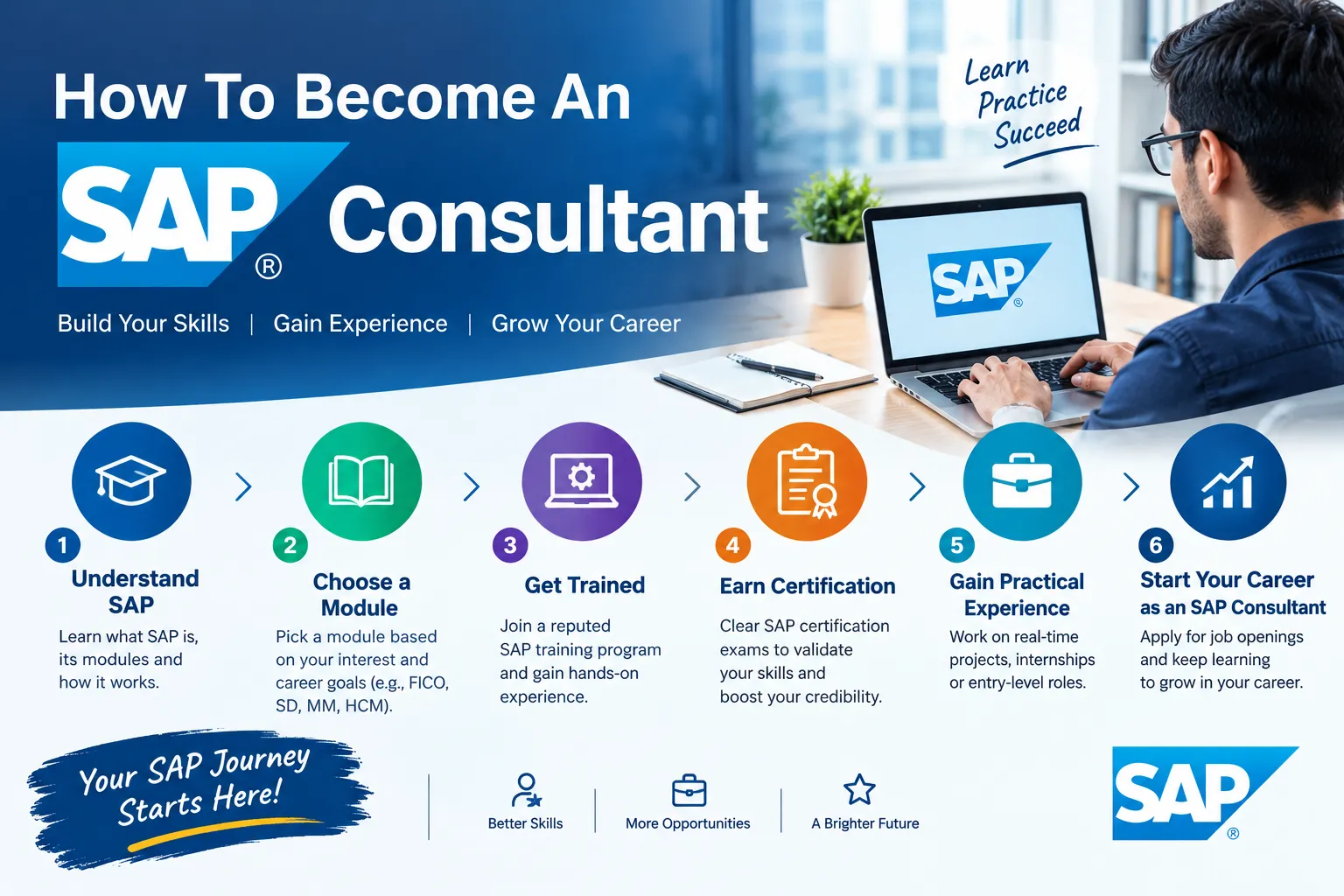
Learn how to become an SAP consultant: skills, SAP FICO training, certification, entry-level roles and a step-by-step roadmap to start your SAP career in India.
To become an SAP consultant, build a base in your functional area (such as finance), learn an SAP module like FICO through structured training and hands-on practice, earn a relevant SAP certification, then start as a junior or support consultant. Many people enter through accounting, support, or implementation roles.
What Does an SAP Consultant Actually Do?
An SAP consultant helps companies configure, implement, and improve SAP software so it matches how their business really works. You are the bridge between business users and the system.
There are two broad paths: How to Become an SAP Consultant
- Functional consultants configure modules such as FICO (Finance and Controlling), MM (Materials Management), SD (Sales and Distribution), or HR/HCM. They gather requirements, configure the system, test, and train users.
- Technical consultants work on ABAP development, integration, SAP Basis administration, or analytics and data tools.
If you are searching for how and where to start, the functional route is usually the easiest entry for people with commerce, accounting, supply chain, or business backgrounds.
Who Can Start an SAP Career?
No single degree is required, but your background shapes your best starting point:
|
Your background |
Natural SAP starting point |
|---|---|
|
B.Com, M.Com, CA, CMA, accountants |
SAP FICO |
|
Supply chain, procurement, logistics |
SAP MM or SAP SD |
|
Engineering or computer science |
ABAP, SAP BTP, or integration |
|
HR professionals |
SAP HCM or SuccessFactors |
|
Fresh graduates (any stream) |
Module matching your degree, or a support/testing role |
Business knowledge matters more than most beginners expect. A consultant who understands month-end closing, GST, or vendor payments is far more useful than one who only knows menu paths.
How to Become an SAP Consultant: 7 Steps
Step 1: Pick a Module That Matches Your Strengths
Choose one module and go deep. Trying to learn five at once is the most common beginner mistake. Finance professionals usually choose SAP FICO, because it builds directly on what they already know about ledgers, payables, receivables, assets, and costing.
Step 2: Learn the Business Process First
Before touching the system, understand the process it supports. For FICO, that means:
- General ledger, accounts payable, and accounts receivable basics
- Asset accounting and bank reconciliation
- Cost centers, profit centers, and product costing
- Month-end and year-end closing
- Indian taxation context, such as GST and TDS, if you target India-based projects
Step 3: Get Structured Training With Real System Access
Self-study works for theory, but consulting is learned by doing. Look for training that gives you:
- Access to a working SAP system (not only slides or recordings)
- Configuration practice in the Implementation Guide (SPRO)
- End-to-end scenarios such as procure-to-pay and order-to-cash
- Guidance on S/4HANA, since new projects increasingly use it
SAP also offers its own free learning content through SAP Learning and the SAP Community.
Step 4: Practice Configuration and Troubleshooting
Build small projects. For example, create a company code, set up a chart of accounts, configure automatic account determination, post sample invoices, and run a period-end close. Then deliberately break something and fix it. Troubleshooting is what interviewers test.
Step 5: Earn a Relevant SAP Certification
Certification is not mandatory, but it helps a resume stand out when you have limited project experience. SAP publishes current certification options on its official certification site, and exam codes and versions change, so always confirm the latest one there instead of relying on older blog posts.
Step 6: Build a Resume Around Practical Work
Hiring managers want evidence, not course lists. Include:
- Your prior domain experience (for example, three years in accounts payable)
- Configuration scenarios you have practiced
- A short case study or mock project you can explain clearly
- Any certification or SAP-related coursework
Step 7: Target the Right Entry Roles
Most newcomers do not start as a senior consultant. Realistic starting points include:
- SAP support or helpdesk analyst
- Junior functional consultant or associate consultant
- SAP testing or UAT analyst
- Key user or super user in your current company, then a move to consulting
- Internal transition from finance or operations into an SAP project team
The key-user route is underrated. If your employer runs SAP, volunteering for an implementation or rollout is often the fastest way to gain real project exposure.
Skills You Need Beyond SAP Knowledge
Technical configuration skill gets you hired; these skills help you grow:
- Communication: explaining system behavior to non-technical users
- Requirement gathering: asking the right questions in workshops
- Documentation: writing functional specifications and test scripts
- Problem-solving: tracing an error across modules
- Adaptability: projects, clients, and SAP versions change often
How to Choose a Good SAP FICO Training Institute in India
People often search for the best SAP FICO training institute in India. There is no official ranking, and any institute claiming to be "number one" should be asked for proof. Instead of chasing a title, evaluate institutes on criteria you can verify:
|
What to check |
Why it matters |
|---|---|
|
Trainer's real project experience |
Consultants who have worked on implementations teach scenarios, not just theory |
|
Live SAP system access |
Hands-on practice is where skill is built |
|
S/4HANA coverage |
Many employers now expect it |
|
Syllabus depth |
Should cover FI, CO, integration with MM and SD, and closing processes |
|
Demo class availability |
Lets you judge teaching quality before paying |
|
Verifiable student reviews |
Look at independent platforms, and speak to past students directly |
|
Placement support honesty |
Be cautious about "100% placement" promises; support is not a guarantee |
|
Batch size and doubt-clearing |
Smaller groups and follow-up sessions help beginners |
Ask to speak with a former student who is now working in an SAP role. Their answer is more reliable than any brochure.
Realistic Timeline
Timelines vary by background, effort, and the job market, so treat this as a rough guide rather than a promise:
- Foundation and module learning: typically a few months of consistent study and practice
- Practice projects and certification prep: additional weeks to a few months
- Job search and first role: varies widely by location, demand, and your prior experience
People coming from accounting or finance roles into FICO usually adapt faster, since they already know the underlying business.
Common Mistakes to Avoid
- Learning only navigation and not the business logic behind it
- Choosing a module because it is trending rather than because it fits you
- Relying on certificates without hands-on practice
- Ignoring S/4HANA and learning only older ECC material
- Faking project experience on a resume (interviewers will probe, and it usually backfires)
Frequently Asked Questions
1. Can a fresher become an SAP consultant?
Yes. Freshers typically start in support, testing, or junior consultant roles after completing module training and practice. Domain knowledge from your degree helps considerably.
2. Do I need coding skills for SAP FICO?
No. FICO is a functional module, so coding is not required. Basic familiarity with ABAP concepts helps when working with technical teams, but it is optional.
3. Is SAP certification mandatory?
No. It is not legally or universally required, but it can strengthen your resume, especially if you have no prior project experience.
4. Which SAP module is best for beginners?
The best module is the one that matches your background. Finance graduates often choose FICO, while supply chain professionals choose MM or SD.
5. Is SAP FICO a good career choice?
FICO remains a core module because every business needs financial accounting. Demand varies by region and market conditions, so check current job listings before deciding.
6. What is the difference between SAP functional and technical consultants?
Functional consultants configure business processes and work with users. Technical consultants develop custom programs, build integrations, or manage the system landscape.
7. Should I learn SAP ECC or S/4HANA?
Learn S/4HANA as your priority, since new implementations center on it. Understanding ECC concepts is still useful because many companies run both.
8. How do I get SAP project experience without a job?
Practice on a training system, build mock end-to-end scenarios, volunteer as a key user in your current company, or look for internships and support roles.
9. How do I pick the best SAP FICO training institute in India?
Compare trainers' real project experience, live system access, syllabus depth, S/4HANA coverage, and verifiable reviews. Attend a demo class before enrolling.
10. Can I switch from accounting to SAP consulting?
Yes, and it is one of the most common transitions. Your understanding of ledgers, closing, and compliance is a genuine advantage.
Conclusion
Becoming an SAP consultant is a step-by-step process, not an overnight switch. Choose a module that fits your background, learn the business logic first, practice on a real system, and target entry roles that give you project exposure. Be skeptical of shortcuts and inflated promises from any institute, and judge training by hands-on depth and verifiable outcomes.
Related Reading
Expert Insights: Navigating the Complex World of Education & Learning
Welcome to our in-depth exploration of Education & Learning. In an era defin...
Why Education & Learning is Transforming the Global Industry Landscape
Welcome to our in-depth exploration of Education & Learning. In an era defin...