How Long Does It Take to Build a Blockchain Application?
By Noah Jhon
73 Views
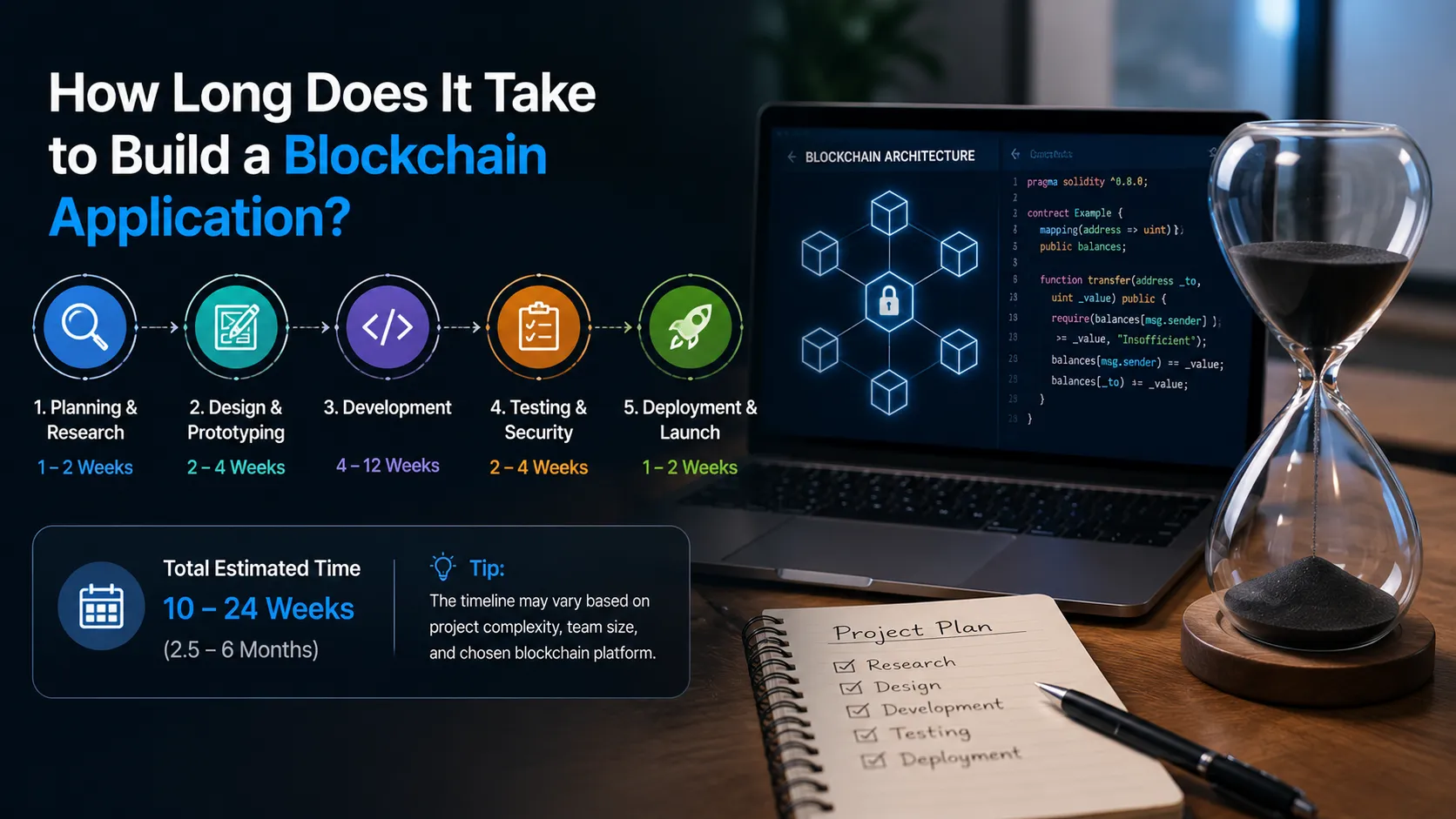
Somebody asked me this at a meetup once. I gave them a number "probably six months" and immediately regretted it. Because they came back four months later wondering why their team was still in the smart contract phase with no end in sight.
The honest answer is: it depends on things most people haven't thought about yet.
That's not a dodge. It's actually the most useful thing I can tell you upfront, because the minute you understand what it depends on, you stop asking "how long" and start asking the right questions. And that shift is what separates projects that ship from projects that stall.
If you're early in this process maybe evaluating a blockchain app development company or trying to make an internal case for resourcing this breakdown is for you. No fluff, no inflated timelines, no "it could be anywhere from 3 months to 3 years" non-answers.
First: Why the Range Is So Massive
Here's something that trips people up. Blockchain development isn't a category it's a spectrum.
A three-person team building a basic NFT drop with an existing contract standard is doing something fundamentally different from an enterprise team building a permissioned supply chain ledger with custom consensus logic. Calling both "blockchain development" is a bit like calling both a lemonade stand and a restaurant "food businesses." Technically true, practically useless.
So when someone tells you "most blockchain apps take 6-12 months," what they're really giving you is an average across wildly different project types. Your project might be a 10-week sprint. It might be an 18-month odyssey. Platform, complexity, team experience, regulatory environment — these determine where you fall.
Let me walk you through each phase in order, with real-ish time estimates, and then we'll get into the variables that push those estimates around.
The Phases (And What People Actually Spend Time On)
Discovery and Architecture — 2 to 4 Weeks
Nobody wants to spend money on planning. I get it. But I've seen teams skip this phase and spend three months fixing decisions they made in week one.
This is where you pick your chain. Ethereum if you want deep tooling and the largest developer ecosystem. Solana if you need speed and low fees but are okay with a younger, sometimes rockier dev environment. Hyperledger or a private network if you're building for enterprise clients who won't touch a public ledger for compliance reasons. Polygon if you want Ethereum compatibility but cheaper gas. Each choice cascades into everything downstream.
You're also mapping smart contract logic here. If you get this wrong, and I mean wrong in a subtle way that doesn't show up until month four, you're looking at a full rewrite. That's happened to more teams than will admit it publicly.
Two to four weeks spent here is not overhead. It's insurance.
Smart Contract Development — 4 to 12 Weeks
This is usually where timelines first go sideways.
A straightforward ERC-20 token? Two weeks, maybe three if your developer is juggling other work. A staking system with governance voting, vesting schedules, and multi-sig controls? You're looking at ten to twelve weeks minimum, and that's assuming experienced Solidity or Rust engineers who've built similar systems before.
The thing that makes smart contract development uniquely painful is the deployment reality. Once it's on mainnet, it's there. You can't push a hotfix at 2am and call it done. Mistakes live forever — or at minimum, require expensive migration workarounds. So you end up doing way more pre-deployment testing than you would in traditional development. That time is real, and it shows up in your timeline whether you plan for it or not.
Backend and API Layer — 4 to 8 Weeks
Your contracts don't exist in a vacuum. They need to connect to a backend that handles off-chain logic, indexes data, serves your frontend, and in many cases communicates with external systems.
This phase covers node integration — whether you're running your own node or using a provider like Alchemy or Infura — plus the API layer that your frontend talks to. If your app needs real-world data, prices, user identity, external events, you're also bringing in oracle infrastructure here. Chainlink is the most common. It adds complexity, but for DeFi or parametric insurance use cases, you have no choice.
Four weeks for a lean app. Eight if you're building something with significant off-chain logic or data dependencies.
Frontend and Wallet UX — 3 to 6 Weeks
I want to be honest about something: Web3 UX is still rough.
The average user trying to connect a wallet, approve a transaction, understand a gas fee, and figure out why their transaction failed is having a worse experience than they would on a five-year-old fintech app. Some of that is inherent to how blockchains work. But a lot of it is just teams not spending enough time here.
MetaMask, WalletConnect, Phantom — whichever wallet ecosystem your chain supports — the integration takes time to do properly. Handling edge cases like rejected transactions, network switches, and insufficient gas requires real thought. The teams that budget six weeks for frontend and actually use them tend to ship products people can figure out. The teams that treat this as a two-week checkbox don't.
Security Audit — 2 to 6 Weeks
Non-negotiable. Not even slightly.
The DeFi ecosystem alone has lost billions to smart contract exploits. Reentrancy attacks, integer overflows, oracle manipulation — these aren't theoretical. They've happened to teams who thought their code was clean. Audit firms like CertiK, Trail of Bits, OpenZeppelin, and Halborn run formal reviews, automated fuzzing, and adversarial testing on your contracts before you go live.
Here's the practical thing nobody mentions: top audit firms are often booked out six to eight weeks in advance. If you don't schedule your audit slot early, you'll be ready to launch and waiting two months for a reviewer. Plan ahead.
The audit itself runs two to six weeks depending on contract complexity. Add remediation time for whatever findings come back — because findings will come back — and budget accordingly.
Testnet Deployment and QA — 2 to 4 Weeks
Before real money touches your contracts, you run everything on a testnet. Goerli, Sepolia, Devnet — your chain will have one.
Testnets surface behavior you didn't see in unit tests. User flows fail in unexpected ways. Wallets behave differently across devices and browsers. Transaction handling breaks under load. This phase exists to catch all of that before mainnet, when the cost of catching it is time instead of money.
Don't compress this. The teams that do tend to discover their edge cases on mainnet, which is a much worse place to find them.
Launch and What Comes After — Ongoing
Mainnet launch is not the end. I'd argue it's the beginning of the harder part.
Post-launch, you're monitoring contract health, handling user onboarding issues, optimizing gas usage during high-traffic periods, and fielding the things your users actually do that you didn't anticipate. If you tokenized anything, you're managing holder relations and market dynamics on top of all of that.
Build runway into your plan for post-launch. Teams that treat launch as the finish line usually struggle in the first 90 days after.
The Variables That Actually Move the Needle
Who's building it. An experienced Web3 team that has shipped three DeFi products before moves faster than a talented traditional engineering team learning Solidity mid-project. That gap can be four months on a mid-size project.
What you're building on. Public chain? Faster to start, but you're working within constraints. Private or custom chain? More control, more infrastructure work upfront.
Regulatory surface area. KYC, AML, securities compliance — any of these apply to your project, you're adding weeks or months. This is especially true for anything touching financial instruments or US users.
How much you're building from scratch. Composing on top of audited protocols like Aave, Uniswap, or OpenZeppelin's contract libraries is significantly faster than building equivalent logic from zero.
A Word on Cost
Timeline and blockchain app development cost move together. A lean app on a public chain with a small experienced team might run $80,000 to $150,000. A mid-complexity DeFi platform with full audit coverage lands closer to $200,000 to $350,000. Enterprise-grade private blockchain deployments with compliance layers? Half a million and up isn't unusual.
The audit alone is $15,000 to $50,000 for a contract suite of any real size. Cut that line item and you're not saving money — you're transferring risk onto your users.
Timeline by Project Type
What You're Building
Realistic Timeline
Simple token or NFT contract
4 – 8 weeks
NFT marketplace (full platform)
3 – 5 months
DeFi protocol (lending/staking)
5 – 9 months
Supply chain tracking platform
4 – 8 months
Cross-chain application
8 – 14 months
Enterprise private blockchain
12 – 24 months
The Thing Most Teams Get Wrong
Everyone obsesses over the development timeline. Almost nobody obsesses enough over the audit and testing window — which is ironic, because that's the part where skimping has the most catastrophic consequences.
Two months of rigorous security review is worth more than two months of rushed feature development. The ledger doesn't forgive mistakes the way a database rollback does.
If I had one piece of advice for any team starting a blockchain project: put your audit on the calendar before you write your first line of contract code. Not as an afterthought. As a date you're building toward.
Bottom Line
Somewhere between six weeks and two years, depending on everything I just described. That's the real answer.
The teams that ship well aren't always the fastest. They're the ones who understand that each phase has a job, that security isn't optional, and that what happens after launch matters as much as what happens before it.
Pick your platform deliberately. Audit your contracts thoroughly. Test until you're bored. And plan for the reality that launching is the start of a different kind of work, not the end of the current one.