How Laboratory Equipment Sourcing Has Changed — And What Institutions Should Know Now
By Atico India
5 Views
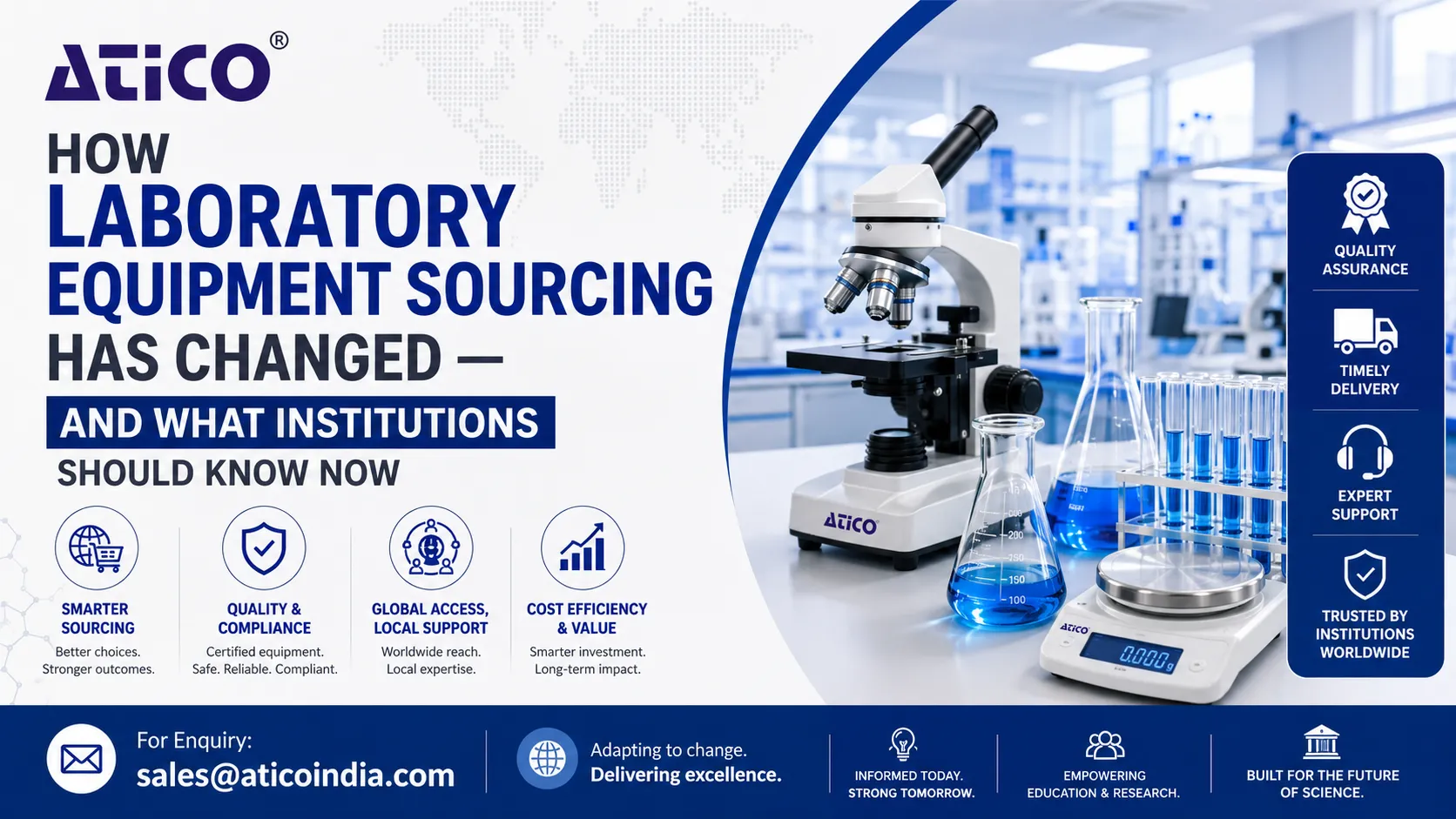
For decades, sourcing laboratory equipment followed a predictable pattern: institutions in developing and emerging markets bought from a handful of Western manufacturers, paid premium prices, and waited long lead times. That pattern has shifted substantially over the past fifteen years, and the institutions that understand the shift are equipping better laboratories for less money. The ones that don't are still overpaying out of habit.
This piece looks at what has actually changed in the laboratory equipment landscape, and what it means for schools, universities, and research institutions making procurement decisions today.
The Rise of Direct Manufacturer Sourcing
The most significant change is structural: institutions are increasingly buying directly from manufacturers rather than through layers of distributors. The old model routed a beaker or a testing machine through an importer, a regional distributor, and a local reseller — each adding margin, each removing a degree of accountability. By the time the equipment reached the institution, the price had inflated and the direct line to whoever actually made the product had disappeared.
Direct manufacturer sourcing collapses those layers. It gives institutions access to bulk pricing without intermediary markup, the ability to customize equipment to a specific syllabus or specification, and a single point of accountability when something needs resolving. For a procurement officer equipping an entire department, the difference in both cost and coordination is significant.
The catch is that "manufacturer" has become a claimed label rather than a verified one. A meaningful share of companies presenting themselves as laboratory equipment manufacturers are actually resellers who don't control production. The skill institutions now need is distinguishing between the two — which comes down to asking whether a company can confirm specifications in writing, produce standards documentation, and accommodate customization. Genuine manufacturers can; resellers cannot.
Emerging Manufacturing Hubs Have Changed the Price-Quality Equation
The second major shift is geographic. Countries with strong engineering and manufacturing bases — India prominent among them — have become major sources of laboratory equipment produced to international standards at prices Western manufacturers cannot match.
This is not the "cheap equals low quality" story it might once have been. Established manufacturers in these hubs produce to ISO, ASTM, and equivalent standards, hold genuine certifications, and export to institutions across dozens of countries. For a Commonwealth-curriculum school in Africa or Southeast Asia, an Indian manufacturer often understands the specific equipment requirements better than a European supplier designing for a different educational system — and delivers it at a fraction of the cost.
The institutions still defaulting to premium Western suppliers out of habit are frequently paying two or three times more for equipment that meets the same standards. The shift isn't about buying cheaper; it's about buying smarter from manufacturers who compete on standards compliance and value rather than brand legacy.
Consolidation as a Procurement Strategy
A third change is subtler but consequential: the move toward consolidating equipment purchases with fewer, broader manufacturers. Institutions historically bought physics equipment from one specialist, chemistry glassware from another, testing machines from a third. Each relationship carried its own contract, lead time, warranty, and freight arrangement.
Manufacturers with genuine breadth across categories — educational, engineering, research, and testing equipment — now let institutions consolidate an entire laboratory or department under one relationship. The savings rarely appear in a per-item price comparison. They appear in the coordination overhead that disappears, and in the single accountable relationship when something needs servicing or replacing.
What This Means for Institutions Buying Today
The practical takeaway for a procurement officer is a short set of principles. Source directly from manufacturers rather than through reseller layers, but verify the manufacturer claim by asking for specifications, standards documentation, and customization capability. Look seriously at established manufacturers in emerging manufacturing hubs, which frequently offer the same standards compliance at substantially lower cost. And consider consolidating across categories with a manufacturer of genuine breadth, rather than managing a sprawl of single-category vendors.
Manufacturers operating on this model — direct, standards-compliant, and broad in range — are increasingly where institutional value lives. Atico India is one example: a manufacturer producing laboratory equipment across educational, engineering, research, and testing categories since 1957, exporting to institutions across more than 30 countries with standards-compliant equipment and in-house export handling. It reflects the broader shift this piece describes — direct manufacturer sourcing, from an emerging hub, with the breadth to consolidate a full laboratory. Whichever manufacturer an institution ultimately chooses, though, the principles for evaluating them are the same.
The Bottom Line
The laboratory equipment landscape has changed more in the past fifteen years than most procurement habits have. Direct manufacturer sourcing, credible emerging manufacturing hubs, and category consolidation have collectively rewritten what good procurement looks like. The institutions equipping the best laboratories for the least money are the ones who noticed.
Related Reading
Top 10 Hidden Secrets About Business & Finance You Need to Know
Welcome to our in-depth exploration of Business & Finance. In an era defined...
Why Business & Finance is Transforming the Global Industry Landscape
Welcome to our in-depth exploration of Business & Finance. In an era defined...