How Does UV Disinfection Affect Pseudomonas aeruginosa?
By xenexdisinfection
3 Views
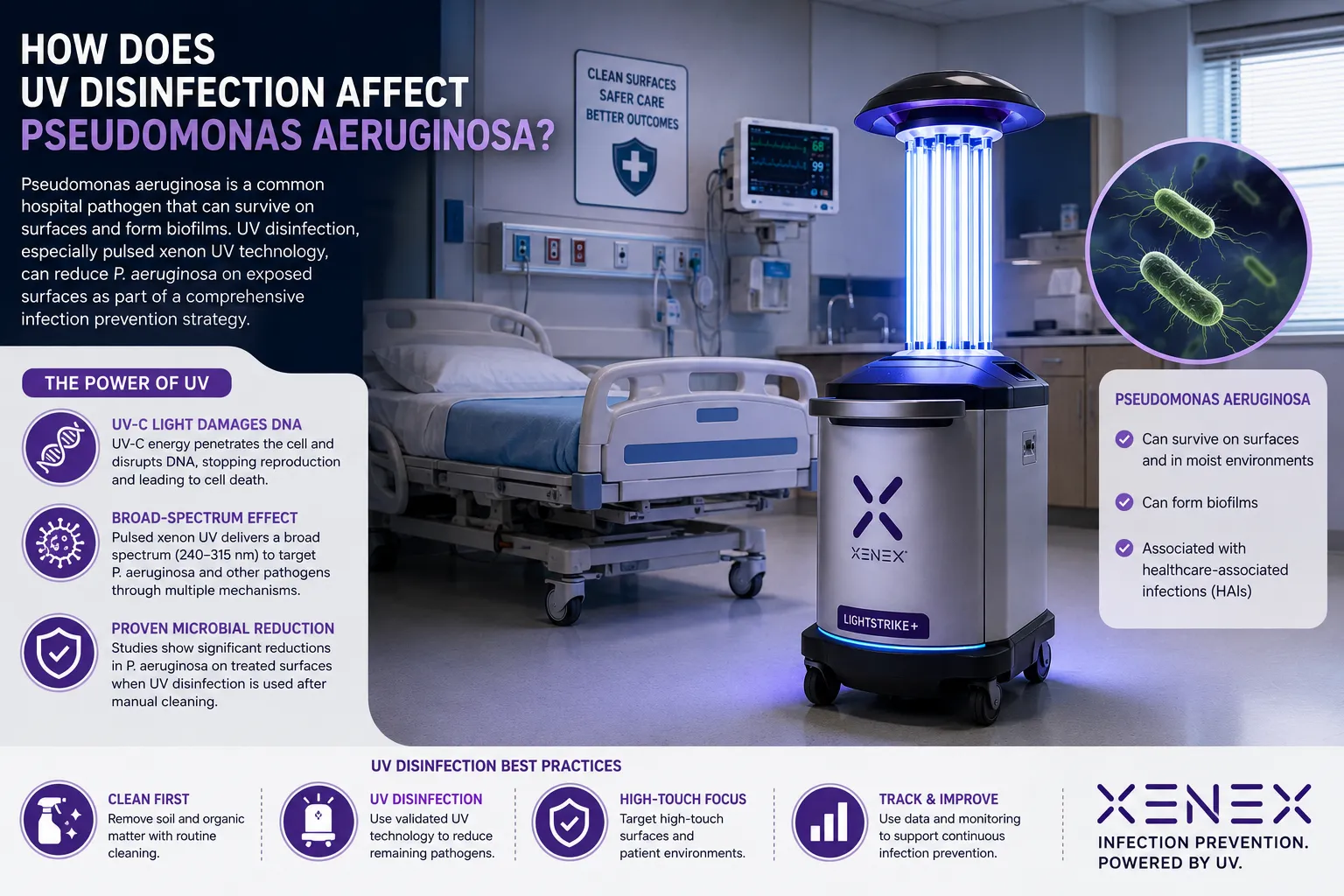
Pseudomonas aeruginosa is a significant concern in healthcare environments because it can persist on surfaces and is associated with healthcare-associated infections. Hospitals can use UV disinfection technology as an additional step after manual cleaning to help reduce microbial contamination on high-touch surfaces. Xenex's LightStrike+ uses intense, broad-spectrum pulsed xenon UV technology designed for healthcare environmental disinfection.
What Is Pseudomonas aeruginosa?
Pseudomonas aeruginosa is a Gram-negative bacterium that can be found in various environments, including water, soil, and healthcare settings. In hospitals, it can become a concern because vulnerable patients may be more susceptible to infections caused by opportunistic pathogens.
The organism can also survive on environmental surfaces and has the ability to form biofilms. Biofilms are communities of microorganisms attached to a surface and surrounded by a protective matrix. This characteristic can make environmental contamination more difficult to manage through routine cleaning alone.
Research involving hospital clinical laboratories has specifically examined P. aeruginosa because of its ability to form strong biofilms on surfaces.
How Does UV Disinfection Affect Pseudomonas aeruginosa?
UV disinfection works by delivering ultraviolet energy that can damage microbial genetic material. UV-C wavelengths are particularly useful for microbial inactivation because they can cause damage to DNA, interfering with the microorganism's ability to reproduce.
Xenex's LightStrike+ uses pulsed xenon UV rather than a conventional single-wavelength mercury UV lamp. According to Xenex, LightStrike+ produces broad-spectrum germicidal UV between approximately 240 and 315 nanometers and uses multiple mechanisms of microbial damage.
For Pseudomonas aeruginosa, this means that appropriately delivered UV energy can reduce viable bacteria on exposed environmental surfaces.
Importantly, effectiveness depends on factors such as UV dose, distance, exposure time, surface conditions, and whether microorganisms are shielded from the light.
Why Is Pseudomonas aeruginosa Important in Hospitals?
Hospitals contain many high-touch surfaces where microorganisms can potentially remain after routine cleaning. Bed rails, tables, equipment, door handles, switches, and other frequently touched areas can become part of the environmental pathway for pathogen transmission.
Research on pulsed xenon UV in clinical laboratories found that P. aeruginosa demonstrated strong biofilm-forming ability and that pulsed xenon UV significantly reduced colony counts of tested biofilm-forming pathogens on surfaces.
This is particularly relevant to infection prevention teams because reducing environmental microbial contamination is one part of a broader strategy for reducing opportunities for pathogen transmission.
Can UV Disinfection Reduce Pseudomonas on Hospital Surfaces?
Evidence indicates that pulsed xenon UV can reduce P. aeruginosa contamination under appropriate conditions.
A study evaluating a pulsed xenon UV device in clinical laboratories tested P. aeruginosa, Staphylococcus aureus, and Klebsiella pneumoniae. The researchers found significant reductions in the colony counts of these organisms following PX-UV treatment.
Another hospital study examined high-touch surfaces after patient discharge. Pseudomonas aeruginosa was among the pathogenic bacteria identified during environmental sampling, and bacterial colony counts decreased following manual disinfection and subsequent pulsed xenon UV treatment.
These findings support the concept of using UV technology as an additional environmental disinfection step, rather than viewing it as a standalone replacement for routine cleaning.
How Does Pulsed Xenon UV Work?
Not all UV disinfection systems operate in the same way. Xenex emphasizes the difference between traditional narrow-spectrum mercury UV devices and its pulsed xenon technology.
LightStrike+ generates high-intensity, broad-spectrum UV light in pulses. Xenex explains that its technology operates across approximately 240–315 nm and is designed to target pathogens through multiple mechanisms. The company also reports cycle times as short as two minutes for certain vegetative bacteria.
The broader spectrum and high-intensity pulses are important because microorganisms can have different sensitivities to different UV wavelengths.
A recent in-vitro investigation of pulsed UV using a xenon source also included P. aeruginosa and found significant microbial reduction following appropriate UV exposure. The study reported that P. aeruginosa was the most susceptible of the tested organisms under its experimental conditions.
Why Surface Positioning Matters
UV light travels from its source, meaning distance and obstructions can influence how much UV energy reaches a surface.
Xenex specifically notes that UV intensity decreases with distance and that objects can create shadows where UV light may not adequately reach. For this reason, the company recommends validated positioning practices rather than relying on a single location to disinfect an entire room.
High-touch surfaces should therefore be considered carefully when developing a whole-room microbial reduction protocol.
Proper positioning can help ensure that important environmental surfaces receive sufficient UV exposure.
Does UV Disinfection Replace Manual Cleaning?
No. UV disinfection should generally complement, rather than replace, manual cleaning and chemical disinfection.
Xenex states that LightStrike technology is intended to be added after manual cleaning. The company cites research indicating that a substantial percentage of hospital room surfaces may not be properly disinfected during liquid chemical cleaning alone.
Manual cleaning remains important because it physically removes dirt, organic material, and contamination. UV technology can then provide an additional microbial reduction step on exposed surfaces.
This combination can be particularly useful in environmental services (EVS) and infection prevention programs.
What About Pseudomonas Biofilms?
Biofilms are an important consideration when discussing Pseudomonas aeruginosa. Once bacteria become established within a biofilm, the organisms may be more difficult to eliminate than free-floating cells.
Research examining PX-UV and biofilm-forming pathogens found that P. aeruginosa could form robust biofilms and that PX-UV significantly reduced colony counts on tested surfaces.
However, UV effectiveness can vary depending on the organism's location, the amount of microbial contamination, surface characteristics, UV dose, and whether microorganisms are directly exposed to the light. Therefore, hospitals should use validated protocols rather than assuming every contaminated surface will receive identical microbial reduction.
How Can Hospitals Use UV Technology for Infection Prevention?
A successful UV disinfection program involves more than simply placing a device in a room. Hospitals should integrate the technology into established environmental cleaning workflows.
Key considerations include:
- Perform routine manual cleaning first.
- Identify high-priority patient rooms and areas.
- Focus on high-touch environmental surfaces.
- Position UV equipment according to validated protocols.
- Follow manufacturer safety procedures.
- Train environmental services personnel.
- Track completed disinfection cycles.
- Review data to identify opportunities for improvement.
- Coordinate UV use with infection prevention teams.
Xenex provides implementation support, training, workflow consulting, and reporting tools as part of its approach to microbial reduction programs.
Final Thoughts
So, how does UV disinfection affect Pseudomonas aeruginosa? Properly delivered UV energy can damage microbial genetic material and reduce viable P. aeruginosa on exposed environmental surfaces. Research involving pulsed xenon UV has demonstrated reductions in P. aeruginosa and other clinically relevant microorganisms under tested conditions.
Xenex's LightStrike+ builds on this principle by using broad-spectrum pulsed xenon UV technology as part of a healthcare-focused microbial reduction strategy. The technology is designed to supplement manual cleaning and help healthcare facilities address pathogens that may remain on environmental surfaces after routine disinfection.
For hospitals, the most effective approach is a comprehensive infection prevention program that combines manual cleaning, appropriate disinfection protocols, environmental monitoring, staff training, and validated UV technology where appropriate.
FAQs
1. Can UV disinfection kill Pseudomonas aeruginosa?
UV-C and pulsed UV technologies can reduce P. aeruginosa under appropriate exposure conditions. Research has demonstrated reductions of this organism following pulsed xenon UV treatment of contaminated surfaces.
2. Does Pseudomonas aeruginosa survive on hospital surfaces?
Yes. P. aeruginosa can persist in healthcare environments and can form biofilms on surfaces, making environmental contamination an important infection prevention consideration.
3. Does UV disinfection replace chemical cleaning?
No. UV disinfection is intended to supplement routine manual cleaning and disinfection. Xenex recommends using LightStrike as an additional step after manual cleaning.
4. How does LightStrike+ use UV to reduce pathogens?
LightStrike+ uses pulsed xenon technology to generate intense, broad-spectrum UV light. Xenex states that its system operates across approximately 240–315 nm and uses multiple mechanisms to damage pathogens.
5. Can UV reach Pseudomonas hidden in shadows?
UV disinfection works best when surfaces receive adequate UV exposure. Objects can block UV light and create shadows, so proper device positioning and room protocols are important for effective microbial reduction.