How Digital Marketing Companies Are Becoming the Architect of AI-Driven Growth in Kolkata
16 Views
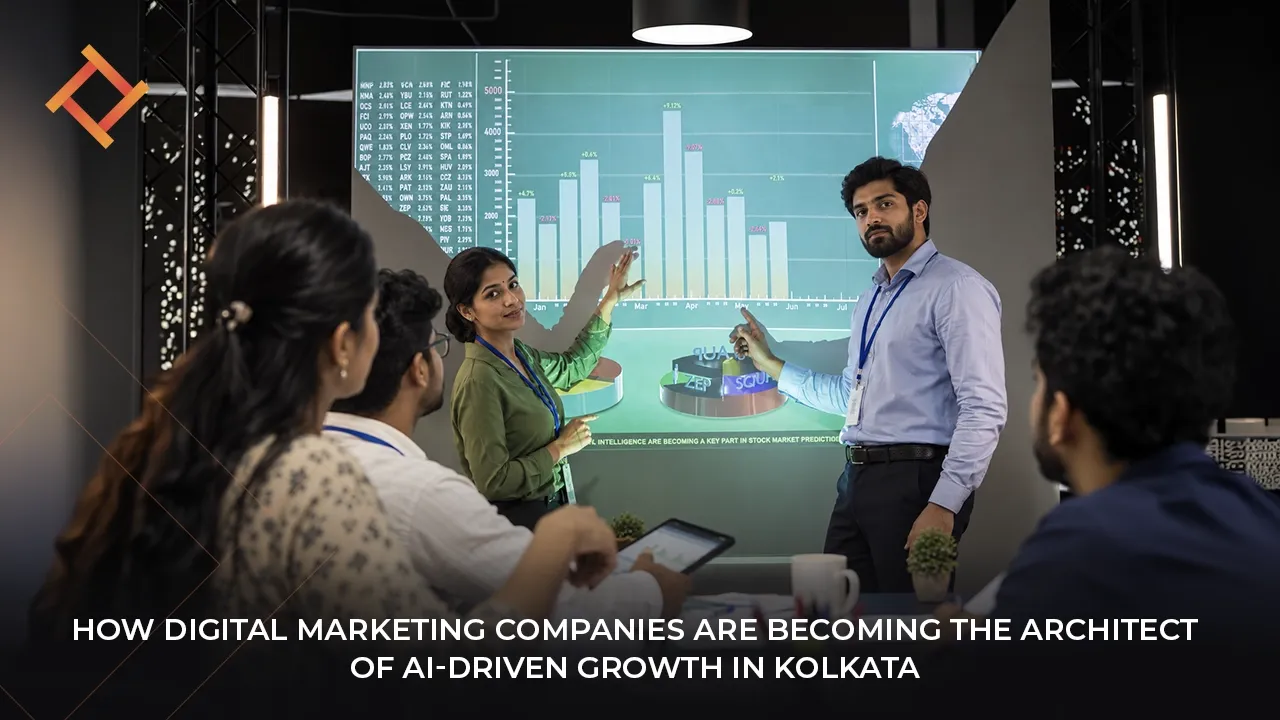
Running SEO with one vendor, PPC with another, and social media in-house rarely works anymore. Businesses in Kolkata keep discovering this the expensive way. Each channel reports its own numbers, nobody owns the full customer journey, and the brand ends up paying for six disconnected efforts instead of one coordinated growth engine.
That fragmentation is now a genuine risk, not a minor inefficiency. India's digital advertising market has already crossed ₹69,856 crore, commanding over 61% of total ad spend, and AI is rewriting how that money gets allocated. Businesses without a unified strategy are simply outspent and outpaced by competitors who treat digital marketing as one connected system.
This article explains why a modern digital marketing company in Kolkata now functions less like a vendor and more like an architect, designing interconnected, AI-powered growth systems. Keep reading to understand exactly what that architecture looks like and why it matters for your next budget cycle.
From Channel Execution to System Architecture
Running isolated campaigns used to be normal. It is now the fastest way to fall behind. Traditional agencies built their entire model around channel execution. One team ran Google Ads, another handled a Meta campaign, and someone else occasionally coordinated an influencer post.
Each channel operated in its own silo, reporting separate metrics that rarely connected to a single growth narrative. That model is breaking down because the scale of digital spend now demands coordination. India's digital media segment is on track to become the first media and entertainment category in the country to cross ₹1 trillion in ad revenues this year, according to the Dentsu-e4m Digital Advertising Report.
Why do businesses need a unified digital marketing strategy instead of separate services? Because customers do not experience your brand in silos. A person discovers you through a social media reel, researches you through organic search, compares you through a paid ad, and finally converts through a retargeting email. If each of those touchpoints is managed by a different vendor with no shared data, nobody actually understands the full journey. A top digital marketing company in Kolkata now positions itself as the architect coordinating that entire structure, not just one contractor working on one wall of the building. This shift from execution to architecture is exactly what separates agencies delivering measurable growth from those simply running ads and hoping for the best.
AI Adoption Is Reshaping Every Digital Discipline at Once
Artificial intelligence stopped being a buzzword in Indian marketing somewhere around 2025, and 2026 is where it became infrastructure.
India now leads global AI adoption at 30%, comfortably outpacing the worldwide average of 26%. The Indian AI market has grown from USD 3.2 billion in 2020 to USD 6.05 billion in 2024, and analysts project it will reach USD 31.94 billion by 2031. That growth curve is not confined to tech companies. It is reshaping how SEO, PPC, content, and analytics operate day-to-day for ordinary businesses.
A 2026 survey from Cloud 9 Digital, based on data from over 500 businesses across 15 cities, found that 78% of Indian businesses now use AI for marketing, up sharply from 45% in 2024. That is not a niche trend anymore. It is the baseline expectation. Brands running AI-optimized campaigns are reporting an average return on ad spend of 3.8x, compared to an industry standard of 2.1x, according to 2026 data compiled from the Dentsu and Madison Advertising Reports. That gap will only widen as more businesses adopt predictive tools while others stay on manual processes.
Why SEO, PPC, and Content Can No Longer Operate in Isolation
Separating your SEO team from your paid ads team made sense a decade ago. It actively hurts performance today. Search engines and AI answer engines now weigh signals across channels when deciding what to rank or recommend. A brand with strong organic content, consistent paid visibility, and active social proof sends stronger trust signals than one relying on a single channel alone. How does AI integration improve SEO and PPC performance together? AI-powered bid management has reduced wasted ad spend by 37% and increased ad ROI by 50%, based on 2026 marketing statistics compiled by Datarefs. Meanwhile, AI-driven media buying is helping brands achieve up to 40% lower cost-per-lead while improving engagement rates, according to 2026 analysis from Spinta Digital.
Content strategy sits at the centre of this integration. AI systems can now analyse millions of data points to predict which products or topics will trend, allowing marketing teams to launch seasonal campaigns weeks ahead of competitors instead of reacting after demand peaks. This predictive layer only works when SEO, content, and PPC teams share data instead of operating from separate dashboards.
Automation adds another layer of efficiency. Automated email flows now generate 41% of total email revenue from just 5.3% of total sends, with revenue per recipient nearly 18 times higher than standard campaigns, according to 2026 industry data. That kind of performance gap simply cannot happen when channels are managed in isolation without shared customer data feeding every decision.
Generative Engine Optimisation Is Rewriting the Rules of Visibility
Ranking on page one of Google used to be the finish line. In 2026, it is barely the starting point.
Generative Engine Optimisation, commonly shortened to GEO, focuses on getting a brand mentioned directly inside AI-generated answers from tools like Google's Gemini or other AI assistants, rather than just appearing as a blue link in traditional search results. Why is generative engine optimisation important now, and what does it entail? When someone asks an AI assistant a question like which company offers the best service in a category, the AI gives a direct summary naming one or two top choices.
Earning that mention requires strong brand authority and positive sentiment signals across the web, not just keyword-optimised landing pages. This update modifies the real goals that material must achieve. It is no longer enough to rank. Content needs to be cited, trusted, and referenced across multiple platforms, so AI systems recognise the brand as an authority. Businesses that ignore this shift risk becoming invisible in an increasingly AI-mediated search environment, even if their traditional SEO metrics still look reasonably healthy on paper.
Agentic AI is accelerating this further. Autonomous AI agents now handle complex tasks like managing ad bids and even booking appointments without human intervention, according to 2026 industry trend analysis. A digital marketing partner that understands both traditional SEO and this emerging generative visibility layer gives Kolkata businesses a genuine head start over competitors still optimising purely for old-style search rankings.
The Trust Deficit Problem in an AI-Saturated Market
More content and more automation created an unexpected side effect nobody fully anticipated.
Brands produced more content, launched more campaigns, and adopted more automation in the past year than any previous year combined, and simultaneously became harder to distinguish from each other. Visibility went up across the board. Credibility went down just as sharply. This trust deficit is not unique to India, but a market this diverse and value-conscious feels the impact more acutely, and it directly affects conversion rates and long-term brand equity.
How can businesses maintain trust while scaling AI-driven marketing? The answer lies in balancing automation with a genuine human-first strategy. AI can optimise bidding, predict trends, and personalise messaging at scale, but it cannot replace authentic brand storytelling or cultural nuance, especially in a diverse regional market. AI-driven personalisation is now responsible for nearly 45% of all online conversions in 2026, which proves personalisation works, but only when it feels genuine rather than robotic and repetitive across every touchpoint a customer encounters.
This is where architecture matters more than pure automation. A business that blends AI-driven efficiency with authentic regional storytelling, local cultural understanding, and consistent brand voice across channels builds the kind of trust that pure automation alone cannot manufacture.
How Keyline Digitech Builds 360-Degree, AI-Powered Growth Systems
Coordinating all these moving pieces requires a genuinely integrated model, not a loose collection of specialists. Keyline Digitech operates as a digital marketing company in Kolkata built around a 360-degree model that connects SEO, PPC, social media, content, analytics, and conversion optimisation into one coordinated growth strategy rather than treating them as separate line items.
What should businesses look for in a digital marketing partner in 2026? Look for a team that shares data across every channel, applies AI tools for prediction and automation without losing human strategic judgement, and understands both traditional search ranking factors and emerging generative engine visibility.
This integrated approach reflects exactly where the broader Indian digital marketing industry is heading. Marketing budgets globally are shifting, with AI systems now accounting for a growing share of spend while allocations for pure execution work decline, according to 2026 AI marketing statistics. Businesses that treat their digital presence as one connected architecture, rather than six disconnected vendors, are the ones capturing that AI-orchestrated ROI advantage.
In a Nutshell
Digital marketing in Kolkata has moved well past the era of isolated channel execution. SEO, PPC, content, social media, and analytics now function as one interconnected system, and AI sits at the centre of that architecture, predicting trends, optimising spend, and reshaping how visibility even gets measured.
With India's digital ad market crossing ₹69,856 crore and AI adoption reaching 78% among Indian businesses, staying on fragmented, single-channel strategies is no longer a safe option. A genuine digital marketing company in Kolkata now acts as an architect, unifying data and strategy across the entire customer journey rather than managing disconnected campaigns.
Businesses that embrace this integrated, AI-powered model position themselves for measurably stronger ROI, while those clinging to outdated channel silos risk losing visibility in an increasingly AI-mediated search landscape.
Frequently Asked Questions (FAQs)
1. Why is AI integration important for digital marketing in Kolkata businesses?
AI improves prediction, reduces wasted ad spend by up to 37%, and increases ROI by up to 50%, giving businesses a measurable competitive advantage.
2. What does a 360-degree digital marketing model actually mean?
It means SEO, PPC, social media, content, and analytics work together under one unified strategy, sharing data instead of operating in separate silos.
3. What is generative engine optimisation, and should businesses care about it?
It is optimising content so AI assistants cite your brand directly in generated answers, which is becoming as important as traditional search ranking.
4. Can small businesses in Kolkata afford AI-driven digital marketing?
Yes. Many AI tools now automate repetitive tasks, cutting operational costs while improving targeting, making AI-driven strategies accessible beyond large enterprise budgets.
5. How does an integrated agency improve ROI compared to hiring separate vendors?
Shared data across channels enables better predictions, consistent messaging, and coordinated optimisation, which is why AI-optimized integrated campaigns report 3.8x ROAS versus 2.1x industry standard.