How AI Strategy Consulting Helps Businesses Turn AI Ideas Into Real Business Outcomes
16 Views
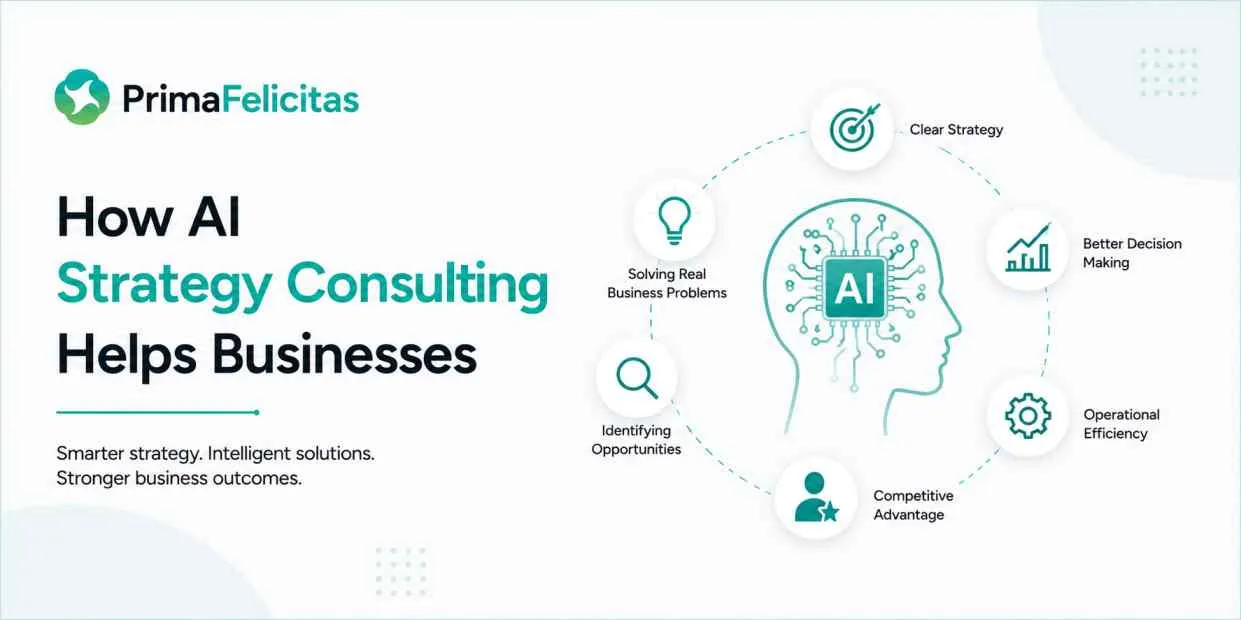
Artificial intelligence is no longer just a technology trend. Businesses across industries are using AI to automate repetitive tasks, improve customer experiences, analyze large amounts of data, and make faster business decisions.
However, adopting AI is not as simple as choosing an AI tool and adding it to your business. Many companies have multiple AI ideas but are unsure where to begin, which use cases are worth investing in, what technology they need, or how AI can generate measurable business value.
This is where AI strategy consulting can help.
AI strategy consulting helps businesses identify practical AI opportunities, prioritize use cases, prepare their data and technology infrastructure, and create a roadmap for implementing AI. Instead of experimenting with AI without a clear direction, businesses can use a structured strategy to connect AI investments with specific business objectives.
What Is AI Strategy Consulting?
AI strategy consulting is the process of developing a clear plan for how a business can use artificial intelligence to achieve its business goals.
An AI consultant looks beyond the technology itself. The focus is on understanding the company's challenges, processes, customers, data, existing software, and long-term objectives.
A typical AI strategy may address questions such as:
- Which business processes can benefit from AI?
- Which AI use cases should be implemented first?
- What data is required?
- Should the company build a custom AI solution or use an existing platform?
- Which AI technologies are appropriate?
- How much will implementation cost?
- What business results can the company expect?
- How can the AI solution scale in the future?
This approach helps organizations move from AI ideas to actionable business plans.
Why Businesses Need an AI Strategy
The rapid growth of generative AI, AI agents, machine learning, and automation has created many opportunities. At the same time, it can make technology decisions more complicated.
A company might consider building a chatbot, AI recommendation engine, document-processing system, predictive analytics platform, or AI agent. But implementing every possible idea is rarely practical.
Without a strategy, businesses can face problems such as:
- Investing in AI solutions without a clear business purpose
- Choosing unsuitable technologies
- Using poor-quality or unstructured data
- Building solutions that are difficult to integrate
- Underestimating implementation costs
- Failing to measure ROI
- Creating AI projects that never reach production
An AI strategy provides a framework for deciding where AI can create the most value and how to implement it effectively.
How AI Strategy Consulting Creates Business Value
1. Identifying the Right AI Opportunities
The first step is identifying where AI can solve real business problems.
Consultants can analyze existing workflows and identify repetitive, time-consuming, expensive, or data-intensive processes.
For example, an organization may spend hundreds of employee hours reviewing documents manually. An AI-powered document processing system could extract important information, classify documents, and reduce manual work.
The objective is not to use AI simply because it is available. The objective is to identify situations where AI can produce measurable improvements.
2. Prioritizing AI Use Cases
A business may have dozens of potential AI ideas, but not all of them should be developed immediately.
AI consulting can help prioritize use cases based on factors such as:
- Business impact
- Implementation complexity
- Data availability
- Development cost
- Expected ROI
- Scalability
- Risk and compliance requirements
This allows companies to focus their resources on AI projects that have a stronger connection to business objectives.
For example, an organization might identify ten possible AI applications but select two for an initial implementation because they offer significant potential value with manageable technical complexity.
3. Creating an AI Roadmap
An AI roadmap provides a structured path from planning to implementation.
A roadmap can include different stages, such as:
Business assessment → AI opportunity identification → Use-case prioritization → Data assessment → Technology selection → Proof of concept → Development → Deployment → Monitoring and optimization
This helps management teams understand what needs to happen at each stage and how individual AI projects fit into their broader digital transformation strategy.
AI Strategy and Data Readiness
Data is one of the most important components of an AI strategy.
AI systems depend on relevant, reliable, and accessible data. If business data is incomplete, duplicated, outdated, or stored across disconnected systems, implementing AI can become more difficult.
An AI strategy should therefore evaluate:
- Data sources
- Data quality
- Data accessibility
- Data security
- Data governance
- Existing databases and systems
- Data processing requirements
For businesses planning generative AI applications, data readiness is particularly important when implementing solutions such as Retrieval-Augmented Generation (RAG).
A strong data foundation can help businesses build AI applications that provide more relevant and useful results.
Choosing the Right AI Technology
Another important part of AI strategy consulting is technology selection.
Businesses can choose from many technologies, including:
- Machine learning
- Generative AI
- Large language models
- Computer vision
- Natural language processing
- AI agents
- Predictive analytics
- Recommendation systems
- Retrieval-Augmented Generation
- Intelligent automation
The right choice depends on the specific business problem.
For example, a company looking to automate customer support may consider a generative AI assistant, while a manufacturing business may benefit more from predictive analytics or computer vision.
The goal is to select technology based on business requirements rather than technology trends.
Building an AI Proof of Concept
A proof of concept (PoC) can help businesses test an AI idea before committing to a larger development project.
For example, a company considering an AI customer-support assistant could first develop a limited version using selected customer queries and company documentation.
The PoC can help evaluate:
- Accuracy
- User experience
- Technical feasibility
- Integration requirements
- Potential cost
- Business value
If the results meet the required objectives, the business can move toward a production-ready solution.
This approach can reduce unnecessary investment in AI projects that have not yet been validated.
Measuring the ROI of AI
AI implementation should be connected to measurable business outcomes.
Depending on the use case, businesses can evaluate metrics such as:
- Reduction in operational costs
- Time saved
- Increase in productivity
- Customer response time
- Conversion rates
- Revenue growth
- Reduction in errors
- Employee efficiency
- Customer satisfaction
For example, if an AI automation solution reduces a manual process from several hours to a few minutes, the business can calculate the resulting productivity and cost savings.
Defining these metrics before implementation makes it easier to evaluate whether an AI initiative is delivering its intended value.
From AI Strategy to AI Implementation
A strategy is only valuable when it can be converted into execution.
After identifying and prioritizing use cases, businesses may need support with AI application development, system integration, model implementation, cloud infrastructure, testing, deployment, and ongoing optimization.
This is why businesses often work with an AI consulting and development partner that can support the entire journey—from identifying an opportunity to building and scaling the final AI solution.
A connected approach can reduce the gap between business strategy and technical implementation.
How to Get Started With AI Strategy Consulting
Businesses do not need to transform every process at once.
A practical starting point is to identify one business problem where AI could create measurable value.
Start by asking:
- What process currently consumes significant time or resources?
- Where are employees performing repetitive tasks?
- What business data is available?
- What decisions could benefit from better data analysis?
- Which customer experiences could be improved with AI?
- What business outcome should the AI project achieve?
The answers can provide the foundation for an AI opportunity assessment and roadmap.
Conclusion
AI can create significant opportunities for businesses, but successful adoption requires more than simply adding AI technology to existing operations.
AI strategy consulting helps businesses connect artificial intelligence with real business objectives. By identifying suitable use cases, evaluating data readiness, selecting appropriate technologies, prioritizing investments, and developing a practical roadmap, businesses can approach AI adoption with greater clarity.
Whether the goal is automation, customer experience improvement, predictive analytics, generative AI, or intelligent business applications, a well-defined AI strategy can provide the foundation for moving from an idea to a scalable AI solution.
The most important question is not simply “How can we use AI?” but rather “Where can AI create measurable value for our business?”
That is where a structured AI strategy can make a difference.
Frequently Asked Questions
1. What does an AI strategy consultant do?
An AI strategy consultant helps businesses identify AI opportunities, evaluate their data and technology infrastructure, prioritize use cases, select appropriate technologies, and create an implementation roadmap.
2. Why is AI strategy important for businesses?
An AI strategy helps businesses focus on practical use cases, reduce unnecessary technology investments, prepare their data, and connect AI projects with measurable business objectives.
3. How long does it take to develop an AI strategy?
The timeline depends on the size of the organization, number of use cases, data environment, and technical complexity. A focused assessment can usually begin with a specific business problem and expand into a broader roadmap.
4. Can small and medium-sized businesses use AI strategy consulting?
Yes. AI strategy is not limited to large enterprises. Small and medium-sized businesses can focus on targeted AI solutions that address specific operational, customer service, sales, or automation challenges.
5. What happens after an AI strategy is created?
The next steps may include developing a proof of concept, building the AI application, integrating it with existing systems, deploying it, monitoring performance, and continuously improving the solution.