How a Stock Screening Tool Can Improve Your Investment Decisions
By vunetom
45 Views
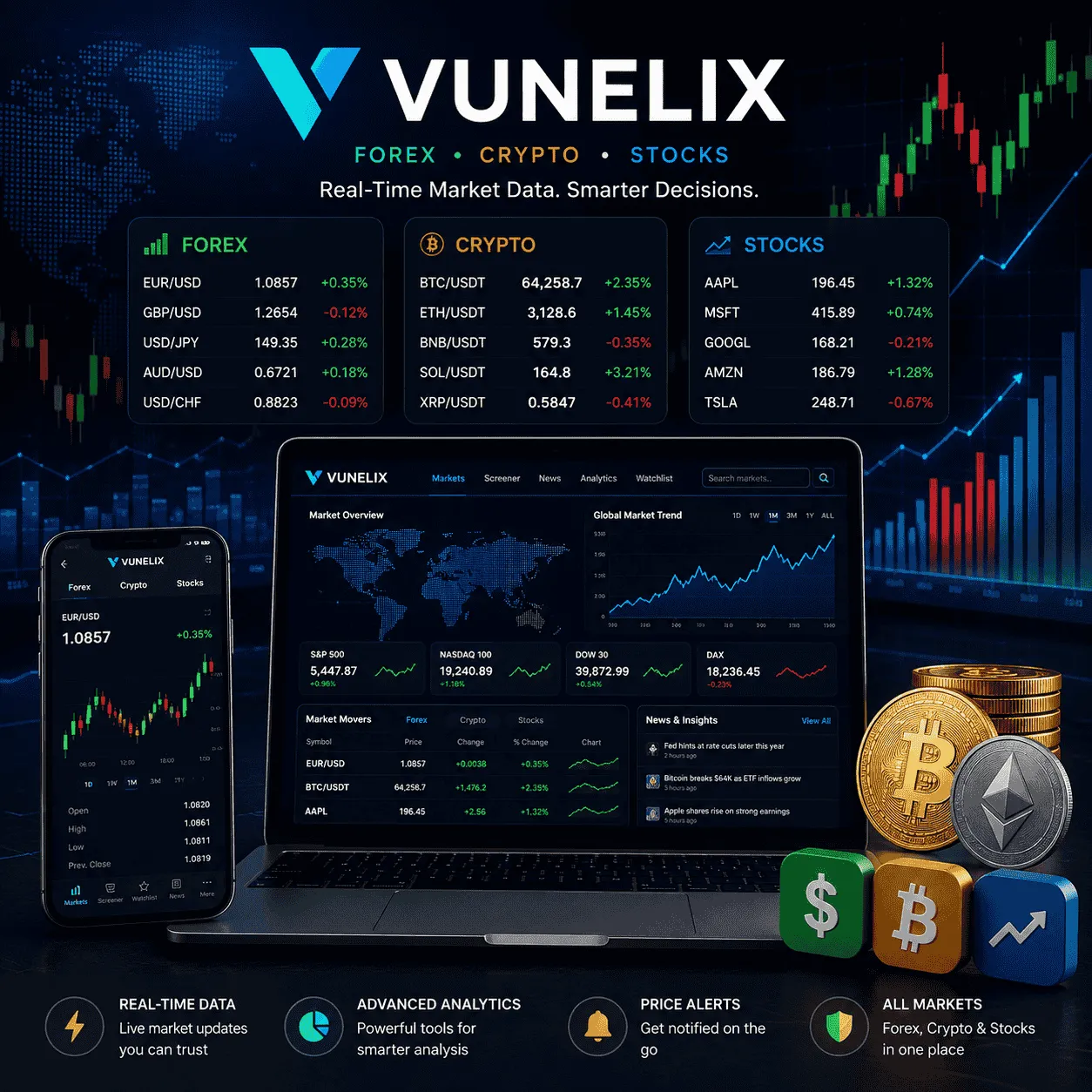
Making good investment decisions can be difficult when financial markets provide thousands of stocks, currencies, and other assets to choose from. Investors need to look at many factors, including price, market trends, company performance, trading volume, and valuation. Checking all of this information manually can take a lot of time.
A Stock Screening Tool can make this process easier. Instead of reviewing hundreds or thousands of stocks one by one, investors can use specific criteria to quickly find assets that match their investment strategy. This helps reduce the amount of time spent searching and allows investors to focus more on research and decision-making.
Platforms such as Vunelix.com provide financial market information, charts, news, and analysis across stocks, forex, cryptocurrencies, commodities, ETFs, and indices. These resources can help investors understand market movements and make more informed decisions.
What Is a Stock Screening Tool?
A stock screening tool is a financial research tool that helps investors filter stocks according to specific conditions. Rather than looking at every company listed on a stock exchange, an investor can enter certain requirements and receive a smaller list of potentially relevant stocks.
How Stock Screening Works
A stock screener can use different types of information to filter stocks. For example, an investor may want to find companies with a specific market capitalization, price-to-earnings ratio, dividend yield, or recent price performance.
An investor could create a screen such as:
- Stocks with a market capitalization above a certain level
- Price-to-earnings ratio below a selected value
- Positive earnings growth
- Strong trading volume
- Dividend yield above a chosen percentage
The tool then filters the available stocks based on those conditions.
Why Filtering Matters
Without filtering, investors may have too much information to analyze. A long list of stocks can make research confusing and time-consuming.
Filtering helps create a more manageable list. This does not automatically identify the best investment, but it can help investors find companies that deserve further research.
How a Stock Screening Tool Can Improve Investment Decisions
A screening tool can support investors at several stages of the research process. It can help with discovering opportunities, comparing companies, and organizing research.
Saves Time During Market Research
Time is one of the biggest advantages of using a stock screening tool. Investors do not have to manually check the same financial metrics for hundreds of companies.
For example, someone looking for undervalued companies could apply valuation-related filters. Instead of opening individual company pages repeatedly, the investor can begin with a smaller group of stocks that meet the selected conditions.
This allows more time for deeper research into financial statements, company news, industry conditions, and other important factors.
Helps Investors Follow a Strategy
Every investor may have a different approach. Some focus on growth companies, while others prefer dividend-paying businesses or companies with lower valuations.
A screening tool allows investors to create filters that match their preferred strategy.
For example, a growth-focused investor might look for companies with strong revenue and earnings growth. A value investor might focus more on valuation ratios and financial strength.
The important point is that the screening process can be based on a defined strategy rather than random stock selection.
Reduces Emotional Decisions
Emotions can influence investment decisions. Investors may become interested in a stock because it is trending on social media or because its price has recently increased sharply.
A screening process can introduce more structure into research. By deciding on criteria before looking at individual stocks, investors can focus on measurable information instead of simply following market excitement.
However, screening does not completely remove emotions from investing. Investors still need discipline when deciding whether to buy, hold, or sell an asset.
Important Factors to Consider When Screening Stocks
A useful stock screening process usually considers several types of information rather than relying on one metric.
Valuation Metrics
Valuation ratios can help investors understand how a company is priced compared with its earnings, sales, or other financial measures.
Common examples include the price-to-earnings ratio, price-to-sales ratio, and price-to-book ratio.
These numbers can be useful for comparing companies, but they should not be considered in isolation. A low valuation does not always mean that a stock is a good investment.
Growth and Financial Performance
Investors can also look at revenue growth, earnings growth, profit margins, and other measures of business performance.
A company showing consistent growth may attract investors who are looking for long-term expansion opportunities. However, high growth can also come with higher risk, so investors should investigate the reasons behind the growth.
Trading Volume
Trading volume shows how actively a stock is being bought and sold. Higher volume can sometimes provide useful information about market interest and liquidity.
Investors can use volume filters to identify stocks that have sufficient market activity for their strategy.
Price Trends
Technical information can also be part of the screening process. Investors may look at price changes, moving averages, momentum, or other technical indicators.
For example, a trader may search for stocks trading above a particular moving average. A long-term investor may use price information differently when evaluating an entry point.
Using a Forex Screener Alongside Stock Research
Investors who follow multiple financial markets may also benefit from a forex screener. While a stock screening tool focuses on companies and stocks, a forex screener can help traders analyze currency pairs based on selected conditions.
What Is a Forex Screener?
A forex screener is designed to help traders filter currency pairs according to market conditions. Depending on the platform, users may be able to analyze factors such as price movement, percentage changes, volatility, volume-related data, or technical indicators.
For example, a trader might want to identify currency pairs that are showing strong price momentum or unusual movement.
Why Forex Screening Can Be Useful
The forex market contains many currency pairs that can move at different times. Monitoring every pair manually can be difficult.
A forex screener can narrow the market down to pairs that meet specific conditions. This can help traders spend more time studying potential setups instead of searching through charts randomly.
It is important to remember that screening tools are research aids. They do not guarantee that a currency pair or trade will move in the expected direction.
Combining Screening With Fundamental and Technical Analysis
A screening tool should normally be the beginning of research rather than the final step.
Use Fundamental Research
After finding stocks that match your filters, investigate the companies more carefully. Look at financial performance, business models, competitive advantages, industry conditions, management, and recent company developments.
A company can meet several screening criteria while still facing significant business risks.
Use Technical Analysis
Charts can provide another perspective. Investors and traders may study price trends, support and resistance levels, moving averages, momentum, and other indicators.
Combining screening with chart analysis can help create a more complete research process.
Follow Market News
Market conditions can change quickly because of economic announcements, interest-rate decisions, geopolitical events, company earnings, and other developments.
This is why market data and financial news should also be part of the decision-making process. Vunelix.com provides market information, charts, news, and economic updates that can help users stay aware of changing financial conditions.
Common Mistakes to Avoid When Using Screening Tools
Although screeners can be useful, they should not replace proper research.
Using Too Many Filters
Adding too many conditions can produce a very small list or even no results. Start with a few important criteria and adjust them as needed.
Depending on One Metric
A single ratio rarely tells the complete story. A low P/E ratio, for example, does not automatically make a company attractive.
Investors should consider multiple factors before making a decision.
Treating Screening Results as Buy Signals
A screening tool identifies assets that match selected conditions. It does not predict the future with certainty.
Every result should be treated as an opportunity for further research rather than an automatic buy or sell recommendation.
How to Build a Better Screening Process
A simple process can make screening more effective.
Define Your Investment Goal
First, decide what you are looking for. Your goal could be long-term growth, dividend income, value opportunities, or short-term trading setups.
Select Relevant Criteria
Choose metrics that support your strategy. Avoid adding conditions simply because they are available.
Review the Results
Once the screener provides results, study each potential investment more carefully. Compare companies and investigate their financial and market conditions.
Monitor Changes
Markets change continuously. A stock that meets your conditions today may not meet them next month. Regular monitoring can help investors keep their research up to date.
Final Thoughts
A Stock Screening Tool can make investment research faster, more organized, and more focused. By filtering stocks according to valuation, growth, trading activity, price trends, and other criteria, investors can reduce a large market into a more manageable list of potential opportunities.
At the same time, screening should not be treated as a replacement for proper analysis. Investors should combine screening results with fundamental research, technical analysis, market news, and risk management before making financial decisions.
Related Reading
Top 10 Hidden Secrets About Business & Finance You Need to Know
Welcome to our in-depth exploration of Business & Finance. In an era defined...
Why Business & Finance is Transforming the Global Industry Landscape
Welcome to our in-depth exploration of Business & Finance. In an era defined...