Hospital ERP Software Integration: Connecting ERP with EHR and Other Systems
31 Views
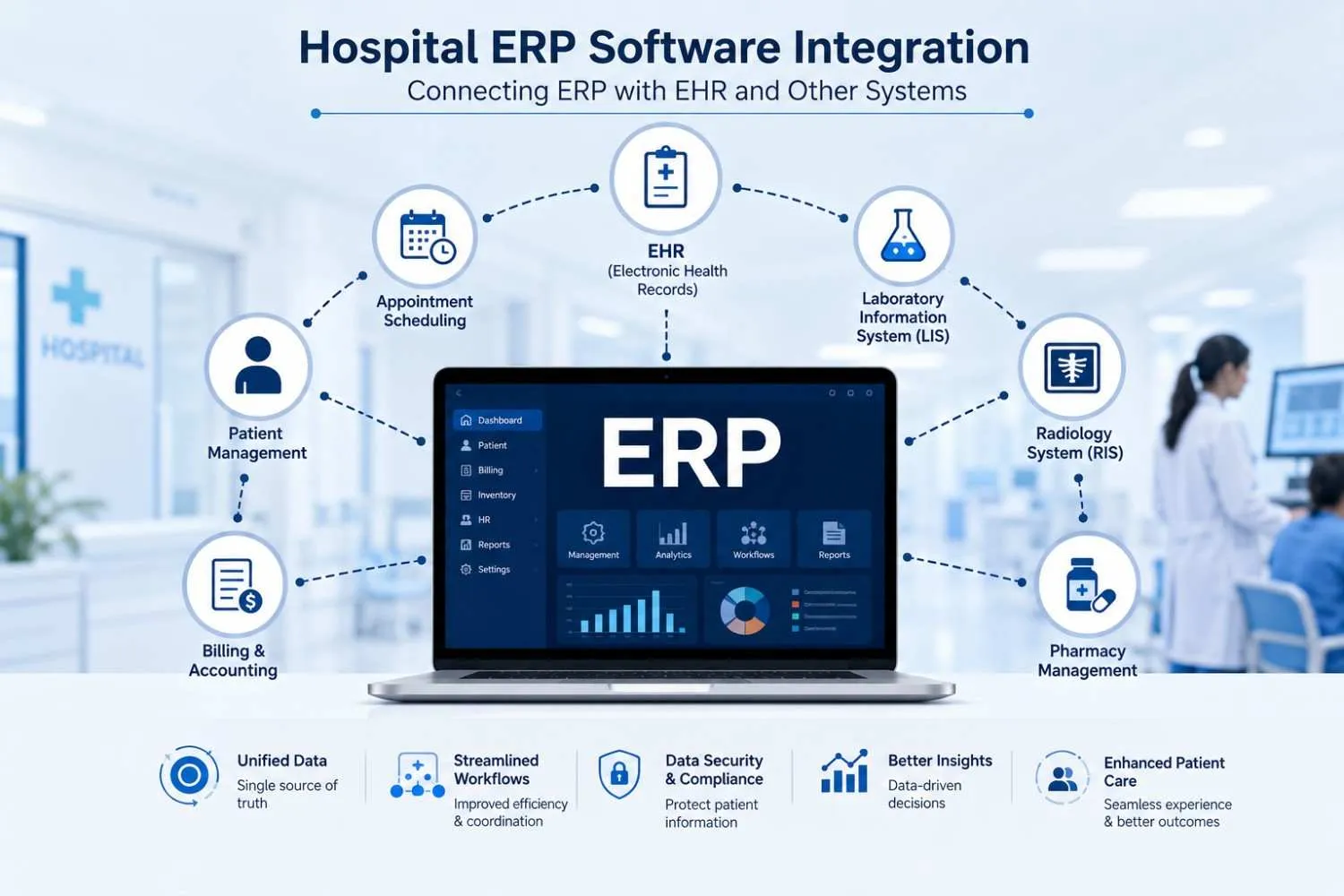
A hospital's finance team closes the books on supply spend while the pharmacy is out of a critical drug because nobody flagged the reorder point. A nurse manager pulls staffing numbers from one system and payroll pulls different numbers from another. Both are technically "right," because neither system is talking to the other.
This is the everyday reality in hospitals running an Enterprise Resource Planning (ERP) system for finance, HR, procurement, and supply chain, alongside an Electronic Health Record (EHR) system for clinical care — with little or no data flowing between them. The fix isn't buying more software. It's integrating the software already in place.
This guide covers what hospital ERP-EHR integration actually involves, the technical standards that make it possible, realistic challenges, and how to approach it without turning it into a multi-year IT project that never ships.
Quick Answer
Hospital ERP integration connects financial, HR, and supply chain systems with the EHR and other clinical or operational platforms so data — patient volumes, supply usage, staffing, billing codes, asset status — moves automatically instead of being re-entered by hand. It's typically done through HL7 or FHIR interfaces for clinical data, APIs for modern cloud systems, and middleware or an integration engine to manage the connections. Done well, it reduces duplicate data entry, closes the gap between clinical activity and financial reporting, and gives administrators a single accurate view of hospital operations.
What Hospital ERP Software Actually Manages
Before getting into integration, it helps to be clear about what sits on each side of the connection.
A hospital ERP typically handles:
- Finance and general ledger
- Procurement and vendor management
- Inventory and supply chain (including medical and surgical supplies)
- Human resources, payroll, and workforce scheduling
- Fixed asset and equipment management
- Budgeting and financial reporting
The EHR, by contrast, is built around the patient record: clinical documentation, orders, medication administration, lab and imaging results, and care coordination. Alongside these two core systems, most hospitals also run separate platforms for billing/revenue cycle, pharmacy inventory, laboratory information (LIS), radiology (RIS/PACS), and biomedical equipment tracking.
Historically, these systems were built and sold as separate products by separate vendors, often for separate departments that never had to coordinate on data models. Integration is the work of making them behave like one coherent system instead of a collection of silos.
Why Integrate ERP with EHR and Other Systems?
The Core Problem: Disconnected Data
When a patient is admitted, the EHR knows immediately. The ERP's finance and supply chain modules often don't find out until someone manually enters that information hours or days later — sometimes through spreadsheets passed between departments. Every manual handoff is a point where data can be delayed, mistyped, or lost.
What Integration Actually Solves
Supply chain accuracy. When a nurse documents that a supply item was used in the EHR (through a barcode scan during a procedure, for example), that consumption event can automatically decrement inventory in the ERP and trigger reordering, instead of relying on periodic manual counts.
Cleaner revenue cycle data. Charges generated from clinical documentation and orders can flow into the ERP's billing and finance modules with the correct codes attached at the source, reducing the rework that happens when billing staff have to reconcile clinical records against financial claims after the fact.
Workforce and scheduling alignment. Patient census and acuity data from the EHR can inform staffing and scheduling decisions managed in the ERP's HR module, instead of staffing being planned from stale or estimated numbers.
Asset and equipment visibility. Biomedical equipment tracked for maintenance and compliance in the ERP can be cross-referenced with usage data from clinical systems, which matters for both cost control and regulatory recordkeeping.
A single source of truth for leadership. Hospital executives making decisions about capacity, spend, or staffing shouldn't have to reconcile numbers pulled from three different systems that don't agree with each other.
None of this requires replacing the EHR or the ERP. It requires building reliable connections between them.
The Standards That Make Integration Possible
HL7v2
HL7 Version 2 has been the dominant messaging standard in healthcare IT for decades. It defines message formats for events like admissions, discharges, transfers (ADT messages), orders, and results. Most EHRs and many ERP-adjacent systems (like lab and pharmacy platforms) can send and receive HL7v2 messages, which is why it remains the backbone of a lot of hospital integration work even though the standard itself is old and, by modern API standards, awkward to work with.
FHIR (Fast Healthcare Interoperability Resources)
FHIR is the newer standard, built around REST APIs and structured resources (Patient, Encounter, Observation, and so on) rather than flat messages. It's designed to be easier for modern software — including ERP platforms with API capabilities — to consume directly. Regulatory pressure in the U.S., including requirements tied to the ONC Cures Act Final Rule, has pushed EHR vendors to expose FHIR-based APIs, which is gradually making this the more common integration path for new projects.
APIs and Web Services
Modern cloud-based ERP systems generally expose REST or SOAP APIs of their own, separate from healthcare-specific standards. Integration work often means bridging a healthcare standard like HL7 or FHIR on the clinical side with a general-purpose API on the ERP side.
Integration Engines and Middleware
Rather than building a direct, custom connection between every pair of systems, most hospitals route data through an integration engine (sometimes called a health information exchange engine or interface engine). This sits in the middle, translates message formats, applies business rules, and routes data to the right destination. It's the difference between wiring every device in a building directly to every other device versus routing everything through a switchboard — one point of control instead of a tangle of point-to-point connections.
Integration Approaches Compared
ApproachBest suited forStrengthsTrade-offsPoint-to-point (direct interface)A single, stable connection between two systemsSimple to build initially, low upfront costBecomes unmanageable as more systems are added; fragile to changes on either endIntegration engine / middlewareHospitals with multiple systems needing to exchange dataCentralized control, easier to monitor and maintain, scales as systems are addedHigher upfront investment; requires dedicated technical ownershipNative vendor connectorsERP and EHR from vendors with pre-built integrationsFaster deployment, vendor-supportedLimited flexibility; locks you into what the vendor has chosen to supportAPI-first / FHIR-based integrationModern cloud systems on both sidesReal-time data exchange, easier long-term maintenanceDepends on both systems having mature API support, which isn't universal yet
Most hospitals of any size end up using a mix of these rather than a single approach across every system.
Common Challenges in ERP-EHR Integration
Data model mismatches. An EHR's concept of a "patient encounter" and an ERP's concept of a "billable event" don't map cleanly onto each other. Someone has to define how these concepts translate, and that mapping work is often underestimated.
Legacy systems. Many hospitals run ERP or ancillary systems that were implemented years ago and were never designed with modern integration in mind. Getting data out of them sometimes still means working with older HL7v2 interfaces or, in the worst cases, flat file exports.
Data governance and ownership. When the same piece of information (a patient's insurance status, for example) can be edited in more than one system, someone needs to decide which system is authoritative and how conflicts get resolved.
Compliance and security. Any interface touching patient data has to account for HIPAA requirements around access controls, audit logging, and data transmission security. Integration expands the number of places PHI can be exposed, so it also expands the surface area that has to be secured and audited.
Testing across departments. A change to how supply usage data flows into the ERP doesn't just need IT sign-off — it needs validation from clinical staff, supply chain managers, and finance, because each will notice different problems.
Vendor cooperation. Not every EHR or ERP vendor is equally willing to expose the interfaces or documentation needed for a smooth integration. This is worth checking before selecting new systems, not after.
Best Practices for a Successful Integration Project
- Map the data flows before writing any code. Identify exactly which data needs to move, in which direction, how often, and who owns each field. This step gets skipped more often than it should, and it's usually where projects run into trouble later.
- Start with the highest-impact connection, not the easiest one. Supply chain-to-EHR consumption tracking or charge capture-to-billing are usually where the biggest operational pain is, even if they're not the simplest interfaces to build.
- Use an integration engine rather than building direct interfaces for every pair of systems, unless the hospital only has two systems that will ever need to talk to each other.
- Favor FHIR-based or API-first connections for new work where both systems support it, since it's generally easier to maintain over time than HL7v2 message-based interfaces.
- Involve compliance and security teams from the start, not as a review step at the end. Retrofitting audit logging or access controls after an interface is built is more expensive than designing them in.
- Pilot with one department or one data flow before rolling out hospital-wide. A limited pilot surfaces data quality and workflow issues while the blast radius of a mistake is still small.
- Plan for ongoing maintenance, not just initial deployment. Interfaces break when either system is upgraded. Someone needs to own monitoring and fixing these connections long after the initial project is marked complete.
Who Should Prioritize This Kind of Integration?
Hospitals running separate best-of-breed systems for finance, supply chain, and clinical care — rather than a single unified platform from one vendor — tend to see the most benefit from ERP-EHR integration, simply because they have the most manual reconciliation happening today. Hospitals evaluating a new ERP or EHR should also treat integration capability (documented APIs, FHIR support, a track record of successful interfaces with the other system in question) as a selection criterion, not an afterthought to be solved post-implementation.
Conclusion
Hospital ERP-EHR integration isn't about chasing a technology trend — it's about closing the gap between what's happening clinically and what shows up in financial, supply chain, and staffing systems. The technical building blocks (HL7, FHIR, APIs, integration engines) are well established. The harder work is mapping data correctly, securing it properly, and maintaining the connections over time.
For hospitals running a mix of legacy and modern systems, or ones whose vendor-supplied connectors don't cover every workflow they need, an off-the-shelf integration often can't handle the specific data mappings and compliance requirements involved. That's usually the point where it makes sense to bring in a custom ERP software development company — one that can build interfaces tailored to the hospital's actual systems and data governance rules, rather than forcing operations to conform to a generic template. Hospitals that treat integration as an ongoing operational discipline, rather than a one-time project, are the ones that actually see the reduction in manual work and reporting errors that integration is supposed to deliver.
Frequently Asked Questions
What is the difference between HL7 and FHIR?
HL7v2 is an older messaging standard that sends discrete, event-based messages (like an admission or a lab result) in a format that predates modern web APIs. FHIR is a newer standard built on REST APIs and structured data resources, designed to be easier for contemporary software to work with. Many hospitals run both simultaneously, since older systems may only support HL7v2 while newer ones support FHIR.
How long does a hospital ERP-EHR integration project typically take?
This varies significantly based on the number of systems involved, whether an integration engine is already in place, and how much data mapping and cleanup is required. Point solutions connecting two specific systems can take weeks to a few months; broader integration programs spanning finance, supply chain, HR, and multiple clinical systems are typically measured in months rather than weeks, and often proceed in phases rather than as a single project.
Does integrating ERP and EHR create HIPAA compliance risk?
It creates additional surface area that needs to be secured properly — more systems touching PHI means more points requiring access controls, encryption, and audit logging. It doesn't inherently create more risk if the interfaces are designed with those safeguards from the start. The risk comes from skipping that design work, not from integration itself.
Can smaller hospitals or clinics do this without a large IT team?
Yes, though the approach usually looks different. Smaller organizations more often rely on native connectors provided by their EHR or ERP vendor, or work with a third-party integration specialist, rather than building and maintaining a custom integration engine in-house.
Is it better to buy an ERP and EHR from the same vendor to avoid integration work?
It can reduce integration effort, since single-vendor suites are usually pre-integrated. The trade-off is less flexibility to choose the best system for each function, and potential vendor lock-in. Whether that trade-off is worth it depends on how satisfied the hospital is with each module of a combined suite versus picking specialized systems for each function.