Hire Professional Laravel Developers for Long-Term Engagement
By ACSIUS Tech
70 Views
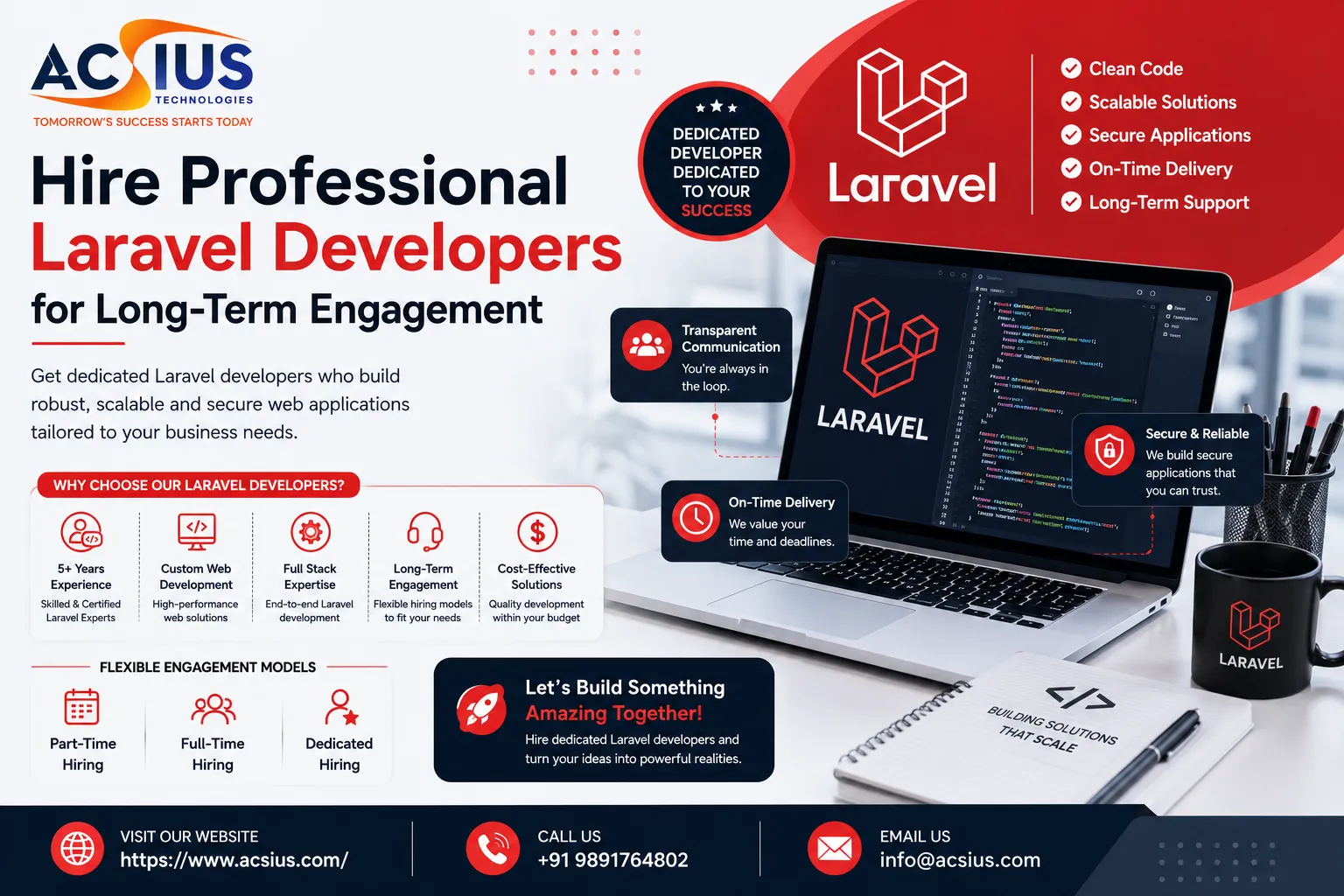
There's a specific kind of stress that comes with realizing your development project has outgrown what your current team can handle. Maybe a freelancer disappeared halfway through a build. Maybe an in-house generalist is now maintaining a backend they never really specialized in. Or maybe you're starting fresh and don't want to gamble six months of runway on the wrong hire. Whatever the situation, the search usually starts the same way — typing laravel developer hire into Google at 11 p.m., hoping the next result is more reliable than the last one.
We've had enough conversations with founders and CTOs at ACSIUS to know this search rarely comes from a place of casual curiosity. It comes from a real, sometimes urgent, need to get a backend built or fixed by someone who actually knows what they're doing. This guide is written for that person — someone trying to figure out what a proper Laravel developer hire actually looks like, how it differs from hiring for other platforms like Shopify, and how to avoid the mistakes that waste time and budget.
Why Laravel Remains a Go-To Framework for Custom Development
Laravel has held its position as one of the most trusted PHP frameworks for a reason that goes beyond popularity. It offers a clean, expressive syntax that makes complex applications easier to build and maintain, a strong built-in security layer, and an ecosystem — Eloquent ORM, Artisan CLI, Laravel Forge, and others — that speeds up development without sacrificing structure.
For businesses building custom web applications, SaaS platforms, internal tools, or anything that needs more flexibility than an off-the-shelf platform can offer, Laravel tends to be the framework development teams reach for. It's not the flashiest choice, but it's a dependable one — which matters enormously when you're trusting a piece of software to run core parts of your business.
How the Search for Developers Has Changed on Google
Something worth pausing on — the way businesses search for developer hiring has shifted quite a bit in the last couple of years, and it's changed what actually shows up as a useful answer.
A few years ago, someone searching "laravel developer hire" was often comparing broad freelance marketplaces or generic agency listings, mostly filtering by price. Today, that same search tends to come from someone who's already been burned once — by a freelancer who vanished, an agency that outsourced the work without saying so, or a hire who looked great on paper but couldn't actually ship working code. As a result, searchers are now looking past surface-level listings toward more specific signals: portfolios with real, verifiable projects, transparent hiring or engagement models, and reviews that speak to communication and reliability, not just technical skill.
Google has adjusted its results accordingly too, increasingly surfacing pages that demonstrate real expertise and experience rather than generic service descriptions. This is exactly why a company like ACSIUS focuses on showing actual process and outcomes when it comes to laravel developer hire inquiries, rather than just listing "we build Laravel apps" and hoping that's enough. Searchers today are more skeptical, more specific, and frankly, more deserving of that skepticism given how much has gone wrong for many of them before.
What to Actually Look for When You Hire a Laravel Developer
Not all Laravel experience is equal, and a resume listing the framework doesn't guarantee someone can build production-ready applications. A few things worth checking carefully:
Real project history, not just tutorials. There's a meaningful difference between someone who's followed Laravel courses and someone who's shipped and maintained applications handling real users, real data, and real edge cases.
Understanding of the broader ecosystem. A strong Laravel developer should be comfortable with related tools — queues, caching, API development, testing frameworks like PHPUnit, and deployment practices — not just the core framework syntax.
Communication and process, not just code. Technical skill matters, but so does someone's ability to explain trade-offs, flag risks early, and keep a project on track without constant hand-holding.
Security awareness. Laravel provides strong security defaults, but a developer still needs to understand how to use them correctly — input validation, authentication handling, and safe database queries shouldn't be an afterthought.
Testing discipline. Developers who write and maintain tests tend to produce more stable applications over time, even if it means slightly longer initial development.
Common Mistakes Businesses Make During a Laravel Developer Hire
We've seen a fairly consistent set of mistakes trip up otherwise well-intentioned hiring decisions:
- Hiring purely on hourly rate, without accounting for the cost of rework when the initial build is poorly structured
- Skipping a technical interview or code review, relying entirely on a portfolio or resume
- Not clarifying ownership of code and documentation upfront, leading to messy handovers later
- Assuming all "full-stack" developers are equally strong in Laravel specifically, when many have surface-level familiarity rather than deep expertise
- Failing to define project scope clearly, which leads to scope creep and budget overruns down the line
Avoiding these issues usually comes down to slowing down slightly at the hiring stage, even when there's pressure to move fast.
Laravel Developer Hire vs. Hiring Shopify Developers: Knowing the Difference
This is a distinction that trips up a surprising number of businesses, especially those without a technical background making the hiring decision. Laravel and Shopify solve fundamentally different problems, and hiring the wrong specialist for your actual need can cost significant time and money.
Laravel is a PHP framework used to build custom applications from the ground up — think internal dashboards, SaaS products, marketplaces, booking systems, or anything requiring bespoke logic that off-the-shelf platforms simply can't accommodate. If your business needs something built specifically around your workflow, a Laravel developer is generally the right call.
Shopify, on the other hand, is a purpose-built e-commerce platform. When businesses look to hire Shopify developers, it's typically because they need a fully functioning online store — product catalogs, checkout flows, payment integrations, and theme customizations — without building the underlying commerce infrastructure from scratch. Shopify developers work within (and around) the platform's existing framework, customizing themes, building apps, and integrating third-party tools, rather than architecting an application from the ground up.
Here's a simple way to think about it: if you're building a store to sell products, hiring Shopify developers is usually faster, more cost-effective, and better supported long-term. If you're building something more custom — a platform, tool, or application with unique business logic — a Laravel developer hire is the more appropriate route. Some businesses actually need both, particularly if they're running a Shopify storefront alongside custom internal tools or integrations built separately.
How ACSIUS Approaches Developer Hiring and Engagement
At ACSIUS, we've structured our hiring and project engagement process around avoiding exactly the mistakes outlined above.
We vet for real-world experience, not just syntax knowledge. Every developer we bring onto a project — whether Laravel or Shopify — is evaluated on actual shipped work, not just familiarity with documentation.
We match developers to project type, not just platform. A Laravel developer working on a SaaS product needs different strengths than one maintaining an internal admin tool. We take time to understand what a project actually requires before assigning talent.
We keep communication transparent throughout. Clients working with us know exactly who's working on their project, what's been completed, and what's coming next — no black-box outsourcing, no disappearing after the contract is signed.
We build with maintainability in mind. Code that works today but becomes unmanageable in six months isn't a real solution. Our developers are expected to write clean, documented, testable code, whether it's a Laravel backend or a Shopify storefront customization.
We support beyond initial delivery. Development doesn't end at launch. We remain available for fixes, updates, and scaling support as a business's needs evolve.
Questions to Ask Before You Hire
Whether you're looking to bring on a Laravel developer or looking to hire Shopify developers, a few honest questions tend to reveal a lot before you commit:
- Can you show me examples of similar projects you've completed, and can I speak to a past client?
- What does your development and testing process actually look like?
- Who retains ownership of the code and documentation once the project is complete?
- How do you handle communication during the project — regular updates, direct access, or filtered through account managers?
- What happens if something breaks after launch — is support included, or a separate cost?
A trustworthy development partner should answer these clearly, without hedging or vague reassurances. Hesitation on ownership or support questions, in particular, is often a red flag worth taking seriously.
What a Well-Executed Hire Actually Delivers
It's worth being direct about what a good hiring decision actually returns. When the right Laravel developer is brought onto a project, businesses typically see fewer bugs reaching production, faster iteration on new features, and an application architecture that can scale without requiring a painful rebuild eighteen months later. Similarly, when businesses hire Shopify developers who genuinely understand the platform's nuances, stores tend to convert better, load faster, and require far less firefighting after major sales periods or traffic spikes.
The inverse is also true — a poor hire, even at a lower upfront cost, often ends up more expensive once rework, delays, and missed opportunities are factored in. This is really the core argument for taking the hiring process seriously rather than optimizing purely for speed or the lowest quote.
Final Thoughts
Hiring a developer — whether for a custom Laravel application or a Shopify storefront — isn't just a technical decision, it's a business decision with real downstream consequences. The right hire quietly becomes a long-term asset, someone who understands your codebase, anticipates issues before they become expensive, and helps your product or store grow without constant firefighting. The wrong hire, even a well-meaning one, can cost far more in delays and rework than it initially seemed to save.
At ACSIUS, we've built our process around getting this right the first time — whether a business comes to us for a laravel developer hire to build something entirely custom, or looking to hire Shopify developers to launch or improve an online store. If you're currently weighing that decision, it's worth taking the time to ask the right questions before signing anything. The clarity you get from that process alone often tells you most of what you need to know.