HEPA vs CBRN Filters in Modern NBC Bunkers
By Sigma Power Tech
2 Views
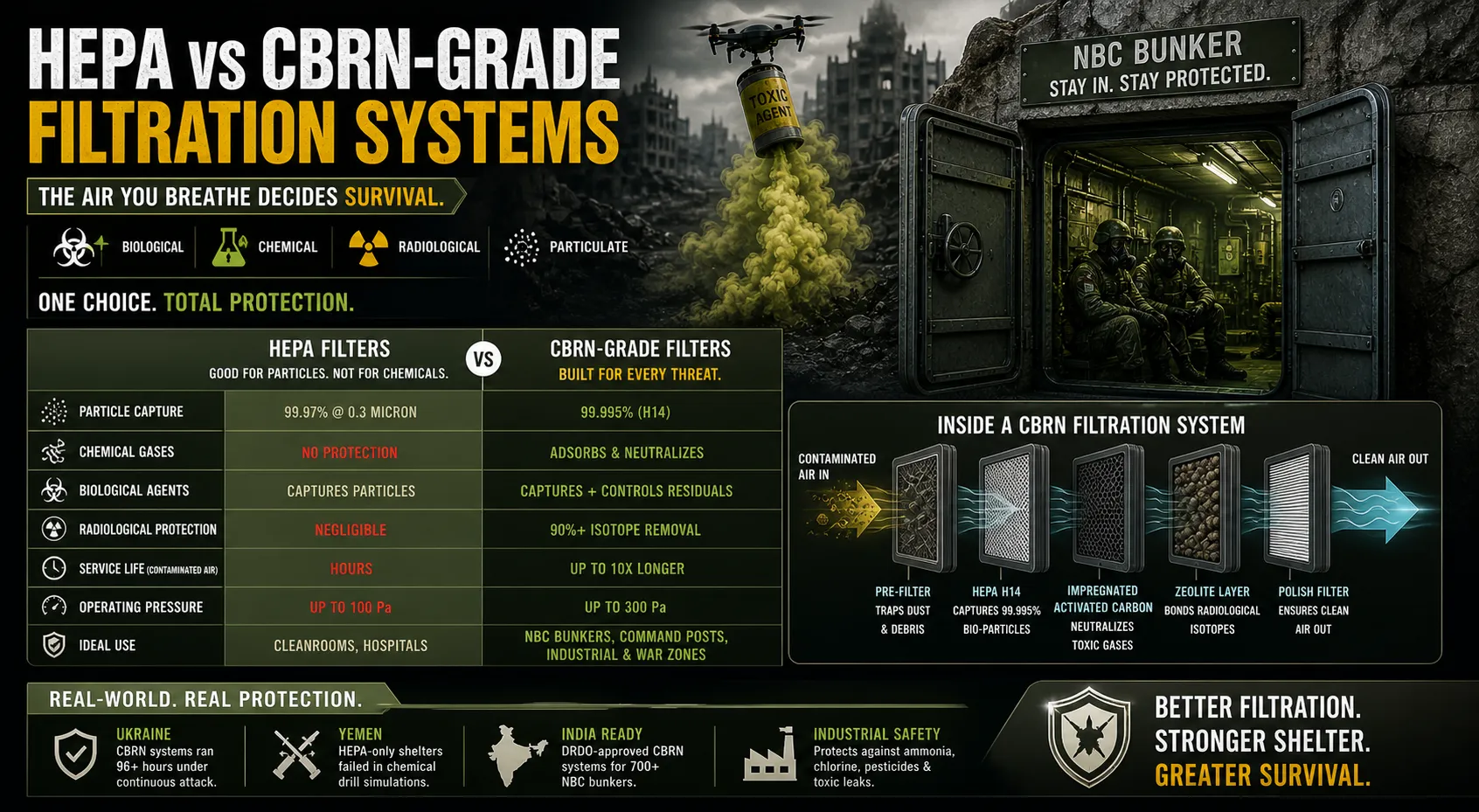
Nerve gas clouds a contested urban zone, herding survivors into an NBC bunker where recycled air turns deadly without proper filtration. Enter the NBC filtration system, pitting everyday HEPA against battle-hardened CBRN-grade NBC filters. Contractors and engineers debate endlessly: Does basic particle trapping suffice, or do gaseous toxics demand specialized layers? Amid drone-delivered threats in Ukraine, Yemen, and emerging Indo-Pacific flashpoints, this detailed breakdown uncovers specs, real-world tests, and decision drivers for NBC shelters.
Why Bunker Filtration Choices Are Make-or-Break Today
Airborne hazards redefine survival. Chem agents like sarin vaporize on impact, bio-spores embed deeply, radiological fallout persists weeks. NBC air filtration systems must sustain sealed habitats through prolonged assaults.
Urgent drivers:
- Proxy wars overwhelm civilian vents hourly.
- Industrial threats—ammonia leaks, pesticide drifts—echo CBRN signatures.
- Hybrid evolution: Pandemics plus sabotage strain single-purpose gear.
Recent 2025 multinational trials laid bare the divide: HEPA saw 70% agent breakthrough, CBRN just 2%. For government contractors, specs dictate bid wins, regulatory nods, operational uptime. Wrong choice risks everything from personnel to project viability in CBRN shelters.
HEPA Filters: Capable but Narrow in Scope
HEPA (High-Efficiency Particulate Air) dominates particulates, capturing 99.97% of 0.3-micron particles via mechanical interception and diffusion.
Core Strengths:
- Cost-effective for dust, allergens, basic viruses.
- Minimal resistance—eases fan loads in small setups.
- Track record in hospitals, cleanrooms worldwide.
Bunker Realities:
- Gases sail through untouched—no molecular adsorption.
- Rapid clogging under heavy spore or fallout bombardment (lifespan drops to hours).
- Lacks rad-binding; isotopes accumulate downstream.
Insight from field: During COVID surges, HEPA retrofits managed viral loads effectively but crumbled in chem-drill cross-tests, highlighting one-dimensional limits.
CBRN-Grade Filters: Engineered for Total Threat Neutralization
CBRN elevates with multi-media stacks: coarse pre-filter, ultra-HEPA (H14), gas-specific activated carbon (impregnated with copper/silver), and optional zeolite for isotopes. NBC filters for bunkers actively destroy or bind, not merely sieve.
Layered Architecture:
- Pre-filter: Shields against macro-debris.
- HEPA H14: 99.995% bio-particle lockdown.
- Impregnated carbon: Neutralizes sarin, mustard (500-1,000 hour capacity).
- Polish filter: Ensures exhaust purity.
Standout Advantages:
- Seamless overpressure integration up to 250 Pa.
- Broad-spectrum: Bio, chem, rad in one unit.
- Resilience: 10x runtime versus HEPA in contaminated flows.
Ukraine frontline logs: CBRN systems powered through 96-hour barrages; HEPA alternatives needed emergency evacuations midway.
Direct Showdown: Metrics and Scenario Tests
Biological Assault: HEPA excels short-term on spores; CBRN prevents viral rebound via residuals control.
Chemical Incursion: HEPA irrelevant; CBRN adsorbs vapors completely.
Radiological Dispersion: HEPA negligible; CBRN zeolites sequester 90%+ cesium.
Overload Mix: CBRN layering prevents cascade failures—HEPA saturates sequentially.
Pressure dynamics: HEPA at 100 Pa max; CBRN thrives at 300 Pa for fortified NBC bunkers.
NBC Filtration Systems in India: Tailored Breakdowns
India accelerates adoption. NBC filtration system India specs favor CBRN hybrids for Ladakh and Arunachal NBC bunkers, with DRDO mandating H14-carbon combos across 700+ installations. Demand climbs 45% after recent exercises, extending to Mumbai refineries and Delhi metro CBRN shelters for dual industrial-CBRN resilience. Bengaluru and Pune fabs produce cost-optimized NBC air filtration systems, trimming import premiums by 25-30% while matching global endurance benchmarks.
Practical Spec, Install, and Sustain Tips
Selection Criteria:
- Particulates only? HEPA saves upfront.
- Full CBRN? Invest $2K-6K extra per module for longevity.
Deployment Steps:
- Align layers intake-to-exhaust precisely.
- DOP-challenge HEPA; vapor-test carbon post-install.
- Tune blowers for uniform distribution.
Avoid Pitfalls:
- Standalone HEPA in gas-prone zones—total exposure.
- Loose seals undermining pressure gradients.
- Humidity neglect—slashes carbon efficacy 50%.
Routine: Quarterly audits double service intervals.
Q1: HEPA sufficient for basic bunker dust control?
Ans. Yes, HEPA handles dust and particles well, but it cannot stop gases. For toxic threats like chemicals, always combine HEPA with activated carbon layers.
Q2: Best CBRN for Indian NBC filtration systems?
Ans. DRDO-spec CBRN filters are ideal for India, designed for heat, humidity, and dust. They combine HEPA and carbon layers for full-spectrum protection.
Q3: Maintenance difference between HEPA and CBRN?
Ans. HEPA filters need frequent checks due to faster clogging. CBRN systems require monthly inspections but last longer due to multi-layer filtration design.
Result
HEPA traps dust; CBRN-grade masters the invisible killers. Demand proven NBC filtration systems for your NBC shelter. Threats accelerate—upgrade decisively.
Related Reading
Top 10 Hidden Secrets About Business & Finance You Need to Know
Welcome to our in-depth exploration of Business & Finance. In an era defined...
Why Business & Finance is Transforming the Global Industry Landscape
Welcome to our in-depth exploration of Business & Finance. In an era defined...