From Injection to Tablet: How Semaglutide Is Evolving Weight Management
18 Views
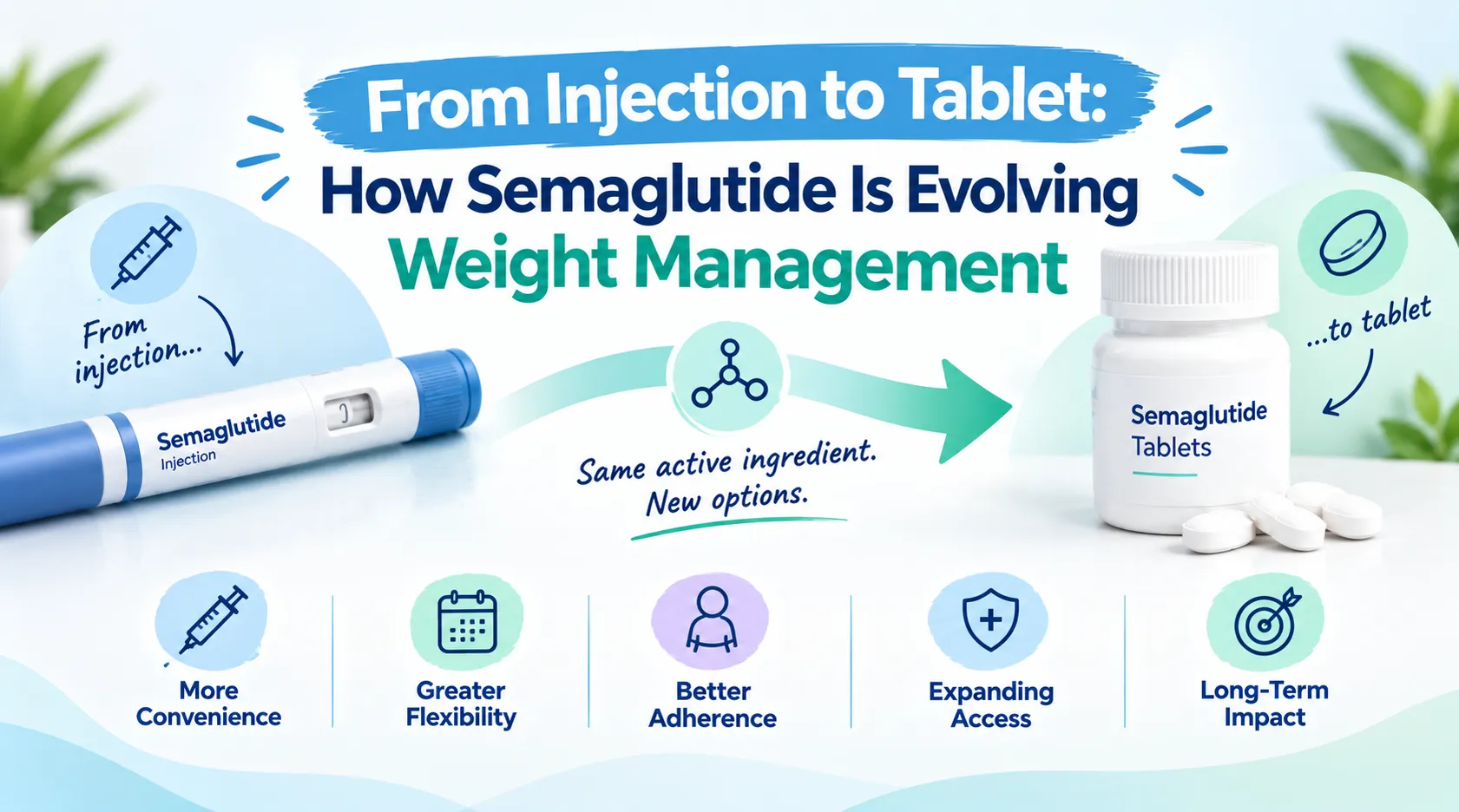
Weight management medicine in the UK has moved faster in the last few years than in the previous two decades combined. Semaglutide, the active ingredient behind Wegovy, has been at the centre of that shift, first as a weekly injection and now, since June 2026, as a once daily tablet.
This is not simply a story about a new delivery format. It is a story about how a single molecule has reshaped what obesity treatment looks like, who is willing to start it, and how clinics deliver ongoing care. This article traces that evolution, from the original injectable pen through to the newly approved oral tablet, and looks at what each stage means for patients today.
Where It Started: Semaglutide as an Injection
Semaglutide first reached UK patients as a once weekly subcutaneous injection, prescribed alongside diet and exercise support for adults living with obesity or significant weight related health conditions. Clinical trials behind the injectable version reported substantial average weight loss over time, and it quickly became one of the most requested treatments in both NHS specialist services and private weight loss clinics.
The injection worked well clinically, but it came with real practical friction for a meaningful share of patients. Weekly self injection required comfort with needles, proper storage in a fridge, safe disposal of sharps, and a routine that some people found difficult to maintain long term, particularly when travelling. None of this reduced how effective the drug was, but it did influence who was willing to start treatment and who stayed on it consistently.
Private providers built structured programmes around these injections precisely because ongoing supervision mattered as much as the prescription itself. Patients considering this route today can look at established Weight Loss Injections UK: Mounjaro & Wegovy programmes that combine the medication with proper clinical monitoring rather than a one off prescription with no follow up.
The Missing Piece: An Oral Version
For a long time, the obvious gap in semaglutide's evolution was an oral option that matched the injection's dosing strength. Rybelsus, an oral form of semaglutide, had already been available in the UK, but only at lower doses licensed for type 2 diabetes rather than weight management. Patients who wanted the benefits of semaglutide without a needle had no equivalent oral route specifically approved for obesity treatment.
The barrier was not desire but chemistry. Semaglutide is a peptide, and peptides are broken down easily in the digestive system before they can enter the bloodstream in meaningful quantities. Getting enough of the drug absorbed through a tablet, rather than injected directly under the skin, needed a genuinely different formulation approach, not just a smaller version of the same product.
The Approval That Changed the Picture
On 11 June 2026, the UK's Medicines and Healthcare products Regulatory Agency approved the Wegovy tablet, the first oral GLP 1 medicine licensed in the UK specifically for weight management. This filled the exact gap described above, giving patients a needle free option carrying the same eligibility criteria as the injectable version, a body mass index of 30 or above, or a BMI between 27 and 30 alongside at least one weight related condition, combined with reduced calorie intake and increased physical activity.
The tablet uses a considerably higher dose than the injection to compensate for how much less efficiently oral semaglutide is absorbed. Dosing increases gradually, starting at 1.5 mg once daily and stepping up to 4 mg, then 9 mg, then a full maintenance dose of 25 mg, with at least a month at each stage before moving higher. Patients already established on the weekly injection have a shortcut available and can transition directly to the 25 mg tablet under clinical supervision, rather than restarting the dose ladder from the beginning.
It is worth repeating clearly that this tablet is not the same product as Rybelsus. Both share the same active ingredient, but Rybelsus remains licensed only for type 2 diabetes at lower doses, while the new Wegovy tablet is licensed specifically for weight management at a higher dose. Prescribers choose between them based on the underlying condition being treated, not simply personal preference for pills over injections.
What Makes the Tablet Work
The oral formulation relies on an absorption enhancing ingredient, the same technology already used in Rybelsus, which helps protect semaglutide from being broken down in the stomach long enough for a portion to be absorbed through the stomach lining. This solution is elegant, but it comes with a strict set of rules around how the tablet must be taken.
The tablet needs to be swallowed on an empty stomach, first thing in the morning, with no more than a small sip of plain water, and at least 30 minutes before eating, drinking anything else, or taking any other oral medication. These instructions are not optional guidance. Any departure from this routine can meaningfully reduce how much active drug reaches the bloodstream, which is exactly why the timing rules here are stricter than for almost any other tablet a patient might be prescribed.
If a dose is missed, patients should not attempt to make up for it by doubling the next day's dose, since this tends to increase gastrointestinal side effects rather than restore any lost benefit. For someone used to a once weekly injection, this daily fasting routine is a real behavioural shift, and one worth discussing honestly with a prescriber before switching.
Comparing the Evidence
The clinical case for the tablet rests on the phase 3 OASIS 4 trial. Adults with obesity taking the full 25 mg tablet lost roughly 14 percent of body weight over 64 weeks, compared with around 2 percent among those on placebo, alongside diet and lifestyle changes applied in both groups.
That gap of roughly 14 percent against 2 percent sits in a similar range to what has already been reported for injectable semaglutide in earlier obesity trials. That consistency matters, because it suggests the shift in delivery method has not meaningfully reduced how well the drug works for most patients, even though the way it reaches the bloodstream is completely different.
What This Evolution Means for Access
Right now, the tablet is available only through private prescription in the UK. It has not yet been appraised by NICE, so it sits outside NHS funding for the time being, and any future NHS access would depend on that appraisal taking place. In practice, this means anyone wanting to start treatment today needs a private clinical consultation rather than an NHS referral pathway.
For patients exploring this option, comparing properly regulated Wegovy Semaglutide Tablets UK programmes is a sensible starting point, since genuine clinical screening matters as much as the medication itself when treatment involves ongoing dose adjustments and monitoring.
Injection or Tablet: How Patients Are Choosing
With both formats now available, the decision has shifted from whether to start semaglutide treatment at all, to which format actually fits a patient's life. Neither option is objectively superior, and the right answer depends on individual circumstances.
The tablet removes needle aversion entirely, needs no refrigeration or sharps disposal, and suits patients who prefer a consistent daily habit over a weekly one. The injection, in turn, needs no fasting window or strict morning routine, which can make it the easier option for people with unpredictable schedules or shift work. Clinics offering both formats are best positioned to walk patients through this trade off properly, rather than defaulting everyone to whichever product happens to be easiest to supply.
Why the Bigger Shift Matters
The evolution from injection to tablet is really about expanding who is willing to engage with obesity treatment in the first place. Needle aversion has always been a genuine, if often unspoken, reason some patients avoided starting semaglutide despite knowing it could help. Removing that barrier, without sacrificing meaningful effectiveness, is likely to bring a wider group of patients into structured treatment over time.
It also signals where the wider market is heading. Semaglutide is not the only GLP 1 medicine in development as an oral option, and this approval is likely to be the first of several oral treatments reaching UK patients over the coming years. For clinics, that raises the standard for what proper obesity care should look like, since a prescription alone, tablet or injection, has never been a complete treatment plan on its own. Sustainable weight loss still depends on medical supervision, dietary guidance, and monitoring for side effects, which is the reasoning behind structured programmes offered through an established weight loss clinic uk rather than an unsupervised online purchase.
Providers such as Weight Medics that offer both the tablet and the injection under proper clinical oversight are well placed to help patients navigate this choice, matching the format to the person rather than the person to whatever happens to be in stock.
What Clinicians Are Watching Next
With both an injection and a tablet now licensed, attention is shifting to how prescribing patterns settle over the next year or two. Early indications suggest most new patients still start on whichever format their clinic is most experienced supporting, while existing injection users are the group most likely to actively ask about switching, largely driven by convenience rather than dissatisfaction with results.
Longer term adherence data will matter more than early enthusiasm. A tablet that patients find easy to start but hard to sustain through a strict fasting routine offers little advantage over an injection that some avoided at first but tolerated well once established. Clinics are likely to track this closely, since the value of either format ultimately depends on whether patients stay on treatment long enough to see meaningful results, not simply on which option looks more convenient on paper.
There is also a cost dimension worth watching. As more oral GLP 1 options move through development and reach the UK market, competition between manufacturers could eventually influence private pricing, though for now both the tablet and the injection remain accessible only through private prescription with broadly similar cost ranges.
Frequently Asked Questions
Is the semaglutide tablet as effective as the injection? Trial data for the tablet shows weight loss results in a similar range to earlier injectable semaglutide trials, roughly 14 percent over 64 weeks on the full dose versus about 2 percent on placebo, suggesting comparable effectiveness for most patients.
Is the tablet the same as Rybelsus? No. Rybelsus is licensed only for type 2 diabetes at lower doses, while the newly approved Wegovy tablet is licensed for weight management at a higher dose. They are not interchangeable.
When did the tablet become available in the UK? The MHRA approved the Wegovy tablet on 11 June 2026, making it the first oral GLP 1 medicine licensed for weight management in the UK.
How should the tablet be taken? On an empty stomach first thing in the morning, with only a small sip of water, at least 30 minutes before any food, drink, or other oral medication.
Is the tablet available on the NHS? Not currently. It is accessible only through private prescription while NICE appraisal is pending.
Can patients switch from injection to tablet? Yes, patients already on the weekly injection can move directly to the full dose tablet under clinical supervision, rather than restarting the dosing schedule from the beginning.
This article is for general information only and does not replace individual medical advice. Anyone considering semaglutide treatment, tablet or injection, should complete a full clinical assessment with a qualified prescriber before starting.