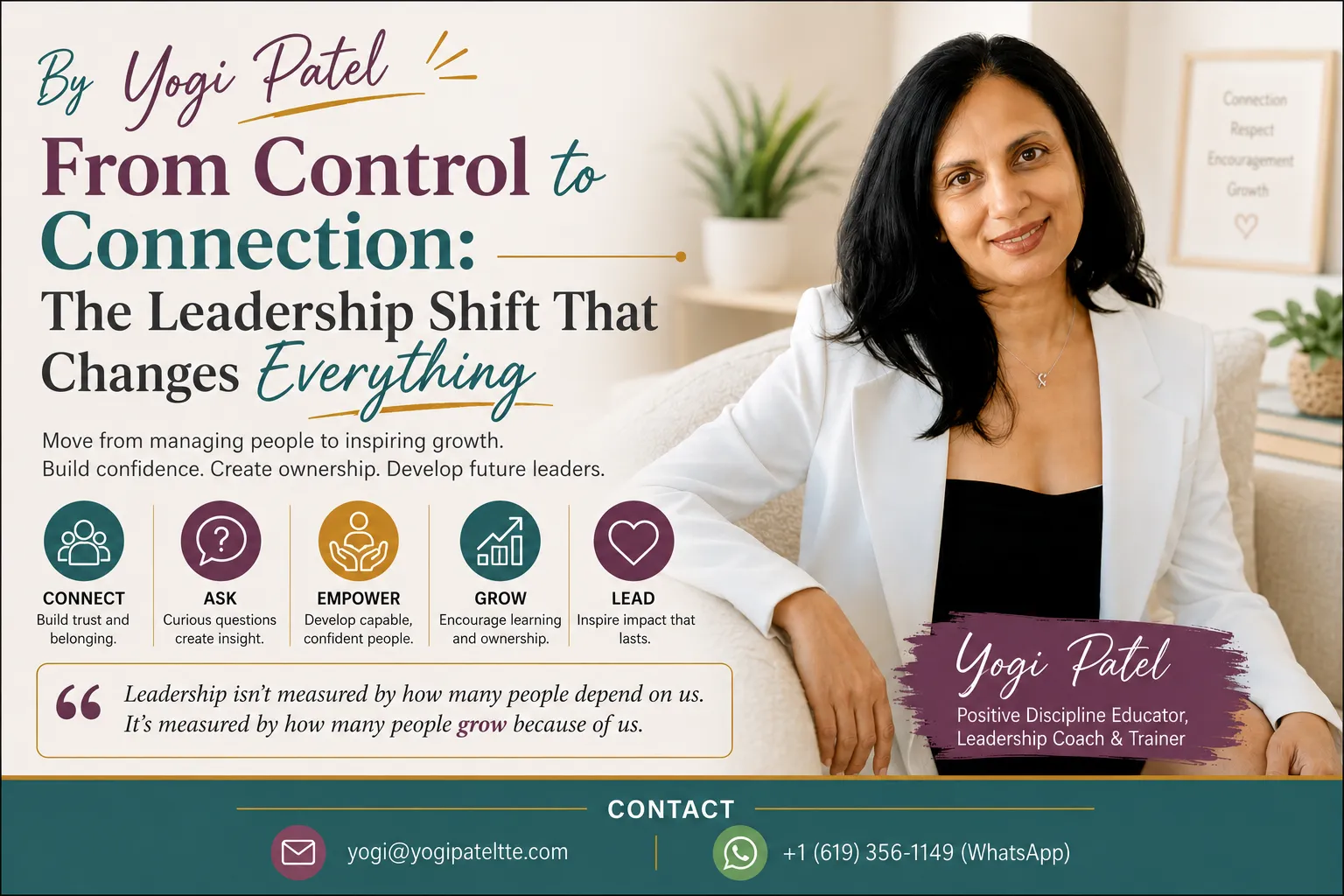
From Control to Connection: The Leadership Shift That Changes Everything
By Yogi Patel
72 Views
By Yogi Patel
When I first stepped into leadership, I believed my role was to have the answers.
If I anticipated every problem, solved every challenge, and stayed involved in every decision, then everything would run smoothly.
At least, that’s what I thought.
Over time, I discovered something important.
The harder I worked to keep everything under control, the more dependent people became on me.
I wasn’t building leaders.
I was becoming the bottleneck.
That realization changed the way I lead, coach, and teach leadership today.
Whether we’re leading a school, a business, a nonprofit, or even a family, our role isn’t to control people.
Our role is to help people grow.
That is the shift from control to connection.
Why Control Feels So Comfortable
Most leaders don’t set out to micromanage.
In fact, control often comes from the very best intentions.
We care deeply about quality.
We want to protect our teams.
We want people to succeed.
Sometimes we’ve built successful careers by being the person who can solve every problem.
The challenge is that when leaders become the answer to every question, everyone else slowly stops looking for answers themselves.
People wait.
They seek permission.
They become hesitant to take initiative.
Eventually, the leader becomes exhausted while the team becomes increasingly dependent.
What began as helping gradually limits everyone else’s growth.
Leadership Is About Developing People
One of the principles of Adlerian Psychology that has shaped my work is the belief that people thrive when they experience belonging, significance, and contribution.
I’ve seen this throughout my career—in schools, businesses, healthcare organizations, and nonprofit teams around the world.
The strongest leaders aren’t those who know the most.
They are the ones who help others discover what they already have within them.
Leadership isn’t about creating followers.
It’s about developing capable, confident people who can think, contribute, and lead alongside us.
That requires a different kind of conversation.
Instead of asking,
“Why wasn’t this done?”
we might ask,
“Help me understand what got in the way.”
Instead of immediately offering solutions, we can ask,
“What ideas have you already considered?”
Simple questions like these communicate trust.
Trust encourages ownership.
Ownership builds confidence.
And confidence develops future leaders.
Connection Doesn’t Mean Lowering Expectations
One of the biggest misconceptions I encounter is that connection means avoiding accountability.
It doesn’t.
Strong leadership is both firm and kind.
We still have difficult conversations.
We still hold people accountable.
We still make decisions that aren’t always easy.
The difference lies in how we lead those conversations.
People grow when they feel respected.
They become more engaged when they feel heard.
They become more willing to take responsibility when they know mistakes will become opportunities for learning rather than reasons for blame.
Accountability and encouragement are not opposites.
Together, they create healthy leadership.
Build a Culture, Not Dependence
Throughout my career, I’ve noticed that exceptional organizations share one common characteristic.
Their leaders invest as much energy in developing people as they do in managing results.
They ask thoughtful questions.
They invite different perspectives.
They encourage problem-solving.
They celebrate learning as much as achievement.
Most importantly, they measure success differently.
Success isn’t determined by how much the leader accomplishes alone.
It’s reflected in how capable the team becomes.
One of the greatest compliments a leader can receive is this:
“We were able to move forward because you taught us how to think, not because you gave us every answer.”
Leadership Begins with Self-Awareness
Leadership always begins with ourselves.
Before we ask our teams to grow, we must be willing to examine our own habits.
I often encourage leaders to reflect on questions like these:
- Do I solve problems too quickly?
- Do I ask enough questions before offering advice?
- Am I creating dependence or developing independence?
- When someone struggles, do I rescue them or coach them?
Self-awareness creates intentional leadership.
Without it, we simply repeat the habits we’ve always known.
The Courage to Let Go
Perhaps the most difficult part of leadership is learning to step back.
Not because we care less.
Because we trust others enough to grow.
Growth includes mistakes.
Learning includes discomfort.
Innovation includes uncertainty.
When leaders create psychological safety, encourage reflection, and support people through challenges rather than rescuing them from every difficulty, remarkable things begin to happen.
People become more creative.
More resilient.
More confident.
They begin leading from within.
Try This This Week
Choose one conversation this week where your first instinct is to provide the answer.
Instead, pause.
Ask a question.
Listen with curiosity.
Allow someone else to think through the challenge before offering your perspective.
At the end of the day, reflect on these questions:
- What surprised me?
- What did I learn about my leadership?
- Where did I create ownership instead of dependence?
- How did my team respond when I chose curiosity over control?
Small shifts in leadership often create remarkable changes in culture.
A Moment to Reflect
Leadership isn’t measured by how many people depend on us.
It’s measured by how many people grow because of us.
Every interaction is an opportunity to build confidence, courage, and capability in someone else.
Ask yourself:
“What is one conversation this week where I can choose connection over control?”
That single question has the power to change not only the way we lead, but the culture we create.
If you’re interested in exploring leadership through the lens of Adlerian Psychology, Positive Discipline, encouragement, and human connection, I invite you to explore the leadership resources, podcasts, workshops, and executive coaching opportunities at YogiPatelTTE.com.
Together, we can create workplaces where people don’t simply perform, they thrive.
Related Reading
Expert Insights: Navigating the Complex World of Education & Learning
Welcome to our in-depth exploration of Education & Learning. In an era defin...
Why Education & Learning is Transforming the Global Industry Landscape
Welcome to our in-depth exploration of Education & Learning. In an era defin...