From Concept to Prototype: The Role of Hardware Design Services
By hunnyjaswal
10 Views
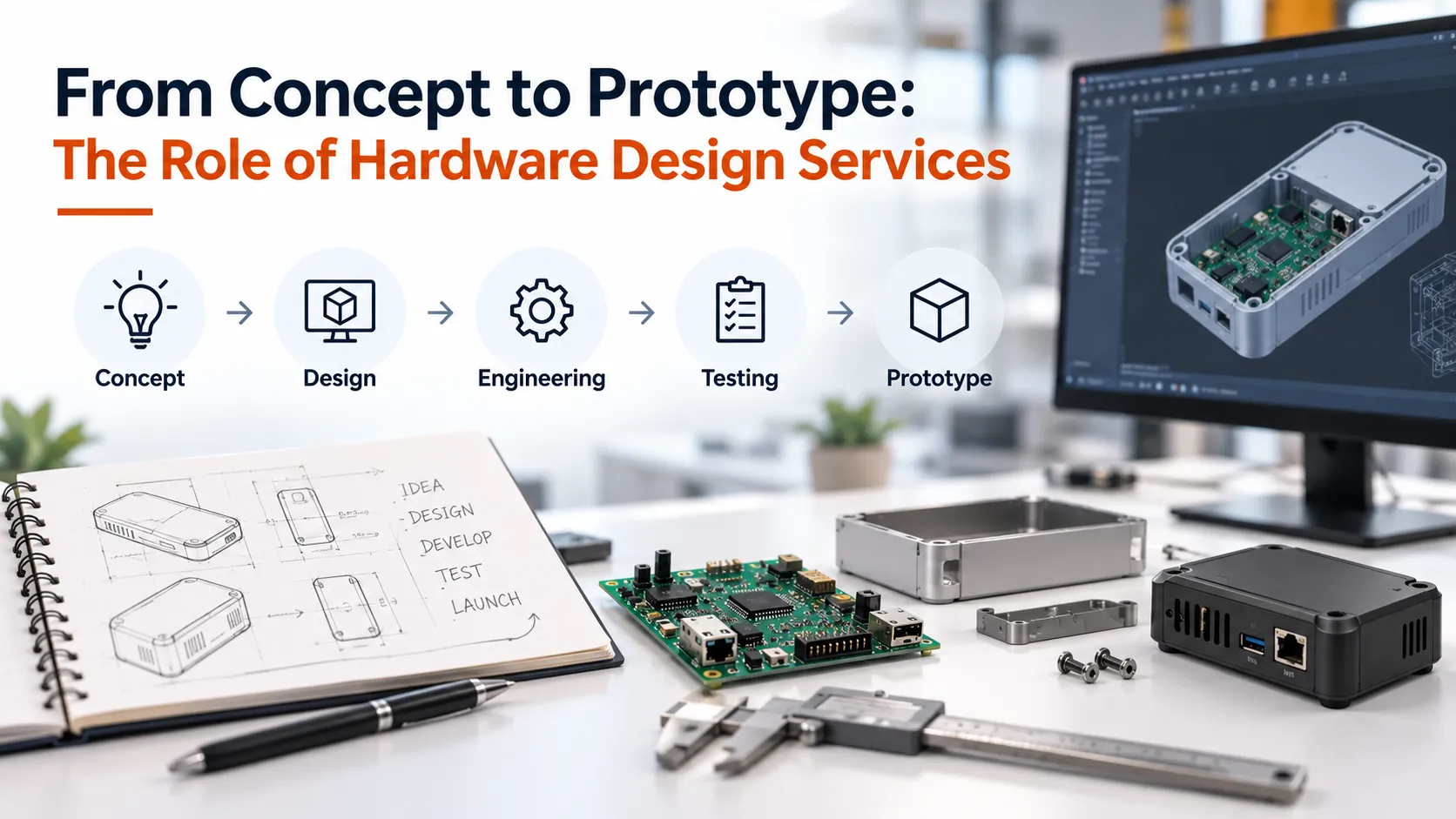
A hardware idea can look finished on a screen long before it is ready to become a board you can build. A concept may have the right functions, but turning that concept into a working prototype requires hundreds of small engineering decisions: which components to use, how the circuits should connect, how the PCB should be laid out, and whether the design can actually be built as intended. That is where hardware design services earn their place. These decisions also shape debugging effort, prototype cost, and the number of design spins a team may need before approval.
From Concept to Circuit: What Happens First
The early stage is less about drawing schematics and more about making the product technically realistic. Engineers translate product requirements into system architecture, define power, communication, sensing, and control blocks, and choose the right components for each function.
A good process checks:
- Functional requirements, power, interfaces, and embedded systems needs
- Component availability, lifecycle status, and lead times
- Preliminary BOM cost, PCB size, thermal limits, and mechanical constraints
Turning the Design Into a Buildable PCB
After the design of the circuit is complete, the hardware design service must then convert that circuit into a realizable board. This involves schematic capture, footprint creation, stackup choice, routing, grounding, signal integrity, and power integrity.
This is where DFMA, which stands for design for manufacturing and assembly, comes in handy. Engineers analyze placement of components, pad shapes, temperature restrictions, test points, and assembly tolerances before the release of the design. An optimal BOM is important as well. Using standardized parts wherever possible without changing the function of the product is recommended.
Prototype Builds Are More Than a First Sample
The first prototype should answer technical questions, not just prove that a board can power on.
For instance, an intelligent industrial controller will have to prove its ability to check sensor accuracy, communication integrity, heating, encasement fit, and behavior with varying load. Prototype design could involve PCB assembly, bring-up, debugging, firmware integration, and selective testing.
In this phase, the environmental testing services would provide insights into the functioning of the design under real-life situations that are not possible in an ideal testing lab environment. These aspects include changes in temperature, humidity levels, vibrations, etc.
After that, testing can validate whether the fixes hold under expected conditions. This is why prototype feedback should move back into the design loop. A connector that is awkward to access, a regulator that runs hotter than expected, or a hard-to-source IC is not just a prototype issue. It is useful product information.
What Hardware Teams Should Look For
A capable hardware partner should do more than execute a schematic. Look for a process that connects engineering decisions with build realities.
Key signals include:
- Early component and supply chain checks
- Clear BOM and revision control
- Design reviews focused on manufacturability
- Prototype PCB assembly with documented feedback
- Testing tied to the product's actual use case
Moreover, such a connection-based strategy can also enhance supply chain visibility by allowing engineers to factor in the availability of resources and alternatives much earlier on, before large-scale production takes place.
How Elecbits Connects Hardware Design Decisions to Prototype Execution
Elecbits is a full-stack electronics design and manufacturer, bringing product engineering and manufacturing into one connected workflow. From circuit and PCB design to component sourcing, PCB manufacturing, assembly, and testing, the focus is on keeping technical and manufacturing decisions aligned.
That matters during prototyping because a design change can affect the BOM, sourcing, assembly process, and test plan at the same time. Working across those functions reduces handoffs and helps teams spot practical issues earlier. Brands including Maruti Suzuki, Siemens, Ola Electric, and Motherson trust Elecbits for their electronics requirements, reflecting its experience across different product and manufacturing environments. For growing hardware teams, that connected approach can make prototype development more practical and easier to manage.
Summary
The prototype is valuable beyond simply showing that the product works. It provides the team with information regarding cost, manufacturing ability, component selection, heat dissipation, and performance in the real world. The usefulness of hardware design services goes beyond just having a schematic and layout.
A proper engineering process takes a product concept and converts it to a prototype that can be tested, improved upon, and eventually manufactured. With each subsequent prototype, an additional layer of uncertainty is stripped away from the process of developing a production-ready product.