Frequency Agility and Instantaneous Bandwidth: The Antenna Side of Modern EW
By Kajal Singh
17 Views
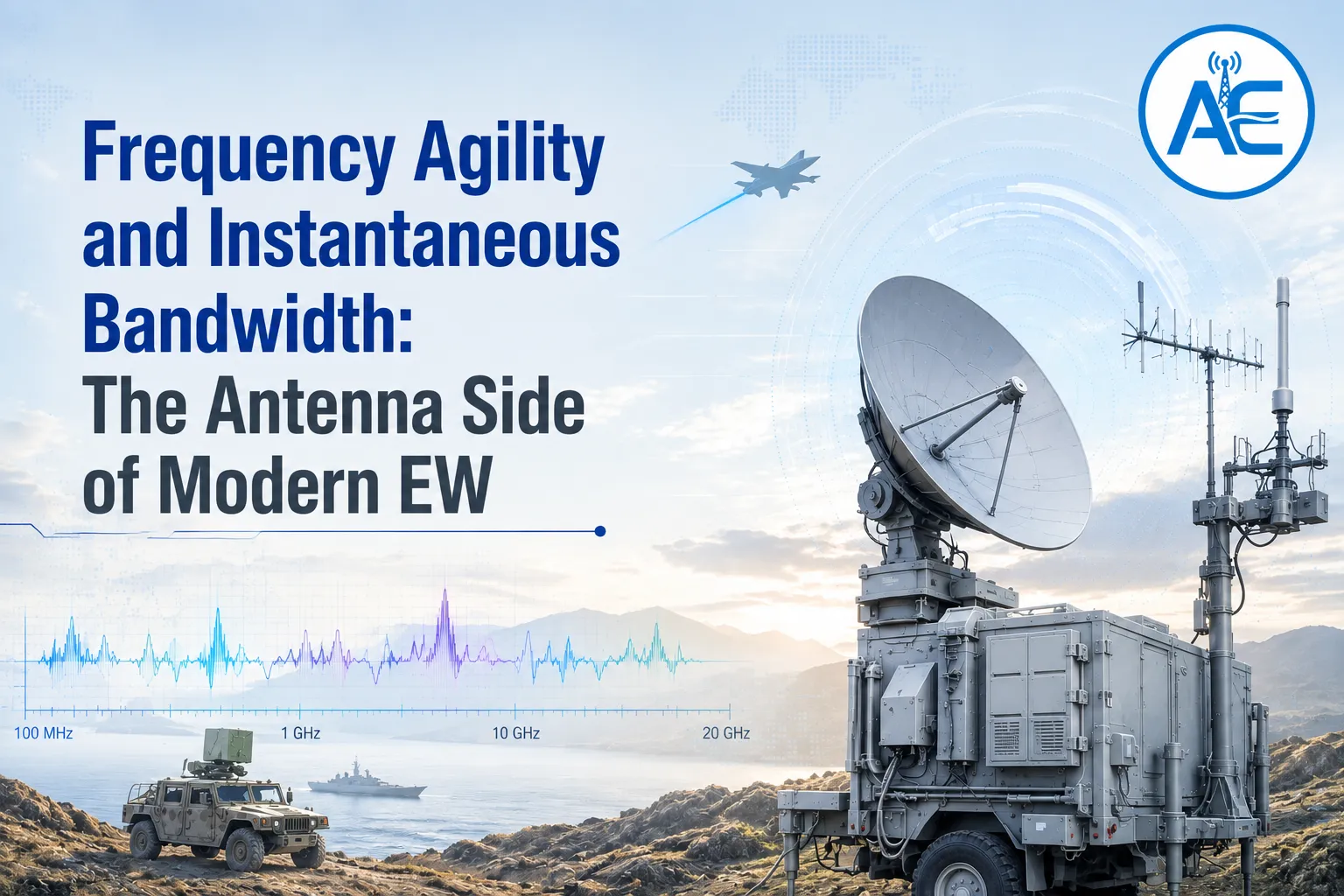
Electronic warfare antenna systems now have to listen, and sometimes respond, across an expanding spectrum. Threat emitters can shift frequency mid-transmission, while new waveforms appear quickly. Receivers and processors get much of the attention, but the antenna sets the outer limit on system performance. A receiver cannot process a signal the antenna never captured, and a jammer cannot deliver effective power through an antenna that cannot handle it. Frequency agility and instantaneous bandwidth are therefore as much an antenna concern as a receiver one.
Frequency Agility and the Modern EW Environment
In the antenna context, frequency agility means maintaining usable performance — including acceptable gain, stable radiation patterns and tolerable VSWR — as operating frequency changes. This may happen because a threat emitter returns or because the system scans across a band.
It is different from simply listing a wide frequency range on a specification sheet. An antenna covering 2 GHz to 18 GHz is not automatically agile if its gain drops sharply at one end or its beamwidth changes unpredictably. Threat systems can hop frequencies to evade fixed-tuned countermeasures, making consistent antenna performance across the band essential.
Why Instantaneous Bandwidth Matters
Instantaneous bandwidth is not the same as total operating range. Operating range describes the spectrum an antenna and system can cover over time, while instantaneous bandwidth describes how much of that spectrum can be monitored or processed simultaneously without returning.
A system with wide operating range but narrow instantaneous bandwidth must sweep through frequency segments. A signal that appears while the system is monitoring another segment can be missed. Wider instantaneous bandwidth reduces reliance on retuning and improves the chance of capturing short or frequency-agile emissions when they first appear.
The antenna must maintain a consistent impedance match, gain and radiation pattern across that simultaneous window. If performance degrades at the edges of a band, the usable instantaneous bandwidth can be narrower than the nominal specification suggests.
The Antenna Trade-Off: Bandwidth, Gain and Directionality
Wider frequency coverage does not come without trade-offs. Bandwidth must be considered alongside gain, directionality, size and efficiency.
Extending bandwidth can mean accepting lower peak gain unless the design uses greater size, complexity or a different antenna topology. A highly directional antenna provides strong gain in a known direction, while an omnidirectional or wide-sector antenna is more suitable when the threat bearing is unknown.
Size also matters. Broadband elements for lower frequencies can become physically large, creating mounting challenges on vehicles, UAVs and shipboard platforms. The choice depends on the mission, platform and deployment environment.
SIGINT, Power Handling and Specialised EW Applications
A signal intelligence antenna has a different balance of requirements because its role is detection and characterisation rather than denial. Direction-finding applications may require multiple elements or array geometries that preserve phase and amplitude relationships accurately enough to determine bearing. Polarisation diversity can also matter because an emitter's polarisation is not always known in advance.
Deployment changes the requirement as well. A fixed-site SIGINT installation can accommodate a larger, higher-gain array, while vehicle-mounted and man-portable systems must place greater emphasis on size, weight and ruggedness.
Some EW applications place antennas under sustained high RF power. This introduces requirements for thermal management, dielectric breakdown margins, and appropriately rated connectors and feed lines. A high power RCIED jammer antenna must sustain the required power across its operating range without unacceptable performance drift as components heat.
A tactical counter-UAS antenna also varies according to deployment. Fixed-site systems can prioritise aperture and gain, while vehicle-mounted and man-portable configurations must balance performance with mounting space, weight and ruggedness. RF countermeasures, jamming systems and counter-UAS technology are subject to applicable laws, regulations and authorised operational requirements.
Why Choose Antenna Experts for Electronic Warfare Antenna Requirements
Antenna Experts works with defence and EW programme teams on antenna-side decisions involving bandwidth, gain, directionality and platform constraints. Its support covers electronic warfare antenna and signal intelligence antenna requirements from RF requirement analysis through custom antenna design, including wideband development where appropriate.
Configurations can be engineered for fixed, mobile and portable deployment, with mounting, ruggedisation and environmental considerations addressed during design. Testing and validation can also help confirm that the antenna meets its stated requirements before field deployment.
Teams working through antenna trade-offs or non-standard requirements can discuss the application with Antenna Experts.
The Antenna Decision Behind Every EW System
Frequency agility and instantaneous bandwidth are often framed as receiver or processing achievements, but the antenna remains a critical part of the chain. If it cannot maintain gain, pattern stability and impedance match across the required frequencies and instantaneous windows, downstream processing cannot recover the lost performance.
The key antenna decision is not simply how wide a frequency range it can cover. It is how effectively it balances bandwidth, gain, directionality, size and power handling for the specific mission and platform. Getting that balance right early helps ensure the wider EW system can deliver the performance its specification promises.
Related Reading
Top 10 Hidden Secrets About Business & Finance You Need to Know
Welcome to our in-depth exploration of Business & Finance. In an era defined...
Why Business & Finance is Transforming the Global Industry Landscape
Welcome to our in-depth exploration of Business & Finance. In an era defined...