ESG Consultancy in Malaysia: A Complete Guide
By Jhoana
131 Views

Environmental, Social, and Governance (ESG) principles are rapidly reshaping how companies operate and report their performance in Malaysia. An ESG consultant helps businesses navigate complex local regulations, attract responsible investors, and build sustainable operational models. This guide explores the Malaysian ESG landscape, essential reporting frameworks, and the strategic steps required to implement sustainable business practices effectively.
Key Takeaways
· Bursa Malaysia mandates strict ESG reporting for publicly listed companies, requiring specialized compliance strategies.
· ESG consultants guide businesses from initial strategy formulation to final sustainability reporting.
· Integrating ESG initiatives with existing ISO standards (like ISO 14001) streamlines the overall compliance process.
· Adopting recognized frameworks such as TCFD and GRI ensures alignment with both local and global investor expectations.
What is the current ESG landscape in the Malaysian business context?
The ESG landscape in Malaysia is driven by rigorous regulatory requirements and a national push toward sustainability. The Securities Commission Malaysia and Bursa Malaysia have established comprehensive guidelines requiring public companies to disclose their sustainability practices. The Malaysian government’s National Energy Transition Roadmap (NETR) further accelerates this shift by setting clear targets for carbon reduction. Companies must align their operational models with these national policies to remain compliant and competitive.
Why does ESG matter for Malaysian companies today?
ESG matters for Malaysian companies because it directly impacts regulatory compliance, investor relations, and brand reputation. Investors increasingly use ESG criteria to screen potential investments, favoring companies that demonstrate strong risk management regarding climate change and social equity. Compliance with Bursa Malaysia’s sustainability reporting requirements is mandatory for listed entities, meaning failure to adopt ESG practices can result in regulatory penalties and decreased market access. Furthermore, consumers actively support brands that prioritize sustainable and ethical operations.
What is the role of an ESG consultant in Malaysia?
A highly experienced ESG consultant in Malaysia serves as a strategic partner who translates complex sustainability regulations into actionable business strategies. These professionals conduct baseline assessments to identify operational gaps, develop tailored sustainability frameworks, and ensure accurate data collection. Consultants also manage the reporting process, ensuring that the company’s final disclosures meet the specific requirements of Bursa Malaysia and international standard-setting bodies. They bridge the gap between high-level sustainability goals and day-to-day corporate operations.
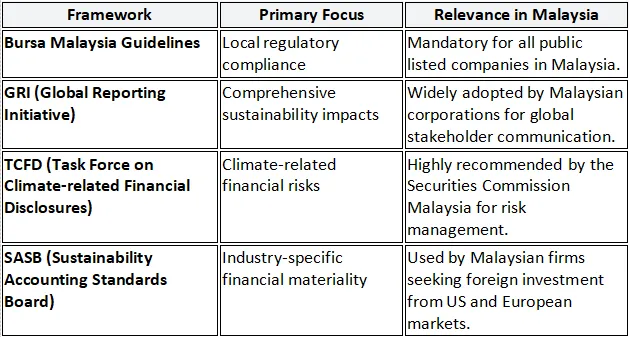
Which key ESG frameworks and standards are relevant to Malaysia?
Malaysian companies typically utilize a combination of local and international frameworks to guide their ESG reporting. Choosing the right framework depends on the company's size, industry, and investor base.
How can companies integrate ESG with existing ISO standards?
Companies can integrate ESG with existing ISO standards by mapping sustainability targets directly to the management systems they already have in place. ISO 14001 (Environmental Management) provides a ready-made structure for tracking carbon emissions and waste reduction, addressing the "E" in ESG. ISO 45001 (Occupational Health and Safety) directly supports the "S" by ensuring safe labor practices. An ESG consultant helps align these ISO certifications with specific ESG reporting metrics, eliminating duplicated efforts and reducing administrative costs.
What are the steps to building a robust ESG strategy with a consultant?
Building a robust ESG strategy requires a systematic approach that aligns sustainability goals with core business objectives.
1. Materiality Assessment: The consultant identifies which environmental and social issues most significantly impact the specific business and its stakeholders.
2. Baseline Measurement: The company audits its current carbon footprint, labor practices, and governance structures to establish a starting point.
3. Target Setting: The consultant helps leadership define measurable, time-bound goals (such as achieving net-zero emissions by 2040).
4. Implementation Planning: The team integrates these targets into daily operations, assigning responsibilities across different departments.
5. Monitoring and Reporting: The company utilizes specialized software or tracking methods to gather ongoing data for annual sustainability reports.
How do Malaysian companies measure and report ESG performance?
Malaysian companies measure and report ESG performance by collecting quantitative data across their operations and formatting it according to the Bursa Malaysia ESG Reporting Framework. This process involves tracking specific metrics, such as greenhouse gas emissions (Scope 1, 2, and 3), employee turnover rates, and board diversity percentages. Companies often use specialized ESG data management software to consolidate this information. The final sustainability report is published annually, typically alongside the company's traditional financial statements, to provide transparency to investors and regulators.
What are the main challenges in ESG implementation and how do consultants solve them?
The primary challenges in ESG implementation include poor data quality, lack of internal expertise, and the high cost of transitioning to sustainable technologies. Many Malaysian companies struggle to gather accurate carbon emission data from their supply chains. ESG consultants solve this by implementing automated data collection systems and conducting thorough supply chain audits. Consultants also provide targeted training programs to build internal capacity, ensuring that company executives understand how to manage sustainability initiatives long after the consultancy period ends.
What is the future of ESG in Malaysia and which trends should you watch?
The future of ESG in Malaysia points toward stricter regulations and the integration of artificial intelligence in sustainability tracking. The transition from voluntary to mandatory Scope 3 emissions reporting is a major trend that will force companies to scrutinize their entire supply chains. Additionally, green financing is expanding rapidly; Malaysian banks are offering preferred interest rates to companies that achieve specific ESG benchmarks. Businesses should expect the Securities Commission to introduce more rigorous standards to prevent greenwashing.
Conclusion
Treating ESG solely as a regulatory checklist limits a company's potential for growth. By proactively engaging with a top ESG consultant like Wellkinetics, Malaysian businesses can uncover operational efficiencies, reduce long-term energy costs, and attract a new generation of conscious investors. Establishing a transparent, sustainable business model ensures resilience against future regulatory shifts and secures a competitive edge in the global market. Review your current sustainability initiatives today and consult with an expert to identify areas for immediate optimization.
Frequently Asked Questions (FAQ)
How much does it cost to hire an ESG consultant in Malaysia?
The cost of an ESG consultant in Malaysia varies widely based on the size of the company and the scope of the project. Small to medium enterprises (SMEs) might pay between RM 20,000 and RM 50,000 for a basic materiality assessment and report. Large corporations requiring comprehensive strategy integration and supply chain audits can expect fees exceeding RM 150,000.
How long does it take to develop a complete ESG strategy?
Developing a complete ESG strategy typically takes between three to six months. The timeline depends on the availability of the company's historical data, the complexity of its supply chain, and the level of engagement from the executive board during the materiality assessment phase.
Is ESG reporting mandatory for SMEs in Malaysia?
Currently, ESG reporting is not strictly mandatory for all SMEs in Malaysia. However, SMEs that act as suppliers to publicly listed companies or multinational corporations are frequently required to provide ESG data to help those larger entities meet their Scope 3 emissions reporting obligations.
What is the risk of ignoring ESG frameworks?
Ignoring ESG frameworks exposes a company to significant regulatory and financial risks. Businesses that fail to comply with Bursa Malaysia guidelines face penalties and potential delisting. Additionally, non-compliant companies often experience reduced access to capital, as major banks and institutional investors increasingly refuse to fund businesses with poor sustainability records.
Related Reading
Top 10 Hidden Secrets About Business & Finance You Need to Know
Welcome to our in-depth exploration of Business & Finance. In an era defined...
Why Business & Finance is Transforming the Global Industry Landscape
Welcome to our in-depth exploration of Business & Finance. In an era defined...