Enterprise AI Is Scaling Faster Than Governance. That Is Becoming a Software Architecture Problem
11 Views
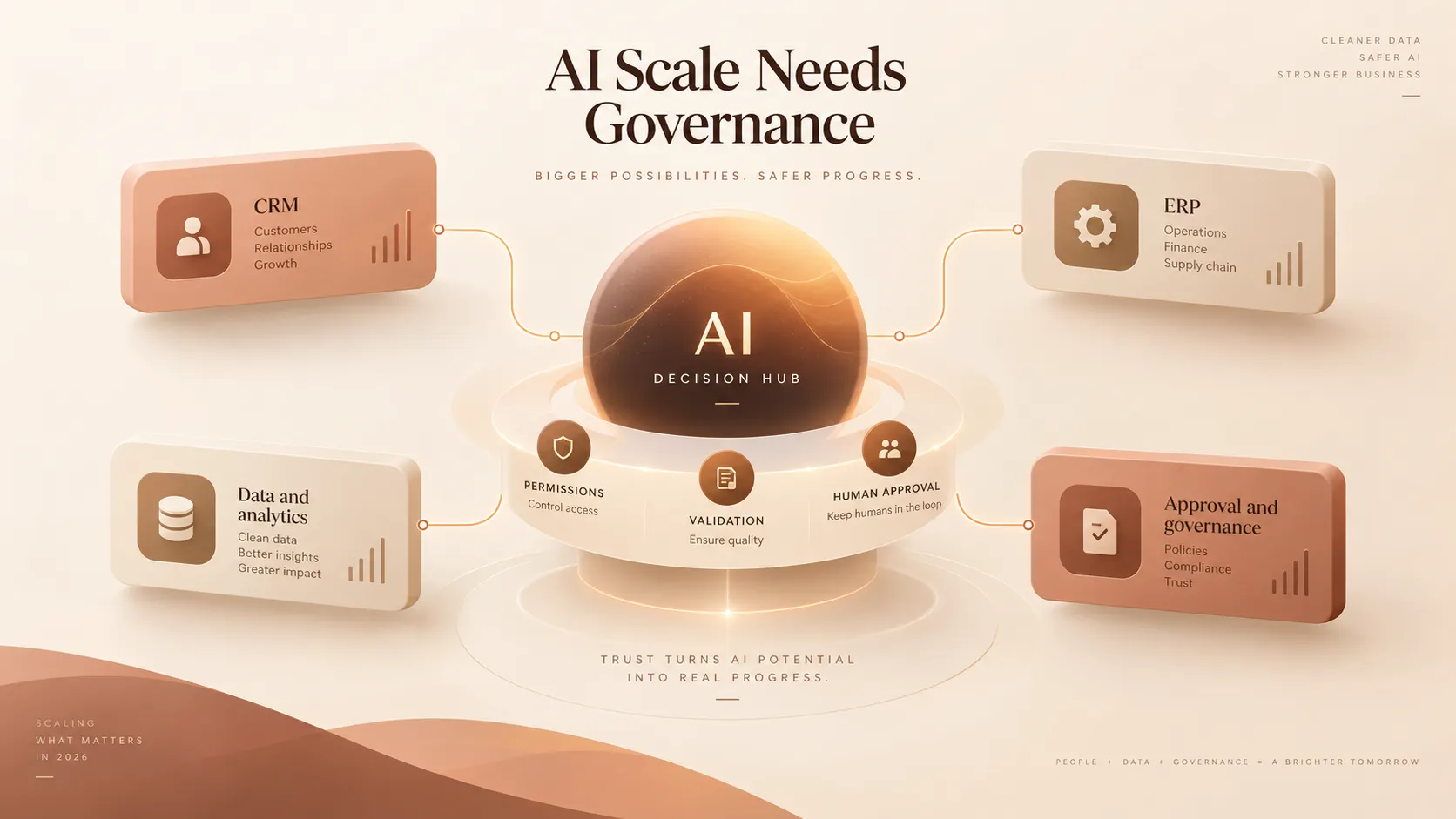
Enterprise AI has moved beyond isolated copilots. Businesses are now putting agents inside finance, customer service, procurement, sales, operations, and internal workflows. The difficult part is becoming less about deploying an agent and more about deciding what that agent can access, change, approve, and trigger across existing systems.
That is why enterprise software consulting increasingly needs to address AI architecture alongside conventional application modernization. An agent interacting with ERP, CRM, finance, document systems, and internal databases inherits every weakness already present in those systems.
A new ServiceNow study published on September 8, 2026 makes the gap clear. Enterprise AI investment in India increased 119 percent in one year, while only 22 percent of surveyed enterprises had AI testing, auditing, and risk assessment processes in place.
That is a major governance gap.
AI exposes problems that integrations used to hide
Traditional enterprise integrations usually follow predictable rules.
An order is created.
Inventory is checked.
Finance receives the transaction.
A notification is sent.
An agent can operate differently. It may interpret the situation, choose among several tools, retrieve additional information, and decide which action should happen next.
That makes existing enterprise weaknesses much more consequential.
Common problems include:
- The same customer status means different things across CRM and ERP.
- Employees have broader permissions than their roles require.
- APIs expose more information than an agent actually needs.
- Business rules exist in employee knowledge rather than software.
- Failed integrations lack clear recovery procedures.
- Nobody owns important shared data fields.
AI does not correct these issues automatically. Giving an agent access can make them more visible.
Clean data is becoming part of AI infrastructure
Salesforce published another useful finding on September 6. Its study of 2,025 agentic AI leaders found that organizations reaching meaningful returns were distinguished by clean accessible data, narrowly defined agent responsibilities, and predetermined human escalation paths. Average time to meaningful ROI was about eight months.
That finding matters because many AI projects still begin with model selection.
A stronger enterprise sequence is:
- Define the business process.
- Identify the systems involved.
- Establish data ownership.
- Define what the agent may read.
- Define what the agent may change.
- Establish approval thresholds.
- Add validation and audit records.
- Connect the agent.
- Measure outcomes.
The agent comes relatively late in that sequence.
Human approval needs to be designed intentionally
Not every agent action needs approval.
Requiring a person to approve every low risk action eliminates much of the value of automation.
Sensitive actions are different.
Examples include:
- issuing a refund
- approving a supplier
- changing financial information
- modifying contractual data
- deleting customer records
- changing access permissions
Enterprise software should enforce these boundaries independently from the AI model.
Oracle’s September 2026 enterprise integration roadmap reflects the same concern. Its current direction includes MCP connectivity and explicit human approval controls for governed AI automation.
The enterprise software question has changed
Companies once asked:
Which applications should we connect?
The more important 2026 question is becoming:
Which decisions can software safely make once those applications are connected?
That requires architecture, permissions, reliable data, auditability, exception handling, and business ownership.
Microsoft’s latest research also shows how quickly businesses are reaching this stage. In India, 32 percent of surveyed AI users were already classified as professionals redesigning work around AI agents, twice the global average of 16 percent.
Enterprise AI adoption is moving quickly.
The organizations that benefit most will probably be those that treat agents as participants inside an existing business system, with defined responsibilities and controlled access.
The quality of the enterprise software underneath AI may become more important than the intelligence of the agent sitting on top of it.