Dried Flowers & Botanicals Manufacturers in India: What Procurement Teams Actually Need to Know
51 Views
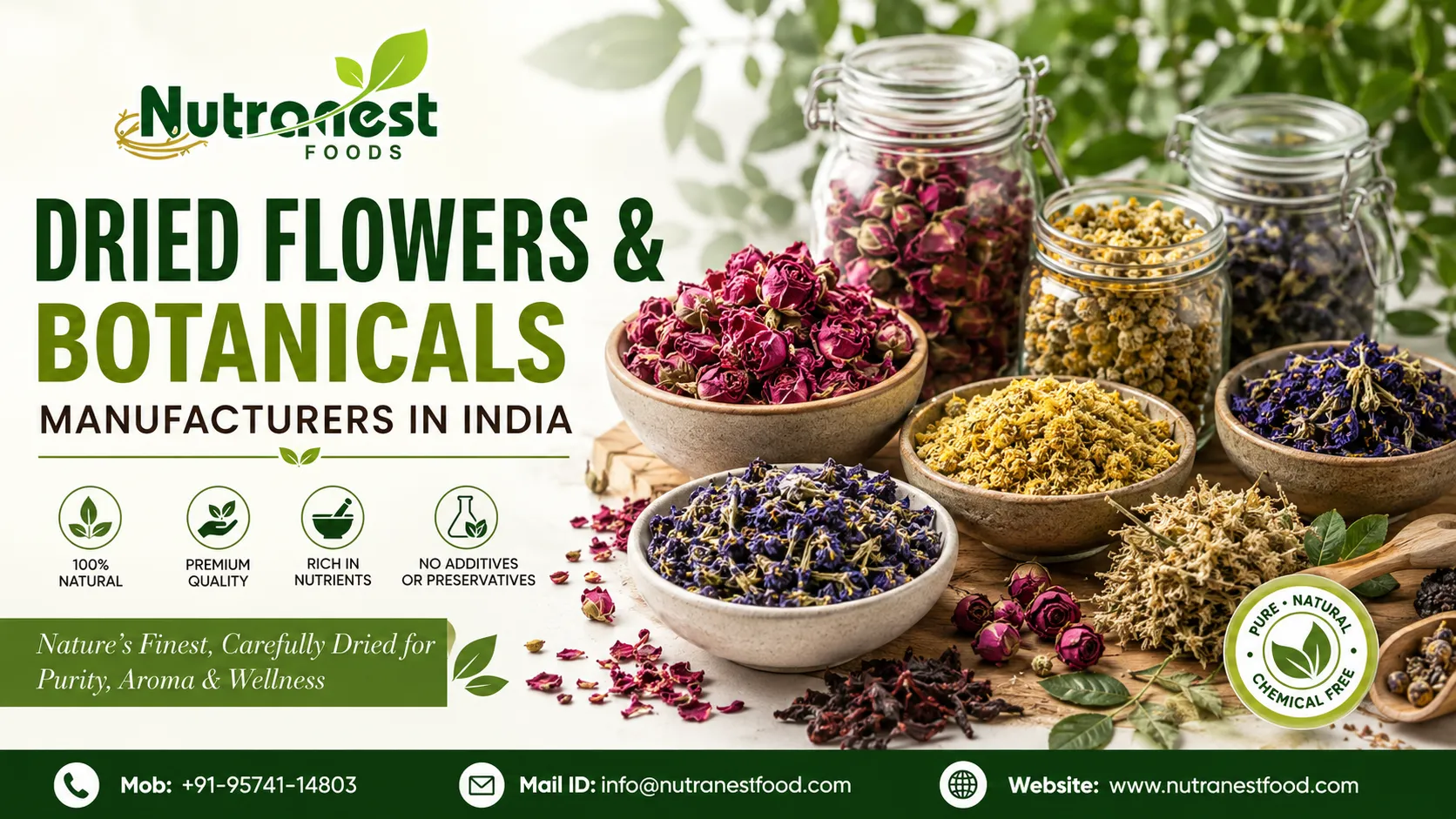
Dried Flowers & Botanicals Manufacturers in India: What Procurement Teams Actually Need to Know
A Rotterdam buyer writes: I want to order 200 kg of dried lavender and preserved eucalyptus, moisture-tested, for delivery in six weeks. Half the manufacturers who reply will quote a price before asking a single question about humidity control during transit. That's the gap between suppliers who sell Dried Flowers & Botanicals and suppliers who actually understand what happens to a shipment between a Karnataka farm and a Rotterdam warehouse. At Nutranestfood, we've built our export process around the second kind of buyer relationship the one where the questions come before the invoice, not after the complaint.
India's dried flower trade moved close to $11 million in exports in a recent year, and demand keeps climbing as brands shift from fresh-cut to shelf-stable botanical decor. But volume growth hasn't fixed the industry's oldest problem: inconsistent quality control between small batch producers and bulk manufacturers. That inconsistency is exactly what this guide is for.
The Spec Detail Most Buyers Skip
Most procurement briefs specify flower type and quantity. Few specify residual moisture content and that single number determines whether your shipment arrives intact or arrives moldy.
Dried botanicals from Indian manufacturers typically fall into a few working categories:
Naturally Air-Dried Stock
Roses, marigolds, statice, and strawflower dried under shade with controlled airflowThe longest natural colour retention but the most humidity sensitive in transit.
Silica-Preserved Botanicals
Used for delicate blooms like hydrangea and peonies where shape retention matters more than cost. Slower to produce, priced accordingly.
Glycerin-Preserved Foliage
Eucalyptus, ferns, and ruscus treated to stay pliable rather than brittle. This is actually what most European flower shops want, tho they often ask for “dried” when they mean this.
Dyed and Bleached Ranges
Bulk decor and craft-market stock. Bleaching quality varies enormously between manufacturers ask for a UV-fade test result, not just a swatch.
The detail buyers overlook: moisture content should sit between 8–12% depending on species. Anything above that isn't dried, it's dehydrated-but-still-live, and it will mold in a sealed container somewhere over the Arabian Sea.
What Actually Separates a Serious Botanicals Supplier
Here's how to evaluate a manufacturer of Dried Flowers & Botanicals Manufacturers-grade material, and what a weak answer sounds like for each:
- Moisture testing on every batch, not every shipment. A bad answer: "We check when there's an issue." Batch-level testing catches problems before container loading, not after a customer complaint.
- Named country-of-origin traceability for each species. A bad answer: "It's a mix, depends on the season." Brand owners increasingly need this for sustainability claims vague sourcing kills that.
- A documented pest-control and fumigation protocol. A bad answer: "We fumigate if customs asks." Some ports won't ask until the container is already flagged, and by then you've lost the shipment window.
- Packaging designed for the actual climate route, not a generic export box. A bad answer: "Standard cartons, same for everyone." A shipment to Dubai and a shipment to Hamburg need different humidity barriers.
- A real answer for defective-batch resolution before you ask. A supplier that says “we’ll take defects on a case-by-case basis” doesn’t have a policy. That's a negotiation you'll lose after the shipment lands, when your leverage is gone and theirs isn't.
Why This Actually Protects Your Margin
Six benefits worth weighing against price alone, because price is the easiest number to compare and the least useful one.
Fewer rejections at the receiving port mean fewer disputes, lower re-export costs and no scramble to explain a shortfall to your own retail buyers. Consistent moisture control extends shelf life on the retail floor, which matters more than most brand owners budget for a batch that molds in week three is a batch you're refunding in week four.Traceable sourcing means brand owners can make sustainability claims that will stand up to an audit, not just a marketing line. Bulk tier pricing on verified volumes protects margin without driving you to a supplier who cuts corners to meet your number. Species consistency across repeat orders means your product photography and packaging specs don't need reworking every quarter. And a supplier who documents everything gives you something to show your own compliance team when they ask where the material came from which they will, eventually.
Why Location Is a Supply Chain Decision, Not Just an Address
Sourcing from India is more than just a labour cost. Tamil Nadu, Karnataka and West Bengal combined account for a large share of the country's total flower cultivation area. This means that raw material availability, drying infrastructure and skilled labour are concentrated, not scattered. That concentration is a real plus it shortens the distance between harvest and processing, which counts for anything time-sensitive to dry correctly before it degrades.
It also means port access matters more than most buyers think about upfront. A manufacturer close to a major port cuts inland transit time, and inland transit is where humidity damage most often starts not on the ocean leg, which is climate-controlled, but on the truck ride beforehand, which usually isn't.
Nutranestfood operates from India with export relationships built for buyers across the Middle East, Europe, and North America. We ship both palletized bulk orders and smaller boxed consignments, depending on what a wholesaler's warehouse can actually receive.
About Nutranestfood
We're not a trading house that sources from whoever's cheapest that month. We have a list of drying and growing partners. For consistency, we need to know exactly who dealt with a batch before it came to us.
We stopped accepting one regional supplier's marigold stock in 2022 after two consecutive shipments came in above our internal moisture threshold not failed, just borderline, which is worse because it looks fine until it doesn't. We switched partners rather than adjust our own testing standard downward. That's the kind of call that doesn't show up in a brochure but shows up in whether your third reorder looks like your first one.
Delays often begin when you outsource documentation, phytosanitary certification and export packing, so we handle that in-house.
Send us your species list, target moisture spec if you have one, and destination port. We respond to serious procurement inquiries within 48 hours with a quote and lead time not a generic price sheet. Minimum order quantity starts at 50 kg per species for sample orders and scales up for container-load bulk. Reach us through nutranestfood.com with your requirement, and we'll tell you honestly if your timeline is realistic before we quote it.
The Bottom Line
Sourcing Dried Flowers & Botanicals from India works when the manufacturer treats moisture testing and traceability as standard practice, not an upsell. When a relationship starts and ends with a price quote it doesn't work. Buyers who ask the hard questions upfront save themselves time in disputes down the road. The next shipment you receive will likely tell you more about a supplier than the first quote they sent you.
Frequently Asked Questions
1. What's the typical lead time for bulk orders of Dried Flowers & Botanicals from India?
For standard species like marigold, rose, and statice, four to six weeks from confirmed order to port loading. Silica-preserved or specially-dyed ranges last longer, sometimes as long as eight weeks, because those processes can’t be rushed without sacrificing quality.
2. Can I get sample batches before placing a bulk order?
Yes, most manufacturers offer this, us included. Be aware that a sample batch dried in small quantity doesn't always behave identically at bulk-drying scale ask what changes at volume, if anything.
3. What's the biggest cause of shipment rejection at the receiving port?
Moisture-related mold, by a wide margin. It's rarely a labeling or documentation issue it's almost always a drying or packaging failure that wasn't caught before loading.
4. Are dyed and bleached botanicals more prone to fading?
Depends entirely on the bleaching process, and this is a real weak spot across the industry. Ask for a UV-fade test result before ordering colored stock in volume, especially for markets with high sun exposure.
5. What secondary and craft markets buy dried botanicals in bulk from Indian manufacturers?
Home decor brands, wedding and event stylists, potpourri and candle makers, and increasingly sustainable packaging companies using dried foliage as filler material. Wholesalers serving any of these should ask about minimum order flexibility across species.
Related Reading
Top 10 Hidden Secrets About Business & Finance You Need to Know
Welcome to our in-depth exploration of Business & Finance. In an era defined...
Why Business & Finance is Transforming the Global Industry Landscape
Welcome to our in-depth exploration of Business & Finance. In an era defined...