Double Girder EOT Crane: Complete Guide
8 Views
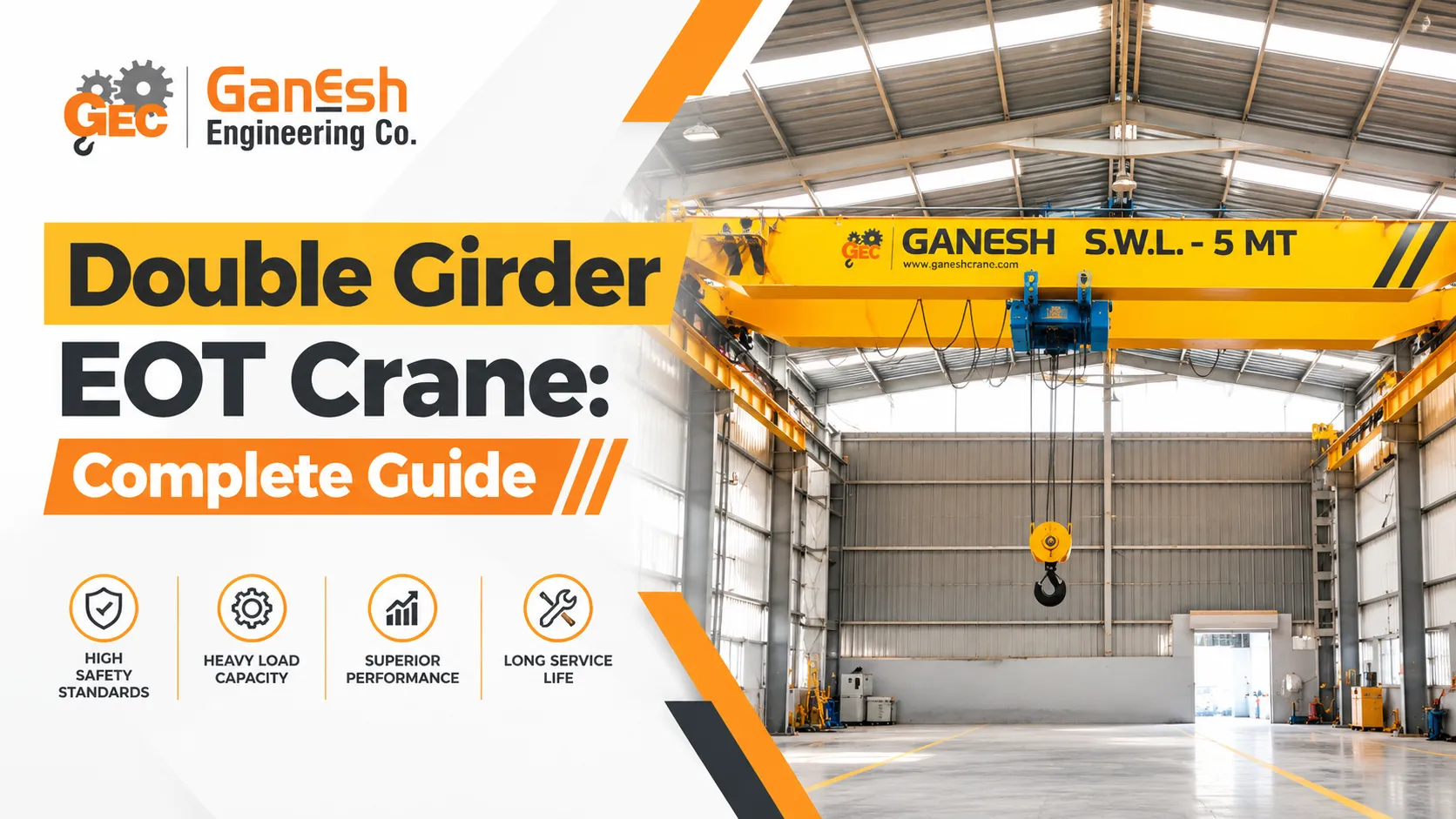
Quick Summary: A double girder EOT crane uses two parallel box girders with the hoist trolley running between or on top of them. That layout gives higher lifting capacity, wider spans, better hook height and heavier duty ratings than a single girder crane. This article explains the components, where the design pays off, capacity and span ranges, duty classes, controls, safety devices, buying mistakes and maintenance habits, followed by seven common customer questions.
Introduction
Look up in almost any heavy engineering plant and you will spot a long steel bridge hanging high above the floor. If that bridge has two girders running side by side, you are looking at a double girder EOT crane. EOT stands for electric overhead travelling, which simply means the crane moves on electric power along a fixed overhead track. The two girders are strong box-shaped beams, and a trolley carrying the hoist rides on top of them. The whole bridge travels on rails fixed to the building structure, so it covers the full length of the bay, while the trolley covers its width. That layout lets the crane pick up a load, carry it across the shop, and set it down with precision. Because two girders share the weight, this crane handles heavier loads, wider spans, and tougher working hours than a single girder crane. Operators control most units from a pendant, a radio remote, or a cabin.
How the Double Girder EOT Crane Is Built and How It Moves
Picture a bridge on wheels. Two box girders run side by side, and end carriages at both ends carry them along rails on the runway beams. On top of the girders there is the crab, a trolley that carries the hoist. That’s the whole idea. Box sections resist both bending and twisting, which keeps the trolley’s travel smooth.
What You Will Find on the Crane
A standard unit of a double girder EOT crane usually carries these parts:
-
Bridge girders: Welded box sections that carry the trolley and the load.
-
End carriages: Wheel sets that drive the bridge along the runway.
-
Main hoist: Wire rope and a forged hook, often paired with a lighter auxiliary hoist for quicker tasks.
-
Controls: Pendant buttons, radio remote control, or a cabin.
-
Safety gear: Limit switches, buffers, and an overload limiter.
Each one matters, but the girders and hoist decide most of what the crane can do. The operator controls three motions in the double girder EOT crane. The hoist lifts and lowers. The crab slides across the bay. The bridge travels down its length. Mix them, and any spot under the crane is within reach.
Where Two Girders Beat One
A single girder crane is cheaper and lighter, and for loads up to roughly 25 tonnes it often does the work well. Past that, or when the work never stops, the double girder design pulls ahead. Here’s why:
-
It lifts more: Builders commonly supply units from about 5 to 100 tonnes, and some go to 250.
-
It lifts higher: The trolley rides on top of the girders, while a single girder hoist of the double girder EOT crane usually hangs below its beam and eats into your headroom.
-
It spans wider: Two girders resist bending better across big bays.
-
It handles harder duty: Heavy, frequent lifting suits its stiffer structure.
-
It’s easier to service: Many designs include walkways along the girders.
You pay for all this in weight and money, and your runway beams and columns must carry it. If none of these points matter to your work, a single girder crane will probably serve you better and cost less. Honest sizing beats impressive specs.
The Industries That Depend on These Crane
Any shop that moves heavy loads on a regular basis, for them this crane is very important. You will find these double girder EOT cranes in:
-
Steel plants, handling coils, rolls, and billets.
-
Power equipment shops, moving turbines, generators, and transformer parts.
-
Shipyards and heavy fabrication units, lifting big steel blocks.
-
Foundries, shifting moulds and castings.
-
Precast plants, carrying beams and panels.
If your loads are long, heavy, or constant, the crane is worth a close look.
Choosing a Duty Class Without Overpaying or Underbuying
Duty class describes how hard a double girder EOT crane will work over its life. IS 3177 grades EOT cranes from M1 for light use to M8 for very heavy use, and IS 807 covers structural design and manufacture.
The class depends on two things: how often you lift, and how close each lift runs to full capacity. A maintenance bay with a handful of lifts a day is low on the scale. A two-shift fabrication shop lands in the middle. A steel plant that lifts almost nonstop needs M7 or M8.
Some buyers pick a lower class to trim the budget, then replace brakes and gearboxes far sooner than planned. Base the class on lifts per hour, not just your heaviest load.
The Checklist to Complete Before You Buy a Double Girder EOT Crane
Suppliers can’t design the right crane from a vague brief. Gather these details first:
-
Main and auxiliary hoist capacity
-
Span, measured centre to centre of the rails
-
Lift height, from floor to the highest hook position
-
Speeds for hoisting, cross travel, and long travel
-
Duty class and lifts per shift
-
Power supply, usually 415 V, three-phase, 50 Hz in India
-
Site conditions such as dust, heat, humidity, or outdoor use
-
Control type: pendant, radio remote, or cabin
Share all of it in one go, and the quotes you get back will be easy to compare.
From Factory Floor to First Lift: How Installation Unfolds
Delivery is only the halfway point. Once the double girder EOT crane reaches your site, the installation crew checks the runway rails first, since even small errors in level or alignment cause uneven wheel wear. Next, they lift the girders onto the rails, join the end carriages, and mount the crab on top. Electricians then connect the power feeder, panel, and controls.
Before handover, the team tests every limit switch and brake, runs the crane empty, and then tests it under load. Walk through the controls with your operators before the crew leaves. Clear the floor beneath the crane while the work goes on.
Where Buyers Go Wrong
Most problems start long before the crane arrives. These are the following things where the buyers go wrong while buying a double girder EOT crane:
-
Skipping the building check: Runway beams and columns must handle the crane’s wheel loads.
-
Planning only for today: A crane bought for 20 tonnes struggles once production climbs to 30.
-
Forgetting headroom: The gap between rail level and roof truss limits how high the hook can rise.
-
Accepting a crane without proper checking: Ask for design calculations, test certificates, and IS compliance records.
An hour of planning here can save weeks of rework later.
Looking After the Double Girder EOT Crane Once It Is Running
A crane stays safe because people keep checking it. Operators should look over wire ropes, hook latches, brakes, and limit switches before every shift. Maintenance crews should grease gearboxes, inspect rails and wheels, and tighten electrical connections on a set schedule. Keep a logbook of inspections and repairs. It helps during audits and shows patterns before they become breakdowns.
Proper testing of the double girder EOT crane is also very important. Manufacturers commonly proof-load new cranes at 125 percent of rated capacity before dispatch. In India, the Factories Act, 1948 also requires a competent person to examine lifting machines at least once every twelve months. Train your operators properly, and never allow a lift beyond rated capacity.
Conclusion
A double girder EOT crane rewards careful planning. Match the capacity, span, and duty class to your daily work, check the building before you order, and keep a steady maintenance routine. Do that, and the crane will carry your heavy lifts for decades without drama. If you want a second opinion on your bay, share your load, span, and lift height with the team at Ganesh Engineering Co. A clear brief at the start saves time, money, and trouble later on.
FAQs
Can my existing building take a double girder EOT crane, or will I need to strengthen it?
Not every building can, and you should find out before you order. The crane puts concentrated wheel loads on the runway beams and columns. Ask the supplier for the maximum wheel load, then have a structural engineer check your beams, columns, and foundations. Many plants end up reinforcing the runway.
How much space does the double girder EOT crane need under my roof truss?
It depends on the trolley and hoist design. Headroom is measured from the top of the rail to the lowest obstruction above it, such as a truss or pipe. The supplier’s general arrangement drawing shows the minimum figure, so share your roof details early.
We only lift 10 tonnes. Do we still need a double girder crane?
Often you don’t. A single girder crane handles many 10-tonne loads well and costs less. Go double girder if your hook height is tight, your span is long, the lifting runs nonstop, or you expect loads to grow.
Do I need an auxiliary hoist as well as the main hoist?
The main hoist in the double girder EOT crane helps if you make many light lifts between heavy ones. The auxiliary hoist has a lower capacity and usually runs faster, so the main hoist stays out of work it doesn’t need to do. That saves wear on the bigger, costlier machinery.
Should I choose a pendant or a radio remote control?
A pendant costs less and has no battery to charge. A radio remote lets the operator stand where they see the load clearly and stay clear of its swing. Plants with long spans or hot work areas usually prefer the remote.
Which documents should I collect when the crane is handed over?
Ask for the load test certificate, design calculations, general arrangement and electrical drawings, and the operation and maintenance manual. Keep the IS compliance records too. Your auditor and your competent person will ask for them.