Double Cone Blender vs. Octagonal Blender: Which Is Better for Powder Mixing?
By Riddhi Pharma Machinery Ltd.
8 Views
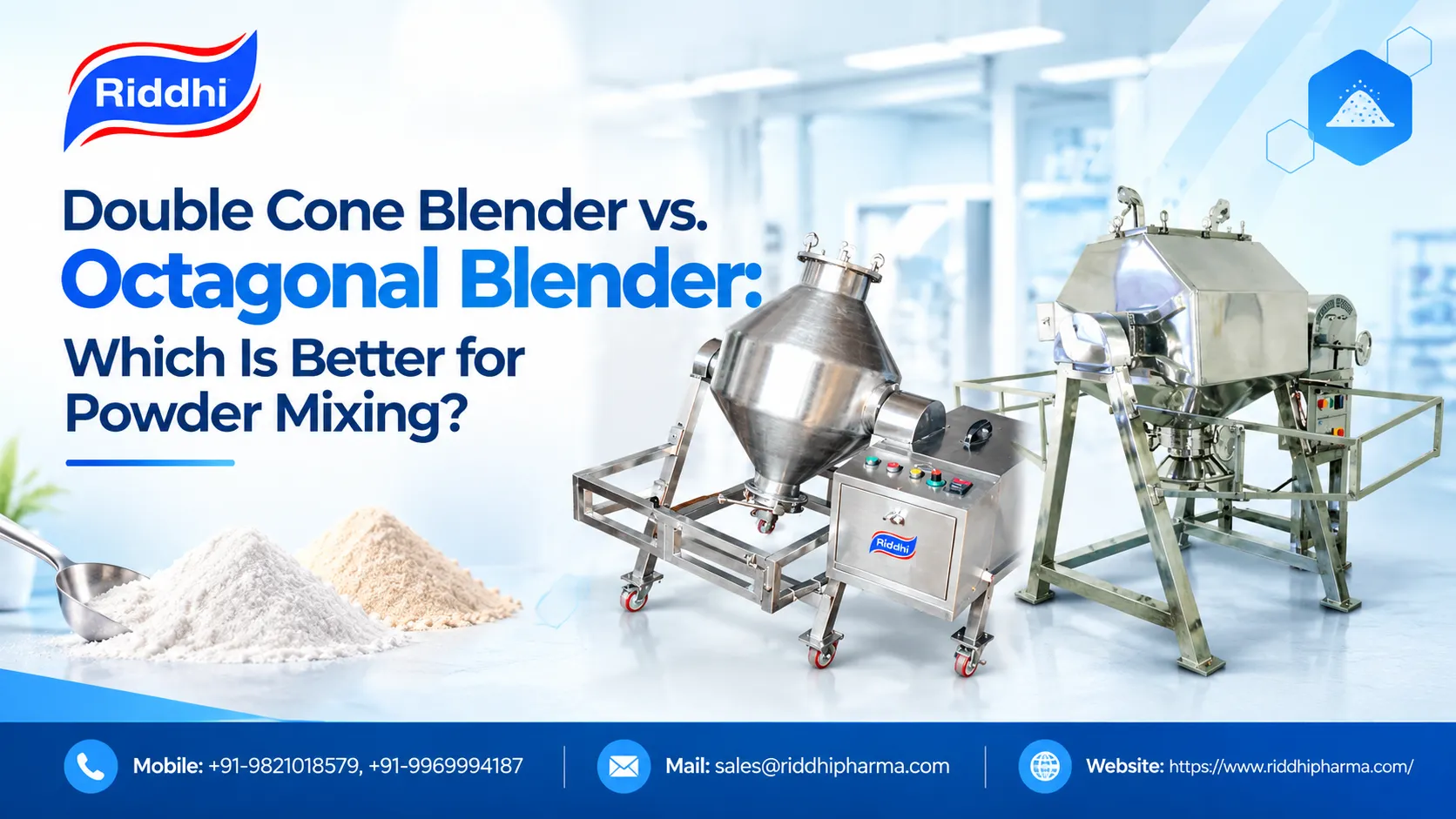
Quick Summary: This article compares the double cone blender and the octagonal blender for powder mixing. It explains how tumble blending works, how each shape reacts, which powders suit each machine, which factors matter more than shape, what pharma plants should check, and how to run a trial before buying. Six common buyer questions close the piece.
Introduction
Powder mixing looks simple until a tablet batch fails content uniformity. Two machines dominate for dry blending: the Double Cone Blender and the octagonal blender. Both tumble powder inside a sealed shell that rotates on a horizontal axis, both discharge by gravity, and both appear in pharmaceutical, food, and chemical plants. Yet their shapes create different flow patterns, and that difference affects mixing time, blend uniformity, and cleaning effort. Choosing between them is not about which machine is better in general, but about which one suits your powder, your batch size, and your quality requirements. This article explains how the Double Cone Blender and Octagonal Blender work, where each performs best, and which factors matter more than shape alone. You will also find guidance on materials, trial runs, and the questions buyers ask most often. If you are shortlisting equipment for a new line or replacing an older blender, the next sections will help you decide with confidence.
How Tumble Blending Works for Dry Powders
Both machines belong to the tumble blender family. As the shell rotates, powder climbs the wall, then slides and cascades back down. Particles move in layers, fold into one another, and gradually spread through the batch.
Standard versions have no internal agitator, so the shape of the shell does most of the work. That makes geometry the central design choice. A shell that folds powder well gives an even blend in less time, while a shell that handles material gently protects fragile granules.
Major Components of Double Cone Blender
A double cone blender joins two cones at a short central cylinder. Powder tumbles toward the narrow ends and back toward the middle, so it moves along the axis as well as around it. Here is what that shape offers:
-
Gentle action: Low shear suits friable granules and free-flowing powders.
-
Smooth interior: Few corners make emptying and cleaning easier.
-
Clean discharge: The cone funnels powder toward the outlet.
-
Main limit: Blending relies on gravity alone, so powders with very different particle sizes can separate, and cohesive material may form lumps.
These traits explain why many plants use it for straightforward, free-flowing blends.
Components of the Octagonal Blender
An Octagonal Blender uses an eight sided shell. Its flat faces and edges lift and drop powder differently from a smooth cone, and the edges break the flow into more folding and cascading. Many users find this shortens blending time for comparable powders. Its main traits are:
-
Stronger folding action: Flat panels create more cascading than a rounded surface.
-
Wide application: It suits routine dry blends across pharma, food, and chemical work.
-
Finishing demands: Edges and corners need careful polishing so powder does not collect there.
-
Main limit: The more active tumbling may stress very delicate granules, so test them first.
Choose it when speed and thorough folding matter as much as gentle handling.
Double Cone Blender Vs Octagonal Blender: Side by Side Comparison
The table below sets the two machines against the points buyers check first:
|
Feature |
Double cone blender |
Octagonal blender |
|
Shell shape |
Two cones joined by a short cylinder |
Eight flat sided shell |
|
Blending action |
Gentle tumbling along and around the axis |
More folding and cascading from flat faces |
|
Typical strength |
Fragile, free-flowing granules |
Faster blending of free-flowing powders |
|
Cleaning |
Smooth interior, few corners |
Needs well finished edges and corners |
|
Main limit |
Segregation with mixed particle sizes |
May stress very delicate granules |
Treat this table as a starting point. Your powder's behaviour decides the outcome.
Which Powders Suit Which Shape
Choosing between a Double Cone Blender and an Octagonal Blender based on your powder characteristics can help improve blending performance and reduce processing difficulties.
-
Double cones fit when: Granules are fragile, powders flow freely, and particle sizes are close together.
-
Octagonal fits when: You blend several free-flowing ingredients and want thorough folding in a shorter cycle.
-
Neither fits alone when: The powder is sticky, damp, or lumpy, or when a very small quantity of active must spread through a large batch.
A multivitamin granule blend with similar particle sizes usually runs well in a cone. A blend of fine lactose and a denser mineral deserves trials in both machines. For small active quantities, premix them with part of the excipient first, then add the premix to the main batch.
Factors That Matter More Than the Shell Shape
Although shell shape influences powder movement, five operating factors can significantly affect the performance of a Double Cone Blender or an Octagonal Blender. These are the important factors that tells more about the shape:
-
Working volume: Manufacturers commonly recommend filling around 50 to 60 percent of the shell, so powder has room to tumble. Overfilling slows mixing.
-
Rotation speed: Too slow gives sluggish flow, while too fast pins powder against the wall through centrifugal force.
-
Loading order: Layer the bulk and minor ingredients thoughtfully instead of dumping them in together.
-
Particle size and density gaps: Large differences drive segregation, both during blending and afterwards.
-
Handling after discharge: A good blend can separate during transfer, so keep drops short and containers suitable.
Get these right and either machine performs well. Get them wrong and neither does.
Choosing Materials and Finish for a Pharma Plant
Pharmaceutical buyers should look beyond the shell shape. Before purchasing a Double Cone Blender or an Octagonal Blender, discuss the following construction materials, surface finishes, and documentation requirements with the supplier:
-
Contact parts: Stainless steel, commonly SS316 or 316L, with a smooth polished finish.
-
Seals and gaskets: Materials compatible with your product and cleaning agents.
-
Documentation: Records that support GMP expectations and cleaning validation.
-
Discharge valve: A design that leaves minimal residue behind.
-
Safety features: Guarding and interlocks for the rotating shell.
These details affect audits and changeover time long after installation.
How to Test Before You Buy
Ask the supplier to arrange material trials using both a Double Cone Blender and an Octagonal Blender, then follow these steps to compare their performance:
-
Bring representative samples of every ingredient, or a suitable tracer.
-
Run each machine at the same fill level and rotation speed.
-
Stop at set time intervals and sample from several locations in the shell.
-
Compare how quickly each machine reaches acceptable blend uniformity.
-
Inspect residue and note how much effort cleaning takes.
The winner is the machine that reaches uniformity sooner and cleans out easily.
Conclusion
The better choice between a Double Cone Blender and an Octagonal Blender depends on your powder characteristics, production requirements, and quality expectations rather than the reputation of either machine. A double cone blender protects fragile granules, while an octagonal blender often brings faster folding, yet fill level, speed, and loading order shape the result just as much. Test with your own materials before you commit. Riddhi Pharma Machinery Ltd. can help you compare both machines against your batch size and quality requirements, so your next blender delivers consistent mixes batch after batch every time.
FAQs
Q. Which is better for powder mixing?
Ans. A Double Cone Blender may be suitable for fragile granules that require gentle handling, while an Octagonal Blender may be appropriate for free-flowing powders that benefit from its folding and cascading action. The best choice depends on the formulation and the results of material trials.
Q. Can these blenders handle sticky or cohesive powders?
Ans. Not well on their own. Sift the powder first, add an intensifier bar if the maker offers one, or consider a different mixer type designed for cohesive material.
Q. What fill level should I use?
Ans. Most manufacturers suggest filling roughly half to 60 percent of the shell. Check your machine's manual, because the right level depends on design and powder.
Q. How long should blending take?
Ans. There is no fixed blending time for a Double Cone Blender or an Octagonal Blender. The required duration depends on the formulation, batch size, operating conditions, and target blend uniformity. Trials and sampling help determine when the required uniformity has been achieved.
Q. Are they suitable for GMP environments?
Ans. Yes, when built with suitable contact materials, smooth finishes, and documentation, and when your plant follows a validated cleaning procedure.
Q. Can they mix liquids or wet material?
Ans. They are designed for dry powders and granules. Wet or pasty material needs a mixer built for that duty.
Related Reading
Top 10 Hidden Secrets About Business & Finance You Need to Know
Welcome to our in-depth exploration of Business & Finance. In an era defined...
Why Business & Finance is Transforming the Global Industry Landscape
Welcome to our in-depth exploration of Business & Finance. In an era defined...