Donor Sperm for IUI and IVF: When It's Needed and How the Process Works in India
By fertihealth
8 Views

For some couples and individuals, pregnancy may not be possible using the male partner's sperm. In these situations, donor sperm can provide another option through assisted reproductive technology (ART), including intrauterine insemination (IUI) and in vitro fertilisation (IVF).
The decision to use donor sperm is usually made after fertility testing and consultation with a fertility specialist. Donor sperm IUI IVF treatment involves using screened sperm from an eligible donor rather than sperm from the intended male partner.
In India, donor gametes are regulated under the Assisted Reproductive Technology (Regulation) Act, 2021 and related rules. The law requires screening, collection and storage of donor semen to be handled through registered ART banks.
What Is Donor Sperm?
Donor sperm is semen provided by a screened sperm donor for use in fertility treatment.
The sperm is collected, tested and stored by an authorised ART bank before being supplied for use in an eligible ART procedure. Under the ART Act, sperm donors must be male adults between 21 and 55 years of age, and donors must be examined for prescribed diseases.
Donor sperm may be used for procedures such as:
- IUI
- IVF
- Other ART procedures where donor sperm is medically appropriate
The fertility specialist determines whether donor sperm is suitable based on the individual's or couple's medical circumstances.
When Is Donor Sperm Needed for IUI or IVF?
There is no single reason why someone may require donor sperm. A fertility specialist may discuss this option when the male partner cannot provide usable sperm or when using his sperm is not medically appropriate.
1. Azoospermia
Azoospermia means that no sperm are detected in the ejaculate. Depending on the cause, doctors may investigate whether sperm can be retrieved surgically or whether other treatments are possible.
If usable sperm cannot be obtained, donor sperm may be discussed as an alternative.
Therefore, azoospermia donor sperm treatment is generally considered only after appropriate medical evaluation and discussion of available options.
2. Severe Male-Factor Infertility
Very low sperm production or severe sperm abnormalities can sometimes make treatment using the male partner's sperm difficult.
Depending on the diagnosis, options may include medication, surgery, sperm retrieval, IUI, IVF or ICSI. Donor sperm is one possible option when the treating specialist determines that using the partner's sperm is not suitable.
3. Genetic Concerns
In certain situations, a couple may discuss donor sperm because of concerns about passing a known genetic condition to a child.
This requires individual genetic counselling. Donor sperm should not be selected simply because of general assumptions about genetic health.
4. Absence of a Male Partner
Donor sperm may also be considered in situations where a woman is undergoing fertility treatment without a male partner, subject to applicable Indian laws and eligibility requirements.
The fertility clinic should explain the applicable requirements before treatment begins.
Donor Sperm IUI vs IVF
Donor sperm can be used with both IUI and IVF, but the procedures are different.
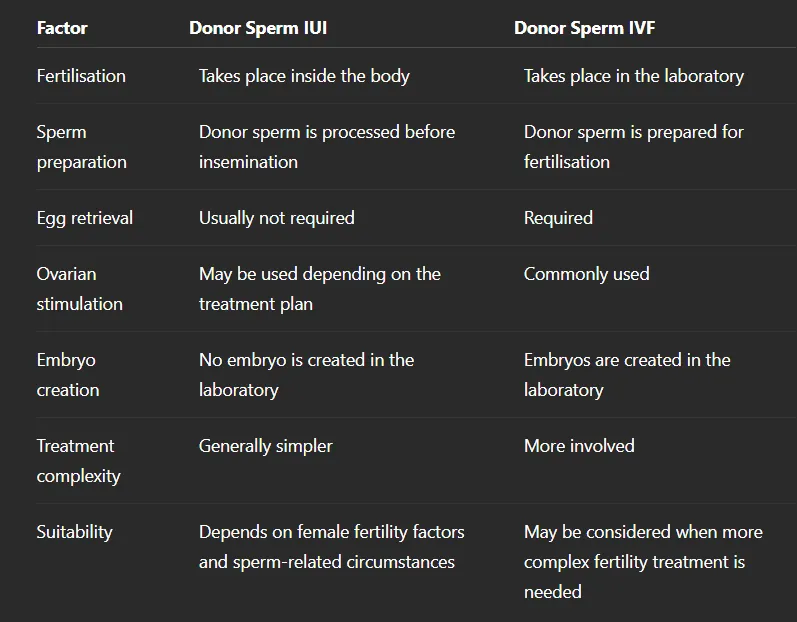
The choice between IUI and IVF depends on factors such as age, ovarian reserve, fallopian tube status, previous treatment history and other fertility findings.
How the Donor Sperm Process Works in India
The donor sperm process India generally involves several stages.
Step 1: Fertility Assessment
The first step is usually a medical assessment of the person or couple seeking treatment.
Depending on the situation, this may include:
- Medical and reproductive history
- Hormonal testing
- Ovarian reserve assessment
- Ultrasound
- Assessment of the fallopian tubes where appropriate
- Previous treatment records
- Genetic or other investigations when indicated
For male-factor infertility, the doctor may also review previous semen analyses and investigate whether sperm retrieval or treatment is possible.
Step 2: Discussion About Donor Sperm
If donor sperm is considered appropriate, the fertility specialist explains the treatment options.
This discussion may cover:
- IUI versus IVF
- Expected treatment steps
- Medical considerations
- Consent requirements
- Donor information available under applicable rules
- Costs and clinic procedures
- Emotional and counselling considerations
The decision should be made after informed discussion rather than simply choosing donor sperm based on convenience.
Step 3: Donor Screening
Donor sperm used in ART is subject to screening requirements.
Under the ART framework, registered ART banks are responsible for screening gamete donors and collecting, screening and storing semen. The ART Rules also require donor testing for specified communicable diseases.
This screening is an important safety step, but no medical screening can eliminate every possible health or genetic risk.
Step 4: Sperm Collection and Storage
The donor provides a semen sample according to the ART bank's procedures.
The sample is processed and stored under prescribed conditions. ART clinics and banks are required to maintain records relating to donor gametes and their use.
The ART Act also places restrictions on the use and supply of donor gametes and requires registered ART banks to handle donor gamete services.
Step 5: IUI or IVF Treatment
If IUI is selected, the prepared donor sperm is placed inside the uterus around the time of ovulation.
For IVF, the woman's eggs are collected after ovarian stimulation. The eggs are fertilised with sperm in the laboratory, embryos are developed and an appropriate embryo may then be transferred to the uterus.
The exact treatment protocol differs from person to person.
What Does the ART Act 2021 Say About Donor Sperm?
The ART Act 2021 donor sperm provisions are designed to regulate how donor gametes are screened, collected, stored and used.
Some important provisions include:
- Donor semen must be sourced through registered ART banks.
- Sperm donors must be between 21 and 55 years of age.
- Donors must undergo prescribed disease screening.
- ART banks must maintain donor-related records.
- Clinics and banks have defined responsibilities for maintaining treatment and donor information.
- A donor relinquishes parental rights over children born from the donor's gametes under the Act.
The Act also states that a child born through ART is treated as the biological child of the commissioning couple under the applicable law, while the donor relinquishes parental rights.
Because ART regulations and implementation requirements can change, patients should confirm the current requirements directly with a registered ART clinic or bank.
Can You Choose the Donor?
Donor information and selection are subject to applicable ART rules and clinic procedures.
Patients should not assume that they can freely select a donor based on any preferred physical, educational or personal characteristic. The availability of donor information and the selection process must follow the applicable regulatory framework.
The fertility clinic should clearly explain what information can legally be provided before treatment.
Is Donor Sperm Safe?
Donor sperm goes through screening and laboratory handling procedures intended to reduce health risks.
However, screening does not guarantee that a donor or future pregnancy is completely free from medical or genetic risks.
Patients should therefore ask the fertility clinic:
- Which tests are performed on donors?
- How is the sample stored and identified?
- Is the ART bank registered?
- What donor information can be provided?
- What consent forms are required?
- What happens to unused samples?
- What legal documentation is required?
These questions can help patients understand the process before treatment begins.
Emotional Considerations of Using Donor Sperm
Choosing donor sperm can involve emotional and personal questions, especially for couples who initially expected to conceive using the male partner's sperm.
Counselling can help couples or individuals discuss:
- Feelings about genetic parenthood
- Disclosure to the child in the future
- Family communication
- Expectations about donor information
- Concerns about social or emotional acceptance
There is no universal emotional response to donor conception. Taking time to understand the decision can be as important as understanding the medical procedure.
Donor Sperm IUI or IVF: Which Is Better?
Neither treatment is automatically better for everyone.
IUI may be considered when the woman's fertility factors are favourable and there are no major barriers to conception through insemination.
IVF may be recommended when additional fertility factors are present, when previous IUI treatment has not worked, or when the clinical situation requires laboratory fertilisation.
Age, ovarian reserve, fallopian tube health, previous fertility treatment and other medical factors can all influence the treatment plan.
Final Takeaway
Donor sperm can provide an important fertility treatment option when using the male partner's sperm is not possible or medically appropriate. It may be used with IUI or IVF depending on the individual's fertility profile.
The donor sperm iui ivf process in India involves fertility assessment, counselling, donor screening, sample handling and treatment through an appropriately registered ART setup. India's ART Act, 2021 provides a regulatory framework for donor gametes, including donor screening, ART bank responsibilities and parental rights.
Anyone considering donor sperm should discuss the medical, legal and emotional aspects with a qualified fertility specialist before starting treatment.
Medical Disclaimer: This article is for educational purposes only and should not replace advice from a qualified fertility specialist. Treatment suitability, testing and legal requirements can vary between individuals and may change with applicable regulations.