Different Sizes of Metzenbaum Scissors: A Practical Guide
27 Views
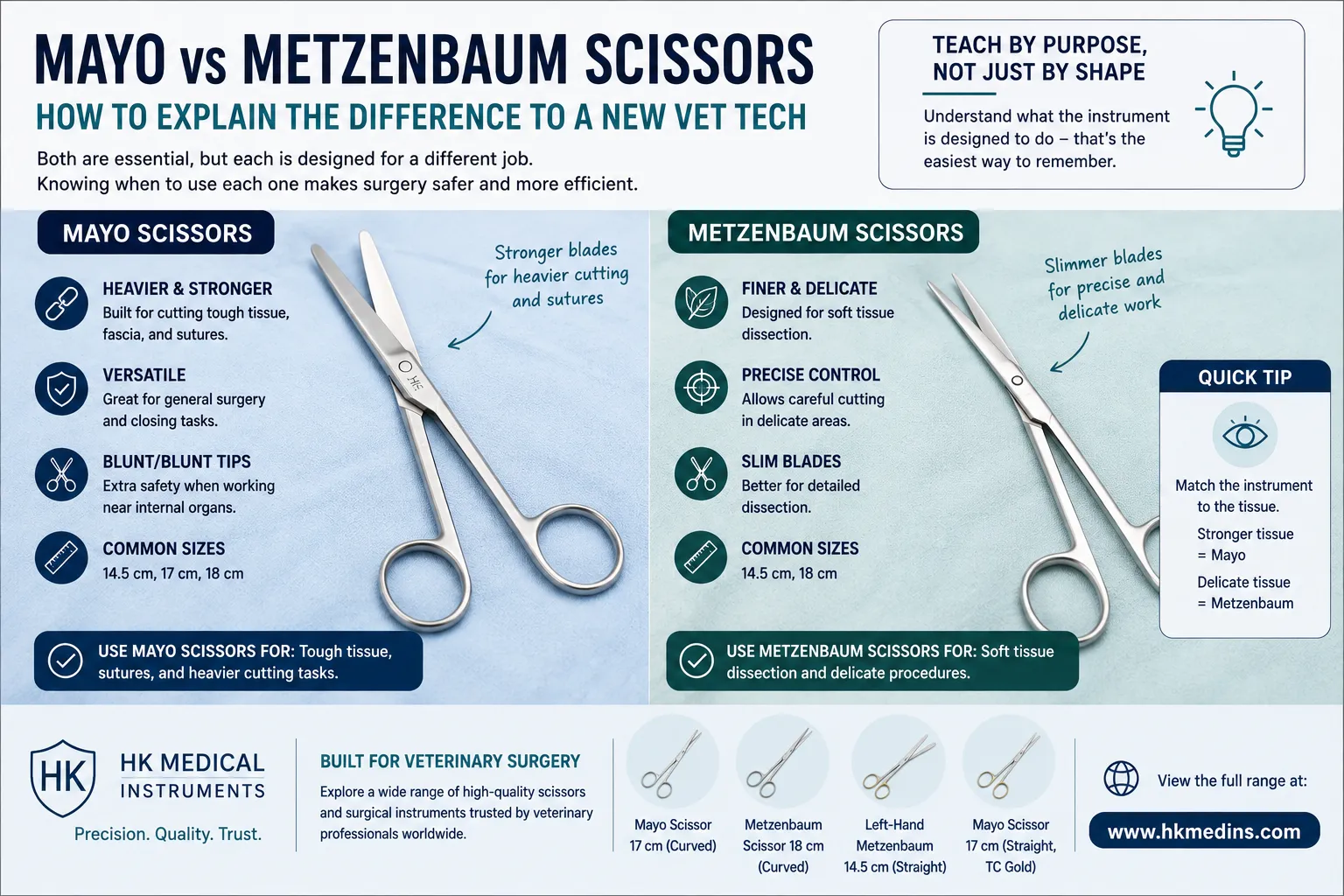
Metzenbaum scissors are widely used for delicate tissue dissection and soft-tissue procedures in surgical and veterinary settings. Their relatively slender blades and distinctive handle-to-blade proportions make them useful when precision and controlled cutting are important.
One of the most important factors when selecting a Metzenbaum scissor is size. Different lengths can provide different levels of access, control, visibility and reach. Understanding the available sizes can help veterinary professionals and surgical teams select an instrument that matches the procedure.
What Are Metzenbaum Scissors?
Metzenbaum scissors are dissecting scissors designed primarily for cutting and separating delicate soft tissue. They are available in several configurations, including straight and curved patterns, as well as different tip designs and lengths.
HK Medical Instruments offers a dedicated Metzenbaum Scissors collection, making it easier to compare different instruments according to their design and intended application.
When choosing a pair, size should be considered together with blade shape, tip configuration and the depth of the surgical field.
Common Metzenbaum Scissor Sizes
Metzenbaum scissors are available in a range of lengths. The most appropriate size depends on the procedure, the patient's size and the accessibility of the tissue being dissected.
1. 4-Inch Metzenbaum Scissors
The smaller 4-inch size is useful when a compact instrument is preferred. Its shorter overall length can provide close hand control and may be appropriate for procedures involving small anatomical structures or limited working areas.
HK Medical Instruments lists a 10 cm (4-inch) straight Metzenbaum scissor with blunt/blunt tips and tungsten-carbide construction. This provides an example of how smaller Metzenbaum instruments can combine compact dimensions with specialized blade construction.
Smaller scissors may be particularly useful in veterinary procedures involving smaller patients where a long instrument could make precise manipulation more difficult.
2. 4½-Inch Metzenbaum Scissors
At approximately 11.5 cm, the 4½-inch Metzenbaum scissor provides a little more reach while remaining relatively compact.
HK Medical Instruments lists a 4½-inch straight, blunt/blunt Metzenbaum scissor. This size can be considered when the user wants a balance between close control and slightly greater working length.
For clinics maintaining instruments for a variety of small-animal procedures, a compact Metzenbaum scissor can be a useful addition to the surgical instrument selection.
3. 5½-Inch Metzenbaum Scissors
The 5½-inch size is a versatile option and is available in different configurations.
For example, HK Medical Instruments lists a 14.5 cm (5½-inch) curved, blunt/blunt Metzenbaum scissor.
A 5½-inch instrument can offer a useful middle ground between compact scissors and longer instruments. The curved pattern may also help with access and visualization when dissecting around tissue structures.
The exact configuration should always be selected according to the procedure and the professional's preferred surgical technique.
4. 7-Inch Metzenbaum Scissors
A 7-inch Metzenbaum scissor provides additional reach compared with shorter models. Longer instruments can be useful when the working area is deeper or when additional distance between the surgeon's hand and the surgical field is beneficial.
Specialized variants are also available. For example, HK Medical Instruments lists a 7-inch Metzenbaum-Fino dissecting scissor with sharp/sharp, curved blades and a slender pattern.
This demonstrates that size is only one part of instrument selection. A 7-inch scissor with a slender, curved design can have quite different characteristics from a shorter blunt/blunt model.
5. 11-Inch Metzenbaum Scissors
Long Metzenbaum scissors are designed to provide greater reach. HK Medical Instruments lists an 11-inch (28 cm) curved Metzenbaum scissor with blunt/blunt tips and TC GOLD construction.
An instrument of this length can be considered when working in deeper surgical fields where a shorter scissor may not provide sufficient reach.
However, longer scissors can feel different in the hand and may require more deliberate handling. Therefore, they should be selected based on the procedure rather than simply choosing the longest available instrument.
Metzenbaum Scissor Size Comparison
| Approximate Size | Length | General Characteristics |
|---|---|---|
| 4 inch | 10 cm | Compact and close-control applications |
| 4½ inch | 11.5 cm | Short instrument with slightly more reach |
| 5½ inch | 14.5 cm | Versatile intermediate size |
| 7 inch | 18 cm | Greater reach; specialized curved/slender options available |
| 11 inch | 28 cm | Extended reach for deeper surgical fields |
These are examples of sizes available from HK Medical Instruments rather than a universal sizing standard. Specific configurations may differ by model.
Straight vs. Curved Metzenbaum Scissors
Size should not be considered separately from blade configuration.
Straight Metzenbaum scissors can be useful when a direct cutting path is desirable. They can provide straightforward control for accessible tissue.
Curved Metzenbaum scissors can be advantageous when the surgeon needs to work around anatomical structures or improve visibility of the cutting area. HK Medical Instruments' product range includes both straight and curved Metzenbaum designs.
The choice between straight and curved blades depends on the procedure, tissue location and the operator's technique.
Why Does Metzenbaum Scissor Size Matter?
Choosing the appropriate length can affect several aspects of instrument handling:
Reach
Longer scissors can provide access to deeper surgical areas without requiring the user's hand to be positioned as close to the operative field.
Control
Shorter instruments can offer a compact feel and may be easier to manipulate during procedures requiring very close control.
Visibility
Curved and longer designs may help position the hand away from the immediate working area, potentially improving the operator's view.
Patient Size
Veterinary professionals may need different instrument dimensions for different animal sizes. A compact scissor can be more appropriate for small-animal procedures, while longer instruments may be useful for larger patients or deeper surgical fields.
Procedure Requirements
The required length ultimately depends on the surgical task. Delicate superficial dissection and deeper tissue work may call for different instrument dimensions.
How to Choose the Right Metzenbaum Scissor Size
When selecting a Metzenbaum scissor, consider these factors:
1. Surgical depth:
Choose a length that provides comfortable access to the working area.
2. Patient size:
The instrument should be appropriate for the animal and anatomical structures involved.
3. Blade configuration:
Decide whether straight or curved blades are better suited to the procedure.
4. Tip design:
Blunt/blunt and sharp/sharp configurations have different characteristics and should be selected according to the intended application.
5. Handling preference:
The instrument should feel comfortable and controllable in the user's hand.
6. Construction:
Specialized options, including tungsten-carbide configurations, may be available for users seeking particular durability or cutting characteristics.
Building a Practical Metzenbaum Scissor Selection
A veterinary practice does not necessarily need every available size. A more practical approach is to maintain a selection that covers the procedures most commonly performed.
A compact model can provide close control, a medium-length model can serve as a versatile general-purpose option, and a longer instrument can provide additional reach for deeper procedures.
HK Medical Instruments also offers other surgical instruments and categories, including surgical scissors, Mayo scissors, forceps and instrument packs. This allows veterinary practices to build an instrument collection around their specific surgical requirements.
Final Thoughts
Metzenbaum scissors are available in several sizes, and each length can offer different handling and access characteristics. From compact 4-inch and 4½-inch models to versatile 5½-inch and 7-inch options and extended 11-inch instruments, the appropriate size depends on the procedure, patient, surgical depth and operator preference.
Rather than choosing a Metzenbaum scissor based on length alone, consider the complete instrument design—including straight or curved blades, tip configuration and construction.
For veterinary professionals looking to compare available options, the HK Medical Instruments Metzenbaum Scissors range provides a convenient starting point for reviewing different sizes and configurations.