# Why Most Data and BI Projects Fail Before Anyone Builds a Single Dashboard
11 Views
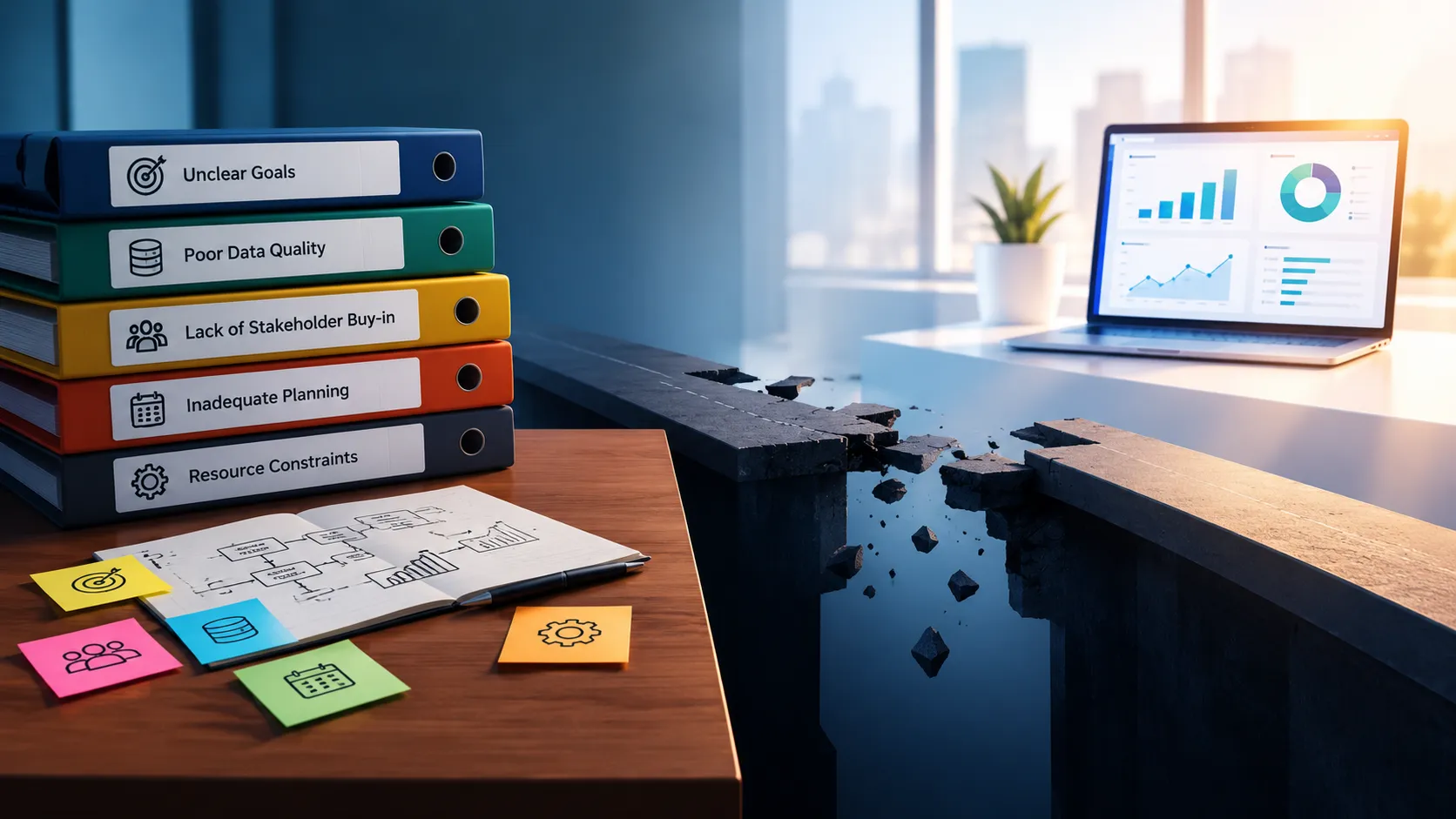
Ask any business leader if they have enough data, and the answer is almost always yes. Ask them if they trust it, and the room gets quiet. Most companies are sitting on years of information spread across an ERP, a CRM, spreadsheets, and a handful of other tools, and every one of those systems tells a slightly different story. The reports exist. The confidence in them often doesn't.
That's the real problem behind most struggling analytics projects. The reporting tool is rarely the issue. Power BI, Fabric, and the rest of the Microsoft stack are more than capable. What goes wrong is everything underneath: how the data is collected, cleaned, connected, and governed before it ever reaches a chart. Good **Data and BI services** start there, not with the dashboard.
## Where Data and BI Projects Usually Go Wrong
A few patterns show up again and again, no matter the industry or the size of the company.
**Data sits in too many places.** Finance has one version of a number, sales has another, and operations has a third. Without a single, shared foundation, every report becomes an argument about whose numbers are right.
**Dashboards get built before the questions are clear.** It's easy to start building visuals the moment data is available. But a dashboard that doesn't answer a real decision-maker's question just becomes one more tab nobody opens.
**Master data is messy.** Duplicate customers, inconsistent product names, vendors entered three different ways. Small problems in the source data turn into big problems in every report built on top of it.
**Nobody owns governance.** When anyone can publish a report and nobody checks how metrics are defined, trust erodes fast. People go back to exporting data into Excel and doing their own math.
**AI is bolted on too early.** Plenty of companies want AI-driven insights, but AI is only as good as the data behind it. Putting a forecasting model on top of inconsistent data just produces confident wrong answers.
## Why a Unified Data Platform Changes the Picture
This is where Microsoft Fabric has changed the conversation. Instead of stitching together separate tools for data engineering, storage, warehousing, and reporting, Fabric brings them into one platform with a shared data layer. For companies already running Dynamics 365 and Power BI, that matters a lot, because it means finance, supply chain, and customer data can finally live in one governed place rather than being copied between systems.
A modern **data lakehouse** is usually the heart of that setup. It gives teams one place to store raw and refined data, apply consistent rules, and feed reporting, analytics, and AI from the same source. The result is simple to describe and hard to achieve any other way: everyone looking at the same numbers.
Good **Microsoft Fabric consulting** helps with the parts that are easy to get wrong, like how to structure the layers of the lakehouse, how to move data in from existing systems without breaking reporting that people already rely on, and how to set up governance so the platform stays clean as more teams start using it.
## Getting Data Ready for AI
Almost every company is now asking some version of the same question: how do we use AI with our data? The honest answer is that most of the work happens before the AI part. An **AI-ready data platform** is really just a well-organized, well-governed one. The data is consistent, the definitions are clear, access is controlled, and there's a reliable pipeline feeding it.
That's why master data management deserves more attention than it usually gets. If the same customer shows up five different ways, no model can reliably predict churn or forecast demand for that customer. Cleaning up and standardizing core data, customers, products, vendors, and accounts, is unglamorous work, but it's what makes everything built afterward actually work.
Once that foundation is in place, the interesting things become possible: demand forecasting, anomaly detection, predictive maintenance, and smarter reporting that tells people what's likely to happen, not just what already did.
## Where Power BI Fits In
Power BI is still the layer most people see, and it should be. It's where decision-makers actually spend their time. But it works best as the top of a well-built stack, not the whole stack. When the data underneath is clean, connected, and governed, Power BI reports load faster, numbers match across departments, and people stop second-guessing what they're looking at.
For organizations running Dynamics 365, this also means reports can combine finance, supply chain, and CRM data in one view instead of living in separate module-level dashboards. That's usually where leadership starts getting real value out of the investment.
## What to Look for in a Data and BI Partner
When choosing who to work with, a few things are worth checking:
**They start with the business question.** A good partner asks what decisions you need to make before asking which tool to use.
**They handle the full stack.** Data engineering, lakehouse design, master data, governance, and reporting all connect. A partner who only covers one layer leaves you to figure out the rest.
**They understand your ERP and CRM.** Analytics built on Dynamics 365 data works best when the people building it understand how that data is structured and where it tends to go wrong.
**They plan for life after launch.** Data platforms need ongoing care. Sources change, new teams join, and reporting needs shift. Support after go-live matters as much as the build itself.
DynaTech Systems brings these pieces together through its [Data and BI services](https://dynatechconsultancy.com/data-and-bi), covering Microsoft Fabric, data lakehouse modernization, master data management, and AI-ready data platforms alongside Power BI, so the reporting layer sits on a foundation people can actually trust.
## The Bigger Picture
Analytics projects don't fail because the tools aren't good enough. They fail because the data underneath wasn't ready, the questions weren't clear, or nobody was responsible for keeping things consistent. Companies that treat data as a foundation instead of a side project end up with something much more useful than a stack of dashboards. They end up with numbers they trust, decisions they can make faster, and a platform that's ready for whatever comes next, including AI.