Danfoss Drives and Vacon Drives Support Smarter Motor Control Across UK Industry
By Abdus Salam
42 Views
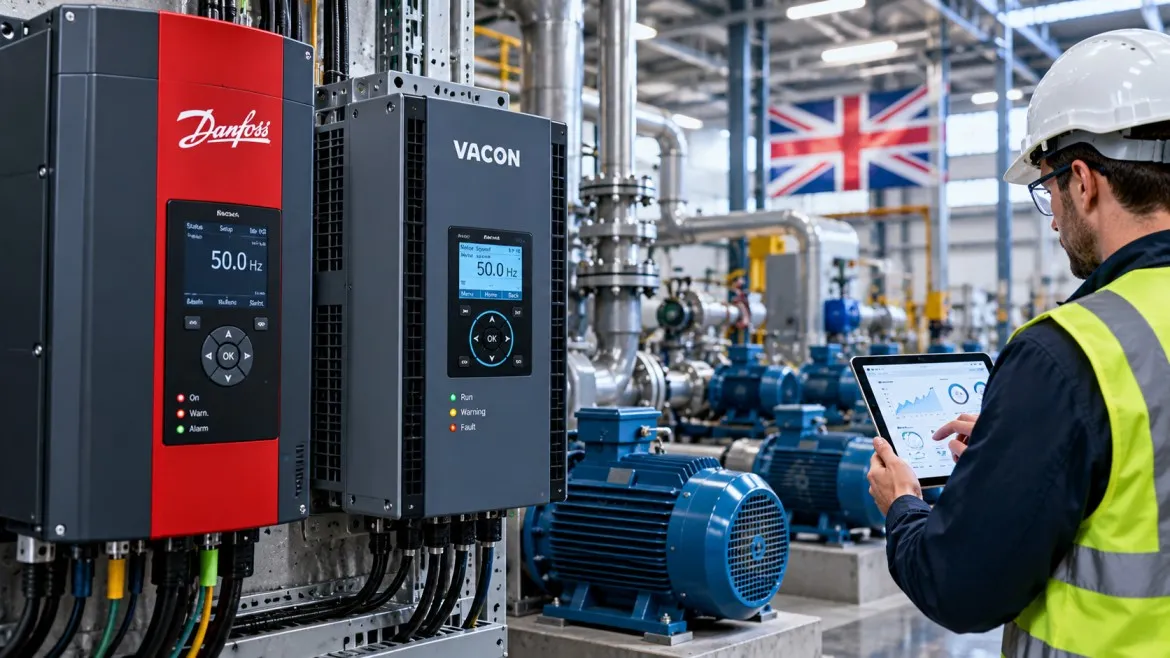
Industrial businesses across the UK face increasing pressure to improve efficiency, control energy costs, and minimise equipment downtime. Motors are central to many manufacturing, processing, HVAC, pumping, and material-handling operations, making effective motor control a key part of industrial performance.
Danfoss drives and Vacon drives are established solutions within the variable speed drive market, offering businesses options for controlling motor speed, torque and overall equipment performance. The most suitable drive, however, depends on the application, motor characteristics and operating environment.
Variable Speed Control Is Becoming More Important for UK Industry
Manufacturers and facilities managers are increasingly examining how equipment operates, not just how much power it consumes.
A motor running continuously at full speed may use more energy than necessary where the application does not require constant maximum output. Variable speed drives can adjust motor operation according to demand, potentially improving efficiency in suitable applications.
Drives are commonly used in:
- Pumps
- Fans
- Conveyors
- Compressors
- Production machinery
- Material-handling systems
- HVAC equipment
- Processing equipment
For businesses operating multiple motors, even small control improvements can add up over time.
Danfoss Drives Offer Flexible Industrial Motor Control
Danfoss produces a broad range of drive technologies for industrial and commercial applications.
Danfoss drives can be used across applications ranging from relatively straightforward speed-control requirements to more demanding automation environments.
When selecting a Danfoss drive, engineers should consider factors such as motor power, voltage, current, load characteristics, required speed range and control requirements.
The objective should be to match the specific drive configuration to the machinery rather than selecting a product simply because it has a suitable kilowatt rating.
Vacon Drives Remain Relevant to Industrial Applications
Vacon is an established name in variable speed drive technology and became part of Danfoss. Vacon drives remain associated with industrial motor-control applications across sectors.
They are used in applications where reliable speed and torque control are important, including pumps, conveyors, compressors, and various types of industrial machinery.
For businesses maintaining existing Vacon equipment, understanding the original drive specification can be particularly important when considering repair, replacement or an upgrade.
Danfoss and Vacon Drives Should Be Compared by Application
Comparing Danfoss drives and Vacon drives purely on brand does not necessarily provide enough information to make an informed purchasing decision.
Engineers should assess:
- Motor specifications
- Application type
- Load profile
- Required torque
- Operating environment
- Duty cycle
- Braking requirements
- Communication protocols
- Panel requirements
- Future maintenance needs
A drive designed for a light-duty application may not suit machinery operating under demanding loads.
Industrial Businesses Are Looking Beyond Initial Purchase Price
A drive's cost is only one part of its overall value. Businesses also need to consider installation, commissioning, energy consumption, maintenance and potential downtime.
A poorly specified drive can create operational problems that outweigh any initial savings.
For this reason, businesses should consider the equipment's full lifecycle. Availability of technical support and replacement components can also become important when machinery is expected to operate for many years.
Digicon Solutions Supports UK Drive Requirements
Digicon Solutions supports businesses looking for industrial drive and automation solutions, including Danfoss drives and Vacon drives.
Its role can extend beyond supplying equipment. Businesses may require help identifying an appropriate drive for an existing motor, replacing an obsolete unit or assessing whether a different specification would better suit an application.
For industrial operators, access to technical knowledge can be particularly useful when replacing a drive connected to critical machinery, where compatibility and correct configuration are essential.
Drive Replacement Can Be an Opportunity to Improve Equipment
When an older drive fails, a like-for-like replacement may seem like the simplest option. However, businesses can use the opportunity to review whether the existing system remains appropriate.
An assessment could consider:
- Current motor efficiency
- Changes to production requirements
- Energy consumption
- Existing drive condition
- Availability of replacement parts
- Control and automation requirements
- Future expansion
A newer drive may provide additional control functionality or better integration with an existing automation system, depending on the application.
Correct Installation Helps Protect Drive Performance
Even a high-quality drive can experience problems if it is incorrectly installed or configured.
Installation may involve electrical protection, cabling, earthing, ventilation, EMC requirements, and motor compatibility. Drive parameters must also be configured appropriately for the motor and application.
Commissioning is therefore an important stage of the process.
For critical industrial machinery, businesses should also retain drive settings and documentation so that future maintenance engineers can diagnose faults or replace equipment more efficiently.
Preventative Maintenance Can Reduce Industrial Downtime
Industrial drives operate in environments where heat, dust, vibration and electrical conditions can affect equipment over time.
Regular inspections can help identify potential issues before they cause unexpected downtime. Depending on the installation, maintenance may include checking ventilation, connections, cooling systems, fault history and associated motor components.
This is particularly important for businesses where a motor failure could interrupt production or affect deliveries.