Custom Software Development in 2026: What's Actually Worth Investing In
By North Rose Technologies LLC
3 Views
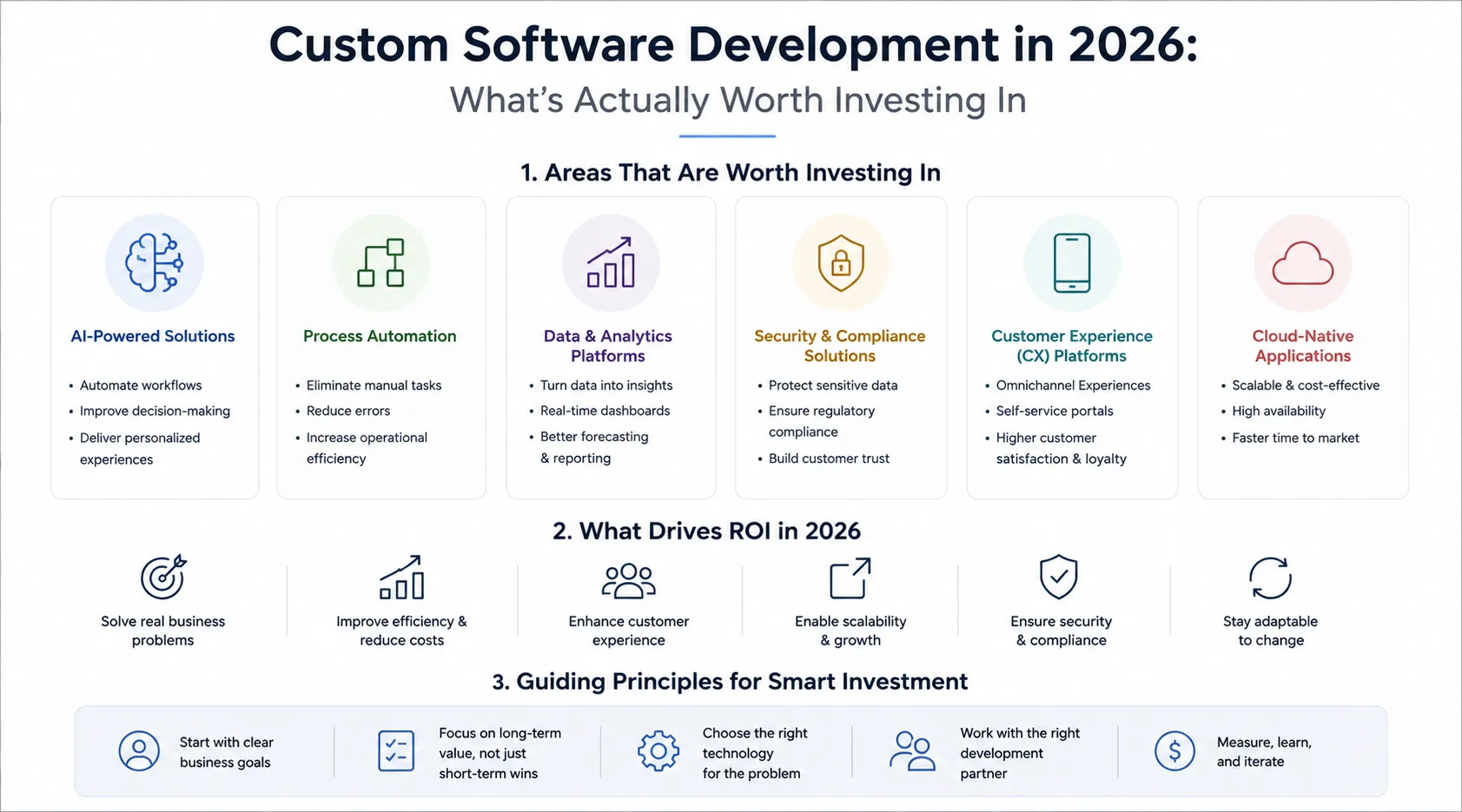
Every year brings a fresh wave of buzzwords in the software world, and 2026 is no exception. AI agents, cloud native architecture, digital twins, low code platforms, the list keeps growing. For a business owner or IT leader trying to plan next year's budget, it can be tempting to either chase every trend or ignore all of them out of fatigue.
Neither approach works well. The businesses seeing real returns from custom software this year are not the ones adopting every new tool. They are the ones being selective, investing in the areas that actually move the needle for their operations, and skipping the noise.
Here is a clear look at what is genuinely worth investing in right now, and what can wait.
AI Integration Is No Longer Optional, But It Needs Boundaries
At this point, artificial intelligence inside custom software is not a differentiator, it is close to a baseline expectation. Development teams across the industry have moved well past experimenting with AI and are now building it directly into core product functionality, from intelligent automation to predictive features that used to require entire dedicated teams.
That said, the smartest businesses in 2026 are not chasing AI for its own sake. They are asking a simple question before adding any AI feature: does this actually solve a real operational problem, or is it there because it sounds impressive in a sales pitch. Custom development gives you the freedom to answer that question honestly, because you are not locked into whatever AI features a vendor decided to bundle into their platform.
If you are evaluating a partner for this kind of work, look closely at how they think through this balance. A team offering strong Custom Software Development Services should be able to explain exactly why a specific AI feature belongs in your system, not just that it can be added.
Cloud Native Architecture Is Worth Prioritizing Early
Scalability used to be something businesses worried about after they hit growth milestones. That approach no longer holds up. Building on cloud native infrastructure from the start has become one of the clearest ways to avoid costly rebuilds down the line.
This matters because growth rarely arrives on a predictable schedule. A seasonal spike, a new client, or a successful marketing push can suddenly demand more from your systems than they were built to handle. Cloud native design means your software can flex with that demand instead of buckling under it.
This is an area where the upfront investment tends to pay for itself many times over. Skipping it to save money early almost always costs more later, once a full replatforming project becomes unavoidable.
Security and Compliance Deserve a Bigger Slice of the Budget
Regulatory requirements are tightening across nearly every industry, and data privacy expectations from customers have never been higher. This is pushing security from an afterthought into a core design requirement for custom software projects.
Businesses that treat security as something to bolt on after launch are increasingly finding themselves exposed, both to breaches and to compliance penalties. The smarter path in 2026 is building security architecture in from day one, including how data is stored, how access is controlled, and how systems are monitored for unusual activity.
This is not an area to cut corners on to save budget. The cost of a breach or a compliance violation almost always dwarfs the cost of doing security properly the first time.
Modular Systems Over Monolithic Suites
There is a clear shift happening away from massive, all in one software suites and toward modular systems built from smaller, purpose built components. This approach gives businesses more flexibility to update, replace, or scale individual parts of their software without disrupting the entire system.
For growing companies, this modularity is particularly valuable. You are not stuck rebuilding an entire platform just because one part of it needs to evolve. Instead, you can upgrade a single module while the rest of the system continues running smoothly.
This is one of the strongest arguments for custom development over generic platforms right now. Off the shelf software rarely offers this kind of flexibility, since it is built as a fixed package rather than a set of independent, adaptable pieces.
Mobile Experiences Deserve Real Investment, Not an Afterthought
As more business processes move into the field, into customer hands, and into everyday mobile use, a genuinely well built mobile experience has become a competitive advantage rather than a nice to have. Businesses that treat mobile as a stripped down companion to their desktop software are increasingly losing ground to competitors offering a true mobile first experience.
This is especially relevant for companies with field teams, delivery operations, or customer facing apps where mobile is the primary point of contact. Investing properly here, through dedicated Mobile App Development Services, often delivers a faster and more visible return than almost any other software investment on this list.
Low Code Tools Have a Place, But Not Everywhere
Low code and no code platforms have matured significantly, and they genuinely speed up development for certain kinds of internal tools and simpler applications. It makes sense to use them where they fit.
The mistake many businesses make is trying to stretch low code platforms into complex, mission critical systems they were never designed to handle. That is where custom development still clearly wins, particularly for systems that need to integrate deeply with existing infrastructure, handle sensitive data, or scale significantly over time.
The smartest approach in 2026 is not choosing one method over the other completely. It is knowing which projects genuinely benefit from low code speed, and which ones need the depth and control that only custom development can provide.
Choosing Where to Invest
With so many trends competing for attention, the businesses winning in 2026 are the ones asking a very practical question before any investment: will this actually solve a problem we have, or make our operations meaningfully better. If the answer is unclear, it is worth pausing before committing budget.
This is exactly the kind of strategic thinking that a strong development partner should bring to the table. Working with a team like North Rose Technologies means having someone who can help you separate genuine opportunity from hype, and build a roadmap that reflects where your business actually needs to go, not just what is trending this year.
The trends shaping 2026 are real, and many of them are worth serious consideration. But the smartest investment any business can make is in clarity first, choosing the right priorities before choosing the right technology.