How CPQ Software for Manufacturing Reduces Quote Errors and Accelerates Deal Closures
114 Views
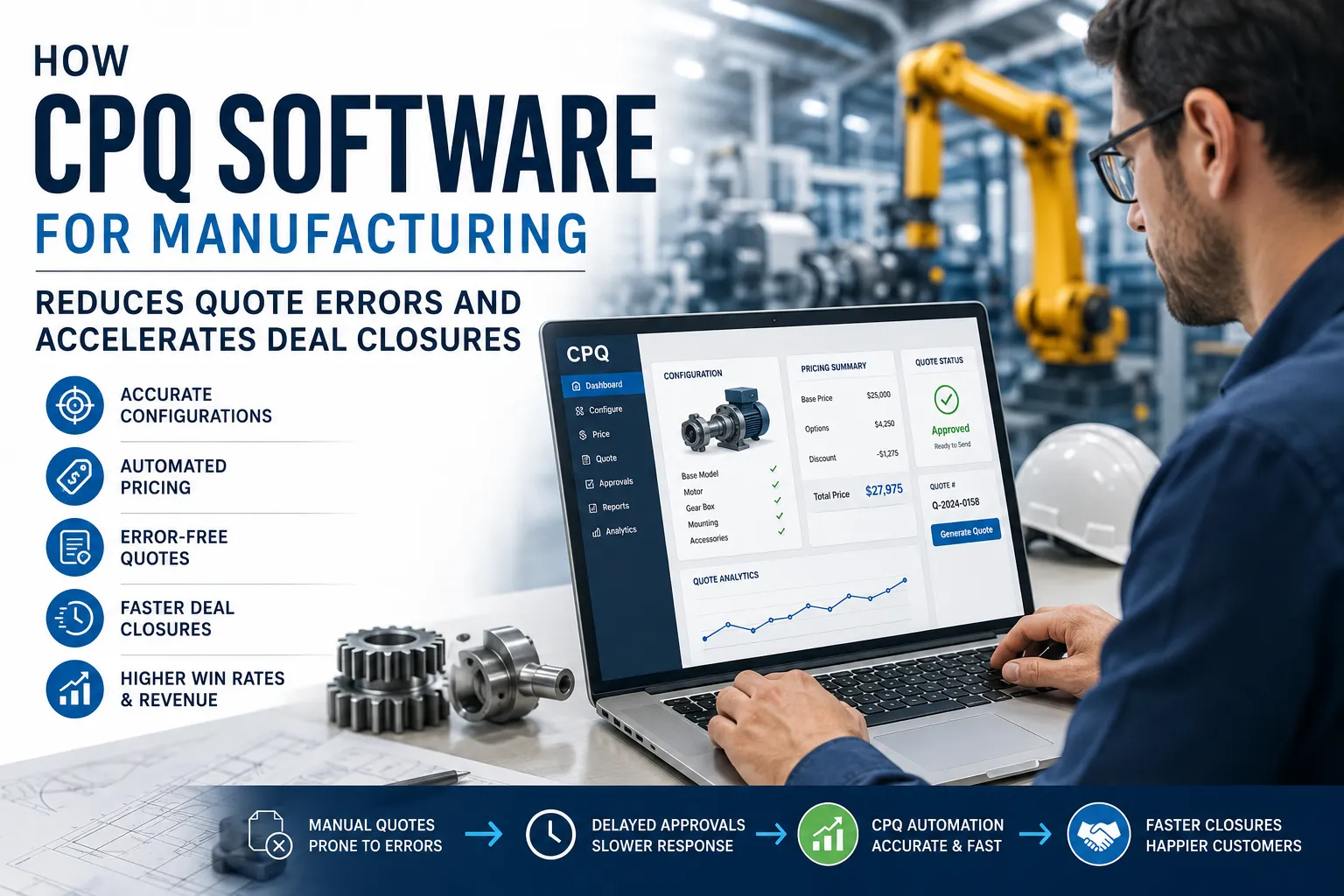
CPQ Software for Manufacturing has become a critical tool for companies trying to balance complex product configurations, tight margins, and growing customer expectations. In many manufacturing organizations, sales teams still rely on spreadsheets, disconnected systems, and manual approval chains to create quotes. That process is slow, error-prone, and difficult to scale.
Manufacturers today face several common quoting challenges:
- Manual quote creation that consumes valuable sales time
- Pricing inconsistencies across regions, products, or sales reps
- Configuration mistakes that lead to production delays
- Approval bottlenecks that stall deals for days or weeks
- Missed opportunities because competitors respond faster
In a competitive manufacturing environment, speed and accuracy matter. Buyers expect fast, precise quotes that reflect their exact requirements. A single pricing error or configuration mismatch can damage trust, delay purchasing decisions, and reduce profitability. That is why more manufacturers are turning to CPQ technology to streamline sales operations and improve revenue performance.
Why Quote Errors Are Costing Manufacturers More Than They Realize
Quote errors are not just administrative mistakes. They create ripple effects across the entire organization.
Revenue leakage and margin erosion
When pricing is handled manually, discounts may exceed approved thresholds or outdated pricing may be used. Even small errors can significantly impact margins over hundreds of deals.
Customer trust issues
If a customer receives a revised quote after an error is discovered, confidence drops quickly. Buyers expect manufacturers to understand their own products and pricing structures.
Operational inefficiencies
Incorrect configurations often lead to rework in engineering, procurement, or production. Teams must revisit specifications, update BOMs, and correct downstream documentation.
Slower purchasing decisions
Long approval cycles and inaccurate quotes delay customer decisions. In many cases, prospects move forward with a competitor that responds faster.
Reduced sales productivity
Sales representatives spend too much time checking pricing, requesting approvals, and correcting mistakes instead of building relationships and closing deals.
For manufacturers managing configurable products, these issues become even more expensive as product complexity grows.
What Is CPQ Software for Manufacturing?
CPQ stands for Configure, Price, Quote. It is a software solution designed to help sales teams create accurate, customized quotes quickly and consistently.
Here is what CPQ Software for Manufacturing typically does:
- Configure products
- Guides sales reps through product options, ensuring only valid combinations are selected.
- Apply pricing automatically
- Uses predefined pricing rules, discount policies, and customer-specific pricing agreements.
- Generate professional quotes
- Creates standardized proposals and quotes automatically, reducing manual document creation.
- Integrate with CRM and ERP systems
- Connects sales, operations, and finance systems so data flows seamlessly across the organization.
Instead of relying on spreadsheets and email chains, CPQ centralizes quoting logic in one system. Sales teams can configure complex products confidently, while operations teams gain visibility into approved configurations and pricing.
How CPQ Software for Manufacturing Reduces Quote Errors
The biggest advantage of CPQ Software for Manufacturing is its ability to eliminate the manual steps where most errors occur.
Automated product configuration
Manufacturing products often include thousands of possible combinations. CPQ systems use configuration rules to ensure sales reps select only compatible options. For example, an industrial equipment manufacturer can prevent incompatible motor, voltage, or enclosure combinations from being quoted.
Built-in pricing rules
Pricing logic is embedded in the system. That means:
- Current price lists are always used
- Volume discounts are calculated automatically
- Customer-specific pricing agreements are applied consistently
- Margin thresholds are enforced
This removes the guesswork and reduces pricing discrepancies across the sales team.
Guided selling workflows
CPQ platforms guide reps step by step through the quoting process. Instead of manually interpreting product catalogs, reps answer structured questions and the system builds the correct configuration.
Standardized discount controls
Unauthorized discounting is a common problem in manufacturing sales. CPQ enforces approval rules automatically, ensuring discounts beyond a certain threshold are routed to the appropriate manager.
Elimination of spreadsheet dependency
Spreadsheets are flexible, but they are also fragile. Version control issues, formula errors, and manual updates create risk. CPQ replaces scattered spreadsheets with a centralized, controlled system.
Reduced human errors
By automating calculations, validations, and document generation, CPQ dramatically reduces the chance of human mistakes. Sales teams can focus on customer conversations rather than administrative checks.
Accelerating Deal Closures Through Intelligent Automation
Reducing errors is only part of the story. CPQ Software for Manufacturing also helps companies close deals faster.
Faster quote turnaround times
What once took days can often be completed in minutes. Sales reps can generate accurate quotes during customer calls or shortly afterward, keeping momentum alive in the sales process.
Automated approvals
Instead of chasing approvals through email, CPQ routes requests automatically based on predefined rules. Managers receive notifications, review exceptions, and approve quotes digitally.
Real-time pricing updates
Manufacturers dealing with fluctuating material costs need pricing agility. CPQ systems can update pricing centrally, ensuring every quote reflects the latest approved rates.
Improved collaboration between sales and operations
Because CPQ integrates with CRM and ERP systems, operations teams gain visibility into incoming orders earlier. Engineering, production, and finance teams work from the same data, reducing handoff delays.
Better customer responsiveness
Customers notice speed. A manufacturer that responds with a detailed, accurate quote within hours often gains an advantage over competitors that take several days.
Real-World Manufacturing Use Cases
CPQ delivers value across many manufacturing sectors.
Industrial equipment manufacturers
These companies often sell highly configurable systems with multiple technical options. CPQ ensures quotes reflect valid engineering configurations and accurate pricing.
Custom machinery providers
Custom machine builders frequently manage unique customer requirements. CPQ helps standardize the quoting process while still supporting customization, reducing engineering involvement in early-stage sales.
Electronics manufacturers
Electronics companies must manage complex component options, compliance requirements, and regional pricing. CPQ helps maintain consistency across global sales teams.
Automotive component suppliers
Automotive suppliers often work with strict pricing agreements and high-volume quotes. CPQ automates pricing calculations and approval workflows, helping teams respond quickly to OEM requests.
In each case, CPQ improves both internal efficiency and the customer experience by delivering faster, more accurate quotes.
The Role of AI and Advanced Automation in Modern CPQ
CPQ technology is evolving beyond basic automation. Modern platforms increasingly incorporate AI and advanced analytics to improve decision-making.
AI-assisted pricing recommendations
AI can analyze historical deals, customer behavior, and market trends to suggest optimal pricing strategies that balance competitiveness and margin protection.
Predictive analytics
Manufacturers can identify which quote characteristics are most likely to lead to a win, helping sales teams prioritize high-probability opportunities.
Intelligent product recommendations
AI can suggest complementary products or configurations based on customer needs, increasing deal value while improving the buying experience.
Automated compliance checks
For industries with regulatory requirements, CPQ can validate configurations against compliance rules automatically, reducing risk and manual review time.
Smart approval routing
Advanced systems can route approvals dynamically based on deal size, margin impact, or customer tier, streamlining governance without slowing sales.
Solutions like Mobileforce are part of this broader shift toward intelligent CPQ platforms that help manufacturers adopt automation while fitting into existing CRM and ERP workflows.
Measuring Success After CPQ Implementation
To understand the impact of CPQ, manufacturers should track measurable business outcomes.
Key KPIs to monitor
- Quote turnaround time – How quickly quotes are delivered to customers.
- Quote accuracy rate – Reduction in pricing or configuration errors.
- Sales cycle length – Time from opportunity creation to deal closure.
- Win rate improvements – Percentage of quotes that convert into orders.
- Revenue growth – Increased sales from faster response times and better pricing control.
- Customer satisfaction – Feedback related to quoting speed, clarity, and accuracy.
Many manufacturers see improvements within months, especially in quote turnaround time and error reduction.
Best Practices for Successful CPQ Adoption
Implementing CPQ is not just a software project. It is a process transformation initiative.
Prepare your data
Clean product data, pricing information, and customer records are essential for accurate CPQ performance.
Standardize product catalogs
Clearly defined product structures and configuration rules make implementation smoother and improve long-term maintainability.
Invest in user training
Sales teams need to understand not only how to use the system, but also why standardized processes matter.
Plan integrations carefully
CPQ works best when connected to CRM, ERP, and other business systems. Integration planning should happen early in the project.
Start with high-impact use cases
Begin with product lines or sales processes where quoting complexity is highest. Early wins build momentum for broader adoption.
Continuously optimize
Manufacturing businesses evolve. Pricing rules, product options, and approval workflows should be reviewed regularly to keep the CPQ system aligned with business needs.
When evaluating modern platforms, manufacturers often look at solutions such as Mobileforce that can adapt to existing business processes rather than forcing teams into rigid workflows.
Building Faster, More Accurate Manufacturing Sales Processes with CPQ
The manufacturing sales process is becoming more complex, but customers still expect one thing: fast, accurate quotes. CPQ Software for Manufacturing helps companies meet that expectation by automating configuration, pricing, approvals, and quote generation.
The benefits are clear:
- Fewer quote errors and pricing mistakes
- Faster deal closures and shorter sales cycles
- Improved customer confidence and satisfaction
- Higher sales productivity and operational efficiency
- Better scalability as product complexity grows
As digital transformation continues across manufacturing, CPQ is no longer just a sales tool. It is becoming a core part of modern revenue operations, connecting sales, engineering, operations, and finance in one streamlined process.
Manufacturers that invest in accurate, automated quoting today will be better positioned to compete in a market where speed, precision, and customer experience increasingly determine who wins the deal.
Frequently Asked Questions
What is CPQ Software for Manufacturing?
CPQ Software for Manufacturing is a solution that automates product configuration, pricing, and quote generation for manufacturing companies. It helps sales teams create accurate quotes faster while reducing manual errors and improving consistency across complex product lines.
How does CPQ reduce quote errors?
CPQ reduces errors by using automated configuration rules, built-in pricing logic, guided selling workflows, and standardized approval processes. It eliminates many manual steps that commonly cause pricing mistakes, invalid configurations, and inconsistent quotes.
Can CPQ integrate with ERP systems?
Yes. Most modern CPQ platforms integrate with ERP systems as well as CRM platforms. This allows product, pricing, inventory, and customer data to flow between systems, improving accuracy and operational visibility across departments.
How long does CPQ implementation typically take?
Implementation timelines vary based on product complexity, data quality, and integration requirements. Many manufacturers complete initial deployments in a few months, while larger enterprise implementations may take longer due to customization and process alignment.
What benefits does CPQ provide to manufacturing sales teams?
CPQ helps sales teams generate quotes faster, reduce administrative work, improve pricing accuracy, shorten approval cycles, and close deals more efficiently. It also enables reps to handle complex product configurations with greater confidence and consistency.