How to Compare Foundation Repair Marketing Agencies Before Hiring One
8 Views
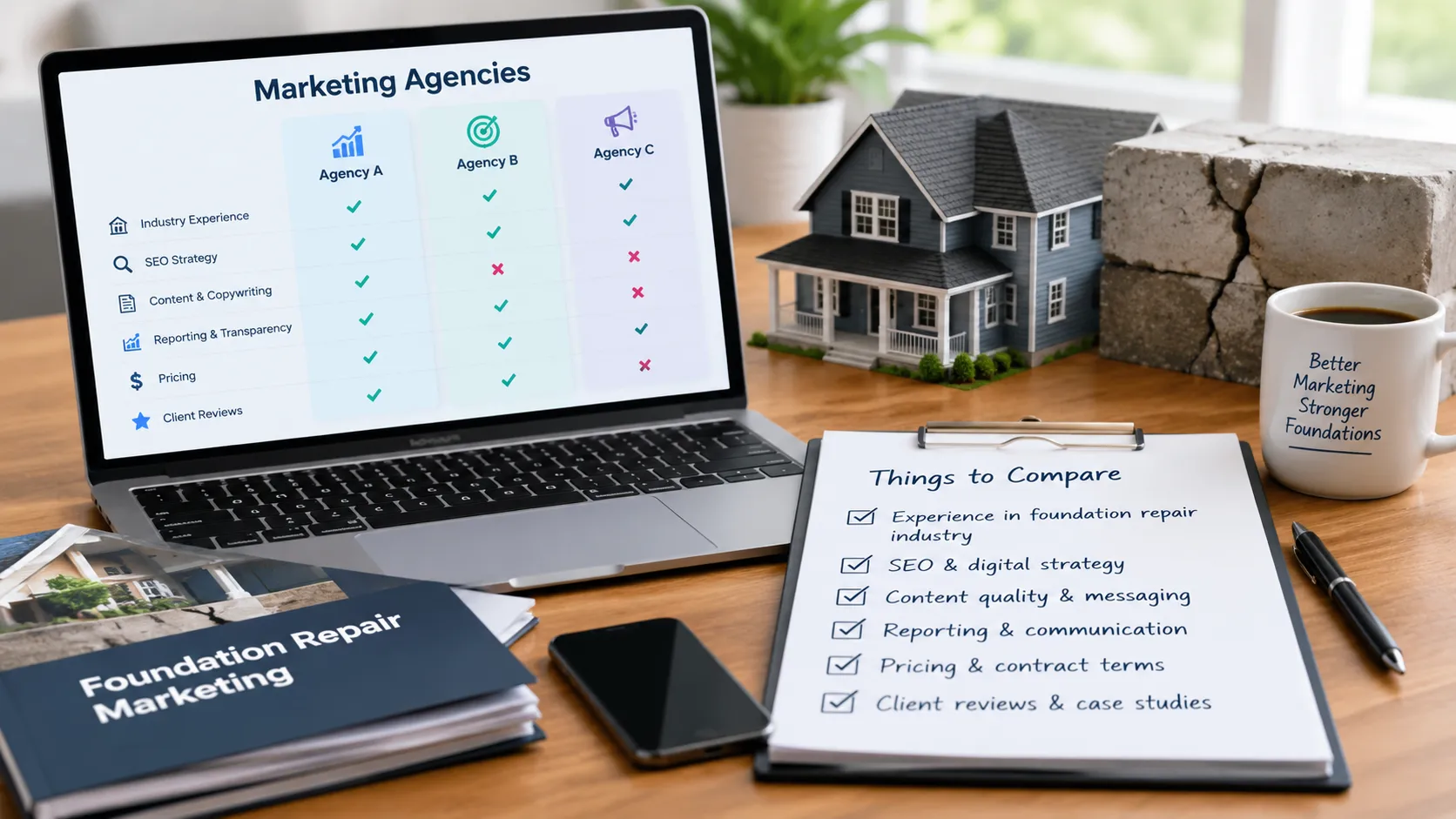
Choosing a Foundation Repair Marketing Agency requires more than comparing monthly fees or reviewing promises about Google rankings. Foundation repair contractors need a marketing partner that understands local search, homeowner trust, inspection bookings, lead quality, and the sales process behind structural repair projects.
Before hiring an agency, compare its foundation repair industry experience, SEO and paid advertising capabilities, reporting methods, contract terms, and ownership policies. The right partner should explain how its work will attract homeowners in your service area and how you will measure the business results.
This guide explains how to evaluate marketing agencies, compare proposals, identify warning signs, and choose a partner that fits your foundation repair company's growth goals.
What Does a Foundation Repair Marketing Agency Do?
A foundation repair marketing agency helps contractors attract potential customers through search engines, paid advertising, website optimization, content marketing, and other digital channels.
Its role should extend beyond generating website traffic. It should help your business reach homeowners looking for services such as foundation crack repair, structural stabilization, basement wall repair, slab foundation repair, and crawl space support.
Depending on your needs, an agency may provide:
-
Foundation repair SEO: Improves organic visibility for relevant repair services and local searches. Explore SEO services from Iynix Digital to understand the core activities involved.
-
Local SEO: Optimizes your Google Business Profile, service-area relevance, local landing pages, and reputation signals. See these Local SEO services for more information.
-
Google Ads management: Targets homeowners actively searching for foundation repair services.
-
Website optimization: Makes it easier for visitors to understand your services, trust your company, and request an inspection.
-
Content marketing: Answers homeowner questions about foundation problems, repair methods, warning signs, and the inspection process.
-
Reputation management: Helps you build a consistent process for requesting and responding to customer reviews.
-
Lead tracking and reporting: Connects marketing activity with phone calls, form submissions, booked inspections, estimates, and completed projects.
Not every contractor needs every service immediately. A company with strong organic visibility but few qualified calls may need conversion improvements, while a newer business may need to build local visibility and establish a reliable lead-generation process.
The agency should recommend services based on your current position, competition, service area, budget, and business goals.
1. Check the Agency's Foundation Repair Industry Experience
Start by determining whether the agency understands the foundation repair business or simply applies a general marketing package to every client.
Foundation repair is different from many other home services. Homeowners may notice a crack, sloping floor, sticking door, or bowing basement wall without knowing whether the issue requires professional evaluation. Your marketing must address those concerns while communicating your company's expertise and services accurately.
Ask prospective agencies these questions:
-
Have you worked with foundation repair or closely related structural repair contractors?
-
Can you show examples of campaigns for similar businesses?
-
How do you approach marketing for different foundation repair services?
-
How do you distinguish research-oriented visitors from homeowners ready to schedule an inspection?
-
Can you explain what improved, how it was measured, and what work contributed to the outcome?
Evaluate case studies carefully
A useful case study should explain the client's initial situation, the work performed, the measurement period, and the results.
For example, an agency might describe how it improved service-page visibility, optimized local listings, refined Google Ads campaigns, and introduced call tracking. Ask whether the reported improvement led to more qualified inquiries or booked inspections.
Look for evidence such as:
-
Growth in relevant organic search traffic.
-
More qualified calls from target service areas.
-
Improvements in inspection booking rates.
-
Better conversion rates from website visitors.
-
Reduced wasted advertising spend.
-
More estimates or signed jobs attributable to marketing.
Do not accept an impressive percentage without context. Ask about the starting point, time frame, seasonality, advertising budget, and other changes that may have influenced the result.
An agency does not need to specialize exclusively in foundation repair to be suitable. However, it should demonstrate that it understands contractor marketing and can develop a credible strategy for your specific services.
For an industry-specific example, read Best Foundation Repair Marketing Agency in Atlanta.
2. Compare Foundation Repair SEO Capabilities
SEO can help your company appear when homeowners search for foundation repair services, investigate structural problems, or compare contractors.
When comparing agencies, look beyond promises to increase rankings. Review the actual work they plan to perform.
Local SEO and Google Business Profile optimization
For contractors serving a defined geographic area, local visibility is essential.
Ask how the agency will improve your Google Business Profile and website's local relevance. Its plan may include accurate business information, appropriate service categories, relevant service descriptions, review management, and useful location-specific content.
The agency should also explain how it will target your actual service territory without creating misleading location pages or suggesting that you operate from addresses where you have no legitimate presence.
Review the agency's approach to Local SEO services when assessing its proposed local search strategy.
Service-page SEO
Your website should explain the foundation repair services you provide and help homeowners understand when to contact your team.
Depending on your offerings, relevant pages may cover:
-
Foundation crack repair.
-
Foundation settlement and structural stabilization.
-
Bowing basement wall repair.
-
Slab foundation repair.
-
Crawl space foundation support.
-
Related basement waterproofing services, if offered.
Ask whether the agency will improve existing pages or create new ones. Each page should serve a distinct search intent rather than repeat the same keywords across multiple URLs.
Technical SEO
Technical issues can prevent useful pages from being discovered, indexed, or used effectively.
Ask whether the agency will review:
-
Indexing and crawlability.
-
XML sitemaps and robots directives.
-
Duplicate or competing pages.
-
Mobile usability and page performance.
-
Internal links and broken URLs.
-
Title tags, meta descriptions, and heading structure.
-
Relevant structured data and its accuracy.
A good proposal should prioritize issues based on their impact instead of presenting a long list of technical tasks without explaining why they matter.
You can review Iynix Digital's SEO services to see examples of the SEO activities that may form part of an optimization plan.
Content strategy
Foundation repair SEO should address both service-related searches and the questions homeowners ask before contacting a contractor.
Examples include:
-
What causes foundation cracks in a house?
-
When should a homeowner have a foundation inspected?
-
What is the difference between foundation settlement and normal settling?
-
How do foundation piers work?
-
What should homeowners ask a foundation repair contractor before approving work?
Ask how the agency will research search intent, assess your existing content, and avoid creating overlapping pages that compete with each other.
The goal is to build useful topical coverage that supports service pages and helps potential customers make informed decisions.
3. Compare Paid Advertising and Lead Generation Services
SEO generally builds visibility over time. Paid search can help a contractor reach people actively searching for services while organic visibility develops.
A capable agency should explain whether Google Ads, Local Services Ads where eligible, or other channels make sense for your business. Availability and suitability depend on your services, location, and current platform requirements.
|
Marketing channel |
Main purpose |
What to measure |
|
Foundation repair SEO |
Build organic search visibility over time |
Relevant traffic, qualified calls, booked inspections |
|
Local SEO |
Improve visibility in relevant local searches |
Profile interactions, qualified calls, local lead quality |
|
Google Ads |
Reach high-intent searchers through paid placements |
Spend, qualified leads, cost per booked inspection |
|
Website optimization |
Convert visitors into inquiries |
Conversion rate, call quality, form completion |
|
Content marketing |
Answer homeowner questions and support discovery |
Relevant organic traffic, assisted conversions, engagement |
|
Review management |
Strengthen customer trust and reputation |
Review quality, response practices, reputation trends |
Do not assume every channel should receive equal investment. A contractor with a limited budget may need to focus on a few high-intent services and geographic areas before expanding.
Ask how the agency qualifies leads
A form submission is not automatically a valuable lead. It could come from outside your service area, concern a service you do not provide, or represent a person who is only seeking general information.
Ask the agency how it will distinguish qualified opportunities from spam, duplicate inquiries, unrelated requests, and unserviceable locations.
Discuss how phone calls and form submissions will be tracked, how missed calls will be handled, and whether lead-source information can be connected to your customer relationship management (CRM) system.
When comparing advertising proposals, ask about the agency's campaign setup, ongoing optimization, budget management, and conversion tracking. You can also review Iynix Digital's digital marketing services to understand the broader range of marketing activities a provider may offer.
4. Compare Agencies Using the Same Proposal Requirements
The easiest way to compare marketing companies fairly is to ask each one to respond to the same requirements.
Otherwise, one proposal may include technical SEO, content, and reporting, while another offers only basic optimization and advertising management. The lower monthly fee may not represent better value if the scope is substantially smaller.
Ask every agency to document:
-
The initial website and marketing assessment.
-
The services included each month.
-
The expected deliverables and implementation schedule.
-
The advertising budget, listed separately from management fees.
-
The reporting tools and performance metrics.
-
The responsibilities of your internal team.
-
The contract length, cancellation terms, and account ownership.
-
The process for reviewing results and adjusting strategy.
Agency comparison checklist
Use the following checklist during sales calls and proposal reviews.
|
Evaluation factor |
What to look for |
|
Industry experience |
Relevant contractor experience and verifiable case studies |
|
Strategy |
A plan based on your services, service area, and goals |
|
SEO |
Local SEO, service pages, technical improvements, and useful content |
|
Paid media |
Clear campaign structure, budget control, and optimization |
|
Lead quality |
A defined method for identifying qualified inquiries |
|
Reporting |
Transparent performance data and regular review meetings |
|
Pricing |
Itemized fees, deliverables, and additional costs |
|
Contract |
Clear duration, renewal, and cancellation provisions |
|
Ownership |
Your business retains access to its website, accounts, and data |
|
Communication |
Named contacts, realistic timelines, and clear responsibilities |
You can also ask each agency to identify the first three priorities it would address in your account. This reveals whether its recommendations are specific to your business or simply a standard sales presentation.
5. Understand Pricing Before Signing a Contract
The cost of hiring a Foundation Repair Marketing Agency depends on the services included, the size of your service area, the competitiveness of your market, your website's current condition, and the amount of work required.
A proposal for local SEO alone is not directly comparable to a package that includes SEO, Google Ads management, website development, content production, and CRM automation.
Instead of comparing monthly fees in isolation, ask for a complete cost breakdown.
What should a marketing proposal include?
-
Agency management fees: The amount charged for strategy, campaign management, reporting, and ongoing optimization.
-
Advertising spend: The money paid to advertising platforms. Confirm whether this is billed directly to you or handled through another arrangement.
-
Website and development costs: Charges for landing pages, redesigns, technical fixes, hosting, or ongoing maintenance.
-
Content production: Any additional fees for writing, photography, design, video, or other creative assets.
-
Software and tracking: Costs for call tracking, CRM tools, reporting platforms, and automation.
-
Contract commitments: Minimum terms, setup fees, renewal conditions, and cancellation charges.
Ask the agency to distinguish one-time setup work from recurring services. Also request clarification about what happens if the relationship ends, including whether you retain the website, campaign data, and tracking history.
The lowest quote is not necessarily the most economical option. Compare the scope, quality, accountability, and expected business outcomes of each proposal.
6. Evaluate How the Agency Measures Results
Marketing performance should be measured in terms that make sense to a foundation repair business.
Rankings and website traffic can help explain visibility, but they do not establish whether marketing is producing profitable work.
Ask the agency to show how it measures performance across the customer journey.
|
Metric |
What it tells you |
|
Organic clicks and impressions |
Whether your website is gaining search visibility |
|
Qualified calls and forms |
Whether potential customers are contacting your business |
|
Cost per qualified lead |
How much marketing investment produces a qualified inquiry |
|
Booked inspections |
How many leads progress to a scheduled appointment |
|
Inspection-to-estimate rate |
How often inspections lead to an estimate |
|
Estimate-to-sale rate |
How often estimates turn into signed jobs |
|
Cost per acquired customer |
How much marketing costs to acquire a paying customer |
|
Marketing-attributed revenue |
Revenue associated with tracked marketing leads, subject to attribution limitations |
Example: Why lead volume is not enough
Imagine two agencies each generate 30 inquiries in a month.
Agency A produces 10 qualified inquiries that result in six booked inspections. Agency B produces 20 qualified inquiries that result in 14 booked inspections.
Although Agency B generates fewer total inquiries, it produces more qualified opportunities and booked inspections in this hypothetical example.
The comparison still needs additional information, including advertising costs, completed estimates, signed jobs, and revenue. The point is that raw lead volume cannot tell the whole story.
Ask how the agency handles repeat callers, spam submissions, duplicate leads, and calls that do not result in an opportunity. Agree on definitions before the campaign starts so you can compare performance consistently.
7. Confirm Website, Advertising Account, and Data Ownership
Before hiring an agency, confirm who owns and controls the digital assets used to market your business.
Your company should maintain appropriate administrative access to its website, domain, Google Business Profile, Google Ads account, analytics, call-tracking data, and CRM data.
Ask these questions directly:
-
Will the website and domain remain under my company's control?
-
Will Google Ads campaigns run through an account my business can access?
-
Who owns the content, landing pages, and creative assets produced for the campaign?
-
Can I access the underlying performance data?
-
What happens to tracking numbers, campaign history, and website files if I leave?
-
Are there transfer fees or technical dependencies that could affect a transition?
Some agencies use proprietary reporting systems or specialized tools. That does not automatically make them unsuitable, but you should understand which assets are portable and which services may require a replacement if the relationship ends.
Do not rely on verbal assurances alone. Make sure ownership, access, and transition arrangements are documented in the agreement.
8. Check Reporting, Communication, and Accountability
Even a well-designed marketing strategy requires ongoing communication and adjustments.
Before signing, establish who will manage your account, how frequently you will receive reports, and how performance reviews will work.
A useful reporting process should explain:
-
What work was completed during the reporting period.
-
Which metrics improved or declined.
-
Where qualified leads originated.
-
Which campaigns or services are generating opportunities.
-
What problems require attention.
-
What the agency plans to change next.
Monthly reporting is a common starting point, with more frequent reviews when campaigns require closer monitoring. The appropriate schedule depends on the scope and complexity of the work.
Ask whether you will have a dedicated account contact and whether the people presenting the strategy will also be responsible for implementing it.
Watch for reports that display dozens of metrics but never explain what they mean for your business. Clear communication should connect marketing activity to specific objectives and next steps.
You can also review how Iynix Digital works with clients for an example of how strategy, communication, execution, and performance monitoring can fit into an agency relationship.
9. Watch for Red Flags Before Hiring an Agency
A polished sales presentation does not guarantee a reliable marketing partnership. Look for warning signs before committing your budget.
Guaranteed first-page rankings
No agency can legitimately guarantee a specific Google ranking. Search visibility depends on competition, website quality, relevance, and changing search systems.
Look for a clear optimization process and realistic performance expectations instead.
Vague deliverables
Promises to improve SEO or grow leads are not enough. Ask exactly what the agency will do, how often it will do it, and how completion will be documented.
Unsupported case studies
Be cautious when an agency presents impressive growth figures without explaining the starting point, measurement period, marketing spend, or lead attribution method.
Ask for a relevant example and permission-based client references when available.
Long contracts without clear responsibilities
A longer agreement is not automatically a problem, particularly when substantial website development or SEO work is involved. However, the contract should define deliverables, reporting, payment terms, and exit conditions.
Pressure to buy every service
An agency should explain why each proposed channel is appropriate for your business. If the recommendation includes SEO, multiple advertising platforms, social media, and automation without a clear priority order, ask how the budget will be allocated and evaluated.
No access to your own accounts
You should not have to depend entirely on an agency to see your marketing data or maintain control of your core digital assets.
Reports focused only on vanity metrics
Traffic, impressions, and rankings can be useful diagnostic measures. They become much more meaningful when connected to qualified leads, booked inspections, and sales outcomes.
For an industry-specific perspective on evaluating providers, read Best Foundation Repair Marketing Agency in Atlanta.
10. Ask These Questions During the Final Agency Interview
Before making your decision, use the final meeting to test how well the agency understands your company and its growth challenges.
Strategy and experience
-
What would you prioritize during the first 90 days, and why?
-
Which foundation repair services and geographic areas would you target first?
-
What similar contractor experience can you demonstrate?
Execution
-
Who will perform the SEO, advertising, content, and website work?
-
What deliverables should I expect each month?
-
How will you prevent overlapping pages from competing for the same search intent?
Measurement
-
How will we define a qualified lead?
-
Can you track calls, booked inspections, estimates, and signed jobs?
-
How will you report results when several marketing channels influence the same customer?
Commercial terms
-
What is included in the fee, and what costs extra?
-
What are the minimum term and cancellation conditions?
-
Who owns the website, accounts, content, and campaign data?
Communication
-
Who is my primary contact?
-
How often will we review performance?
-
How will you respond if the campaign misses its agreed objectives?
The quality of the answers matters as much as the answers themselves. Look for specific explanations, reasonable assumptions, transparent limitations, and a willingness to discuss what may not work.
11. Choose the Agency That Fits Your Business Goals
There is no single marketing agency that is right for every foundation repair company. The appropriate partner depends on your current marketing performance, geographic coverage, available budget, internal sales process, and growth objectives.
Use your business needs to narrow the field.
-
If organic visibility is weak: Prioritize technical SEO, service-page quality, local SEO, and a realistic content plan. Review SEO services to understand the work that may be required.
-
If you need more immediate inquiries: Evaluate paid search, campaign tracking, landing pages, and lead qualification.
-
If leads arrive but few inspections are booked: Review website conversion paths, call handling, response time, and follow-up processes.
-
If you operate across multiple markets: Ask about scalable location strategies, reporting by service area, and consistent brand management.
-
If you receive plenty of leads but few signed jobs: Examine lead quality, inspection and estimate rates, attribution, and the sales process before increasing the budget.
A good marketing partner will not simply recommend more spending. It will help identify the bottleneck, explain the proposed solution, and establish a way to evaluate whether the work is improving performance.
Conclusion
Comparing a Foundation Repair Marketing Agency before hiring one helps you avoid vague promises, unsuitable packages, and marketing expenses that are difficult to evaluate.
Focus on relevant industry experience, practical SEO and paid advertising capabilities, qualified lead tracking, transparent pricing, documented deliverables, and ownership of your digital assets.
Most importantly, evaluate agencies on their ability to connect marketing activity with business outcomes. Traffic and rankings can support growth, but qualified inquiries, booked inspections, estimates, signed projects, and reliable reporting provide a clearer picture of whether the partnership is working.
Take time to compare proposals using the same criteria, ask direct questions, and choose an agency that can explain both its strategy and its accountability.
Frequently Asked Questions
How do I choose a foundation repair marketing agency?
Compare industry experience, SEO capabilities, paid advertising management, lead tracking, pricing, contract terms, and account ownership. Request relevant case studies and a written plan that explains how the agency will attract qualified inquiries in your service area. You can also read this guide to foundation repair marketing agencies for additional industry-specific context.
What services should a foundation repair marketing agency provide?
Depending on your needs, services may include foundation repair SEO, local SEO, Google Business Profile optimization, Google Ads management, website optimization, content marketing, reputation management, and lead tracking. The agency should recommend a combination based on your goals rather than sell an unnecessary package.
How much does a foundation repair marketing agency cost?
Costs vary with the scope of work, market competition, geographic coverage, website requirements, and advertising budget. Request itemized proposals that separate agency fees, ad spend, website work, content production, software, and setup costs before comparing offers.
How long does foundation repair SEO take to produce results?
The timeline depends on your website's current condition, competition, service area, content quality, and technical issues. Some improvements may appear relatively quickly, while stronger organic visibility can require sustained work over several months. Ask the agency to establish milestones rather than promise a fixed ranking date.
Should foundation repair contractors invest in SEO or Google Ads?
SEO can build long-term organic visibility, while Google Ads can provide paid visibility for relevant searches when campaigns are active and properly configured. The right mix depends on your immediate lead needs, budget, existing rankings, and ability to handle new inquiries.
How can I tell if a foundation repair marketing agency is generating quality leads?
Track the source of each inquiry and define what qualifies as a legitimate opportunity. Review qualified calls, service-area fit, booked inspections, estimates, signed jobs, and acquisition costs. This gives you more useful information than total form submissions alone.
Should I sign a long-term contract with a marketing agency?
Only after reviewing the scope, deliverables, payment terms, cancellation provisions, reporting commitments, and ownership policies. Longer agreements may make sense for substantial projects or sustained SEO work, but the expectations and exit conditions should be clear.
Who should own my website and Google Ads account?
Your company should retain appropriate ownership and administrative access to its domain, website, Google Business Profile, advertising accounts, analytics, and business data. Confirm access, content rights, and transition arrangements in writing before signing.
What is the difference between a general digital marketing agency and a foundation repair marketing specialist?
A specialist may have more direct experience with foundation repair services, homeowner concerns, local search patterns, and contractor lead qualification. A general agency can also be a suitable choice if it demonstrates relevant home-services experience, a credible strategy, and transparent performance reporting.
What should I expect from a foundation repair marketing agency in the first 90 days?
Expect an agreed onboarding process, account and website review, baseline measurement, prioritized recommendations, tracking setup where needed, and execution of the initial strategy. Depending on the scope, the agency may also improve service pages, local listings, advertising campaigns, or conversion paths. Early results should be evaluated against the work completed and the starting conditions, not a guaranteed ranking or lead count.