CMA Course: Full Form, Eligibility & Career Scope 2026
By Vishal Y
29 Views
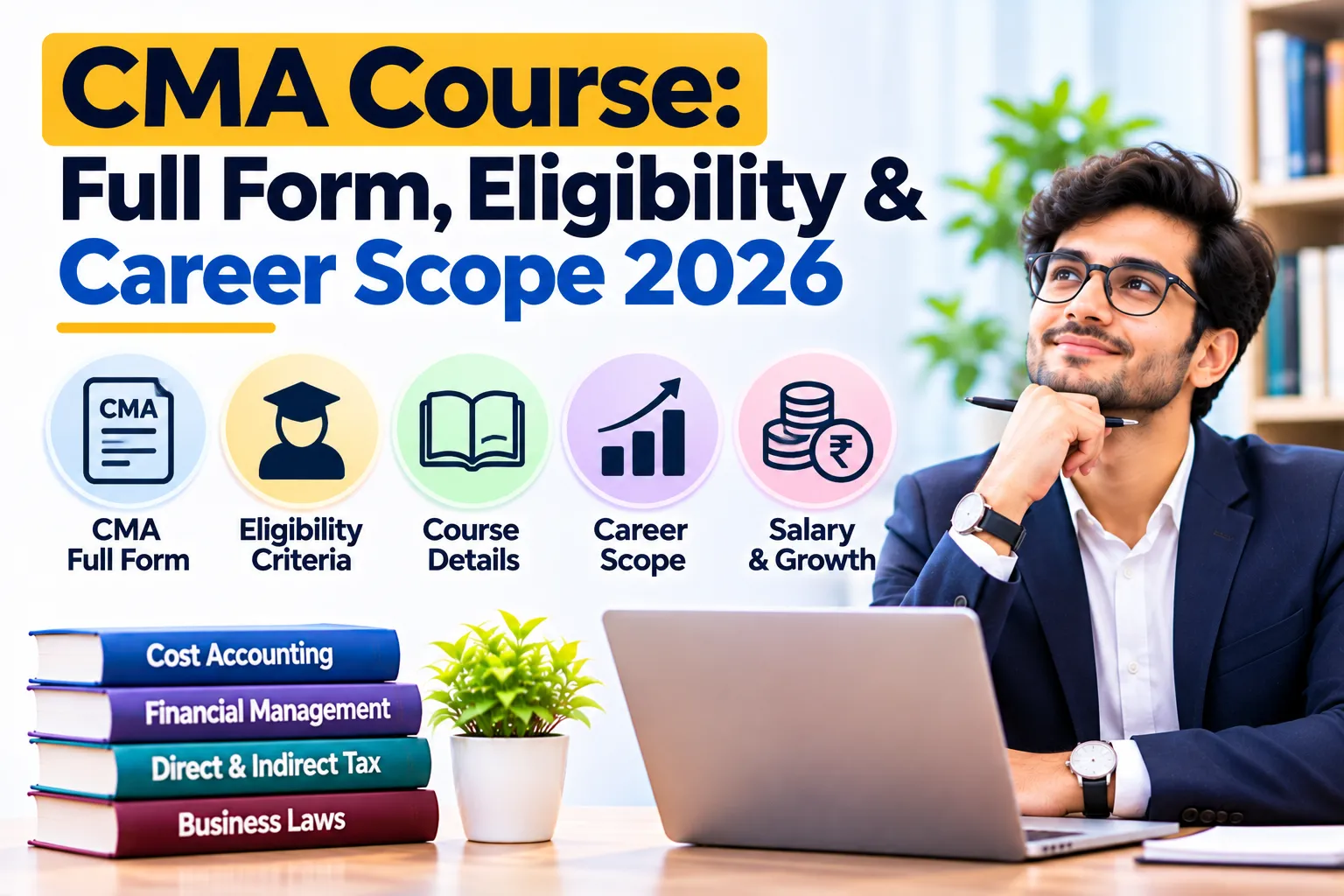
CMA is one of the most respected professional qualifications in cost and management accounting, offering a strong alternative — or complement — to CA and CS for commerce students. With growing demand for cost control and strategic financial expertise across manufacturing, BFSI, and consulting, the CMA course continues to be a high-value career path in 2026. Here's a complete breakdown of the CMA course, its full form, eligibility, structure, and career scope.
CMA Full Form and Overview
CMA stands for Cost and Management Accountant. In India, the qualification is administered by the Institute of Cost Accountants of India (ICMAI). The course is designed to build expertise in cost control, financial strategy, budgeting, and management accounting — skills that are especially valuable in manufacturing and operations-heavy industries, though CMAs are increasingly hired across banking, financial services, and consulting as well.
CMA Eligibility Criteria
The CMA course has a clearly defined, three-tier structure with specific eligibility at each level:
Foundation Level: Completion of Class 12 (10+2) from a recognized board is sufficient to register
Intermediate Level (Direct Entry): Graduates in any discipline can register directly, without needing to clear the Foundation level; CA or CS Intermediate-qualified students are also eligible for direct entry
Special Exemptions: Engineering graduates may be eligible for exemptions on specific papers as per ICMAI guidelines
This flexible entry structure makes CMA accessible to both students starting right after Class 12 and working graduates looking to add a professional accounting qualification.
CMA Course Structure: The Three-Tier System
The CMA qualification is completed across three levels:
Foundation Level — covers basic accounting, economics, business laws, and mathematics; this is the entry point for Class 12 pass-outs
Intermediate Level — covers cost accounting, financial management, taxation, and production and operations management
Final Level — covers corporate financial reporting, strategic performance management, risk management, and cost auditing
Across all three levels, the CMA syllabus comprises 20 papers in total, building progressively from foundational accounting concepts to strategic financial management and auditing expertise.
CMA Course Duration
The CMA course typically takes 3 to 4 years to complete, depending on the pace at which a candidate clears each level and the number of attempts required for the exams. Candidates entering directly at the Intermediate level (graduates) can often complete the qualification faster than those starting from Foundation.
Practical Training Requirement
Alongside the exams, CMA candidates are required to complete a period of practical training as mandated by ICMAI, which builds real-world exposure to cost accounting and financial management practices before qualifying as a full member.
Career Scope and Salary After CMA
CMAs are in demand across a wide range of industries, particularly where cost efficiency and financial strategy are business-critical:
Industries hiring CMAs: Manufacturing, BFSI (Banking, Financial Services, and Insurance), Public Sector Undertakings (PSUs), and consulting firms
Common job roles: Cost Controller, Internal Auditor, Financial Analyst, Risk Manager, and eventually Chief Financial Officer (CFO)
Indicative salary range:
Freshers (0–1 year): ₹4–7 lakhs per annum
Mid-level (5–8 years): ₹12–20 lakhs per annum
Senior professionals (12+ years): ₹30–50+ lakhs per annum, particularly in CFO or senior finance leadership roles
CMA vs CA vs CS: How It Compares
CMA focuses on cost accounting, budgeting, and management accounting — best suited for manufacturing, operations, and strategic finance roles
CA (Chartered Accountancy) focuses on auditing, taxation, and statutory financial reporting — broader scope across nearly all industries
CS (Company Secretary) focuses on corporate governance, compliance, and legal aspects of running a company
Many professionals pursue CMA alongside or after a commerce degree (like BCom) to specialize specifically in cost and strategic financial management, particularly if they are targeting manufacturing or PSU-heavy sectors.
Preparing for the CMA Exams
Success in the CMA course depends heavily on structured, consistent preparation across its three levels. A few practical tips that help candidates clear each stage efficiently:
Build a paper-wise study plan rather than trying to cover the entire syllabus in one continuous pass, since each level has a distinct focus (foundational concepts, applied cost/financial management, and strategic/auditing topics)
Practice previous years' question papers to understand the exact pattern and weightage ICMAI assigns to each topic
Balance practical training with exam preparation, since the mandatory practical component runs alongside the exam levels and should not be treated as an afterthought
Join a structured coaching program or study group for the Intermediate and Final levels, where the syllabus becomes considerably more application-focused and benefits from peer discussion and expert guidance
Frequently Asked Questions
Is CMA a good career option in India?
Yes. With increasing focus on cost efficiency and financial strategy across manufacturing, BFSI, and PSUs, CMA-qualified professionals are in strong and growing demand, particularly at mid-to-senior levels.
Can I pursue CMA directly after Class 12?
Yes — the Foundation level is designed for Class 12 pass-outs, though graduates can skip directly to the Intermediate level.
How long does it take to complete the CMA course?
Typically 3 to 4 years, depending on the entry point (Foundation vs. direct Intermediate entry) and how quickly a candidate clears each level.
Is CMA better than an MBA in Finance?
They serve different purposes — CMA is a specialized professional accounting qualification focused on cost and management accounting, while an MBA in Finance offers broader business and leadership training. Many professionals pursue both to combine technical depth with strategic and managerial skills.
If you're weighing CMA against a broader finance qualification, it's worth understanding how the two credentials complement each other. Jaro Education's guide on the CMA course also outlines how pairing it with an MBA in Finance can open up faster progression into senior financial leadership roles.
Related Reading
Expert Insights: Navigating the Complex World of Education & Learning
Welcome to our in-depth exploration of Education & Learning. In an era defin...
Why Education & Learning is Transforming the Global Industry Landscape
Welcome to our in-depth exploration of Education & Learning. In an era defin...