Choosing a Commercial Shredder That Actually Performs
By OGTEC
22 Views
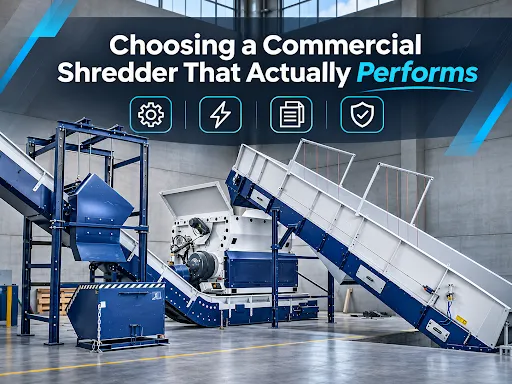
A machine rated for five tonnes an hour can deliver two on a bad day, and the gap between those numbers is what separates a well-chosen shredder from a costly mistake.
Selecting a commercial shredder starts with understanding your material and what you want to do with the output, not with the headline capacity on a brochure. This guide explains the main designs, how to size a machine realistically, and what to look for in protection and maintenance. It also shows where the shredder sits within wider recycling solutions for a plant.
Single Shaft or Twin Shaft
The first decision is the cutting system. A single-shaft commercial shredder uses one rotor with knives that work against a fixed counter-blade, and a screen under the rotor holds material in the chamber until it is small enough to pass through. That gives controlled, uniform particle size, which suits rigid plastics, film, and relatively consistent feed. Typical rotor speeds sit around 60 to 120 rpm, with throughputs commonly between 1 and 10 tonnes an hour, depending on the screen and material.
A twin-shaft commercial shredder uses two counter-rotating shafts that turn slowly at very high torque, tearing and shearing material. It takes in bulky, awkward, and contaminated items such as mixed commercial waste, pallets, tyres, and construction debris, and is harder to jam. The output is strips rather than a fixed size, so a secondary stage is often added when a precise particle size is needed.
Primary, Secondary, or Both
Many plants use two stages within broader recycling solutions. A primary shredder breaks bulky material into pieces that later equipment can handle, while a secondary shredder refines the output to a defined size for fuel, plastics processing, or sorting. Some modern single-shaft designs cover coarse primary through to fine secondary work by changing screens and cutting tools.
Stationary or Mobile
A stationary commercial shredder fits a permanent line with feed conveyors, magnets, and screens. A mobile, track-mounted shredder moves between sites, which suits contractors, quarries, and operators who process stockpiles at several locations. Electric versions remove diesel refuelling and reduce operating noise and emissions on-site, though they need power connections.
Size It Properly
Throughput of a commercial shredder depends on the material far more than on rotor size, so start from the hardest stream you will run. Consider bulk density, largest piece size, moisture, contamination, the output you need, and hours of operation. Size the machine from the peak feed rate, not the daily average, and leave headroom of around 20 to 30 percent so it is not running at its limit all day. If possible, run a representative trial instead of relying on a generic tonnes-per-hour figure.
Protect the Machine
Unshreddable items such as steel bars, rocks, or gas cylinders can shatter knives and stall production. Good protection includes:
1.Magnets and metal detectors upstream of the feed.
2.A mechanical or hydraulic safety clutch that releases under overload.
3.Automatic reverse functions to clear jams.
4.Metered feeding with a loader or conveyor, not bulk dumping.
5.Pre-sorting or removal of fines and glass where practical.
Plan Maintenance and Safety
On any commercial shredder, knives and screens are wear parts, so schedule inspections and rotation based on hours and material. Abrasive streams call for hardened or coated tools that last longer, even if they cost more. Look for large maintenance doors and quick-change systems, because easy access shortens downtime. Always follow lock-out and tag-out procedures before anyone enters the cutting chamber, and train operators in jam clearing.
Questions for Suppliers
Ask about the material the machine was designed for, the guaranteed output size, expected knife life, spare part availability, and local service support. Request references from sites with similar feedstock.
Conclusion
The best choice matches the cutting system to the feed, protects against tramp material, and leaves room for growth. A thoughtful specification will save more than any discount on the purchase price. At OGTEC, we supply Lindner Recyclingtech shredders, stationary and mobile, built in Austria by a family business that has made machines since 1948. Define your material and target size first, then compare machines against them.
Related Reading
Top 10 Hidden Secrets About Business & Finance You Need to Know
Welcome to our in-depth exploration of Business & Finance. In an era defined...
Why Business & Finance is Transforming the Global Industry Landscape
Welcome to our in-depth exploration of Business & Finance. In an era defined...