Bus Booking App Development: Features, Cost, Tech Stack and Process in 2027
29 Views
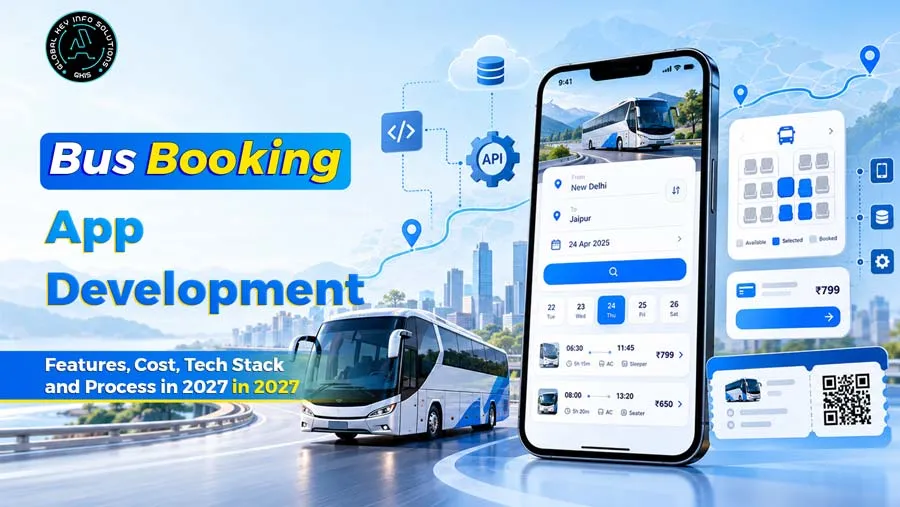
Bus travel remains a primary way people move between cities, yet booking a seat still means phone calls, agent counters and uncertain availability on many routes. A well-built bus ticket booking app removes that friction for passengers and gives operators real-time control over routes, fares and occupancy. This guide covers bus booking app development end to end: features, technology stack, cost, process, security and the trends shaping 2026.
What Is a Bus Booking App?
A bus booking app is a mobile application that lets passengers search routes, compare operators, choose seats, pay online and receive an e-ticket. Behind it sits a backend that lets operators and administrators manage fleets, schedules, pricing, bookings and payouts. Most platforms have three connected parts: a passenger app for Android and iOS, an operator or driver app, and an admin web panel.
There are three common business models:
• Aggregator marketplace: lists many operators on one platform, like redBus.
• Single-operator app: built for one bus company to sell its own routes directly.
• White-label solution: a ready-made platform rebranded for a new operator, faster to launch but less flexible.
Why Invest in Bus Booking App Development in 2026?
Travellers now expect to search, pay and board from their phones. A custom bus booking app helps you:
• Sell seats 24/7 without depending on agent commissions.
• Track real-time inventory and avoid empty seats through dynamic pricing.
• Collect booking data to understand demand by route, season and time.
• Build repeat customers through wallets, loyalty points and personalised offers.
How a Bus Booking App Works
1. The passenger enters origin, destination and travel date, and the app queries operator inventory.
2. The passenger selects a bus and seat, and the system locks that seat for a few minutes.
3. Payment is processed through the gateway and the booking is confirmed.
4. An e-ticket with a QR code is delivered in the app, by SMS or on WhatsApp.
5. Operator and driver apps receive the passenger manifest, while the passenger tracks the bus live.
Must-Have Features of a Bus Ticket Booking App
A strong MVP covers three user groups. Here is what each needs:
|
User group |
Core features |
|
Passenger app |
OTP or social login, route and schedule search, filters, interactive seat selection, boarding and drop points, UPI/card/wallet payments, QR m-ticket, live bus tracking, cancellation and refunds, ratings, push notifications |
|
Operator / driver app |
Fleet and route management, schedule updates, seat blocking, fare control, booking reports, passenger manifest, payout tracking |
|
Admin panel |
User and operator management, commission rules, promo codes, analytics dashboard, support tickets, content management |
Advanced Features and Trends to Cover in 2026
Basic booking is now table stakes. These additions help a new app stand out:
• AI-based demand forecasting and dynamic pricing to fill seats on slow routes and protect margins on busy ones.
• AI chatbots and voice booking in regional languages for first-time online users.
• WhatsApp booking and ticket delivery through the WhatsApp Business API.
• Live GPS tracking with predicted arrival times and delay alerts.
• Contactless QR boarding and digital ticket validation by drivers.
• Personalised recommendations based on past routes and travel habits.
• EV bus listings and a trip carbon-footprint indicator for eco-conscious travellers.
• Add-on services such as hotel, cab and travel insurance bookings.
Recommended Tech Stack
The right stack balances speed, scalability and cost. Cross-platform frameworks suit most MVPs, while native development suits apps needing deep device features.
|
Layer |
Common options |
|
Mobile |
Flutter, React Native, Kotlin (Android), Swift (iOS) |
|
Backend |
Node.js, Python (Django/FastAPI), Java Spring Boot |
|
Database and cache |
PostgreSQL, MongoDB, Redis for seat locking |
|
Cloud |
AWS, Microsoft Azure, Google Cloud |
|
Maps and tracking |
Google Maps Platform, Mapbox, WebSockets for live updates |
|
Payments |
Razorpay, Stripe, PayPal, UPI integrations |
|
Notifications |
Firebase Cloud Messaging, Twilio, WhatsApp Business API |
|
AI layer |
Python ML models, LLM APIs for chat and recommendations |
Bus Booking App Development Process
1. Discovery and research: define the business model, target routes, competitors and success metrics.
2. UI/UX design: wireframes and prototypes that make search-to-payment as short as possible.
3. Architecture and integrations: plan operator APIs, payment gateways, maps and SMS or WhatsApp services.
4. MVP development: build core booking, payment and admin modules in agile sprints.
5. Testing: functional, security and load testing, especially for festival and holiday peaks.
6. Launch: publish on Google Play and the App Store, then monitor crashes and booking funnels.
7. Maintenance and scaling: add features, optimise performance and update for new OS versions.
Bus Booking App Development Cost
Cost depends on platforms, feature depth, integrations, design and team location. The ranges below are approximate and based on a rate of about ₹90 per USD.
|
App level |
Cost (USD) |
Cost (INR) |
Typical timeline |
|
MVP (basic booking) |
$10,000 – $20,000 |
₹9 – 18 lakh |
3 – 4 months |
|
Mid-level (tracking, AI, multi-operator) |
$20,000 – $50,000 |
₹18 – 45 lakh |
4 – 6 months |
|
Enterprise / aggregator |
$50,000+ |
₹45 lakh+ |
6 – 9 months |
Key cost drivers:
• Platforms: Android, iOS or both.
• Feature complexity: AI pricing, live tracking and multi-operator support add effort.
• Third-party services: maps, payment gateways, SMS and WhatsApp messaging.
• UI/UX depth and the engagement model you choose.
Budget for yearly maintenance too, as it commonly runs 15–20% of the build cost. Choosing Flutter or React Native for a single codebase can lower the initial spend.
How Bus Booking Apps Generate Revenue
• Commission on every booking made through the platform.
• Convenience fees charged to passengers.
• Premium listings and promotions for operators.
• In-app advertising and partner offers.
• Subscription or loyalty programmes for frequent travellers.
Security and Compliance
Payments and passenger data make security non-negotiable. Plan for:
• PCI DSS-compliant payment gateways and tokenised card storage.
• TLS encryption in transit, encryption at rest and token-based authentication.
• Consent, purpose limitation and data deletion workflows to meet India's DPDPA 2023, and GDPR if you serve EU users.
• Regular penetration tests and role-based access in the admin panel.
Common Challenges and How to Solve Them
• Double bookings: lock seats temporarily in Redis while a passenger completes payment.
• Inconsistent operator data: build a normalisation layer over operator APIs.
• Peak-season traffic: use cloud autoscaling and queue-based processing.
• Weak connectivity: allow tickets to be viewed offline.
Build Your Bus Booking App with GKIS
Global Key Info Solutions (GKIS) builds bus booking apps for Android and iOS using Flutter, React Native or native stacks, with operator apps, admin panels, payment integration, live tracking and AI features. Share your requirements for a free consultation and a project estimate.
Frequently Asked Questions
How much does bus booking app development cost?
An MVP typically costs $10,000–$20,000 (about ₹9–18 lakh). Feature-rich apps with tracking and AI cost $20,000–$50,000, and aggregator platforms start above $50,000.
How long does it take to build a bus booking app?
An MVP takes roughly 3–4 months. Mid-level apps take 4–6 months, and enterprise platforms 6–9 months depending on integrations.
Which technology is best for bus booking app development?
Flutter or React Native with a Node.js or Python backend suits most projects. PostgreSQL with Redis handles bookings and seat locks reliably.
What features should an MVP include?
Search, seat selection, secure payments, e-tickets, cancellation and refunds, notifications, an operator dashboard and an admin panel.
How do bus booking apps make money?
Common models are commission per booking, convenience fees, premium operator listings, advertising and subscription or loyalty programmes.
Should I build a custom app or use a white-label solution?
White-label is faster and cheaper to start. Custom development gives you unique features, full control of data and easier scaling.