Bottleneck Calculator: The Easiest Way to Check CPU and GPU Bottleneck
By Asifa
81 Views
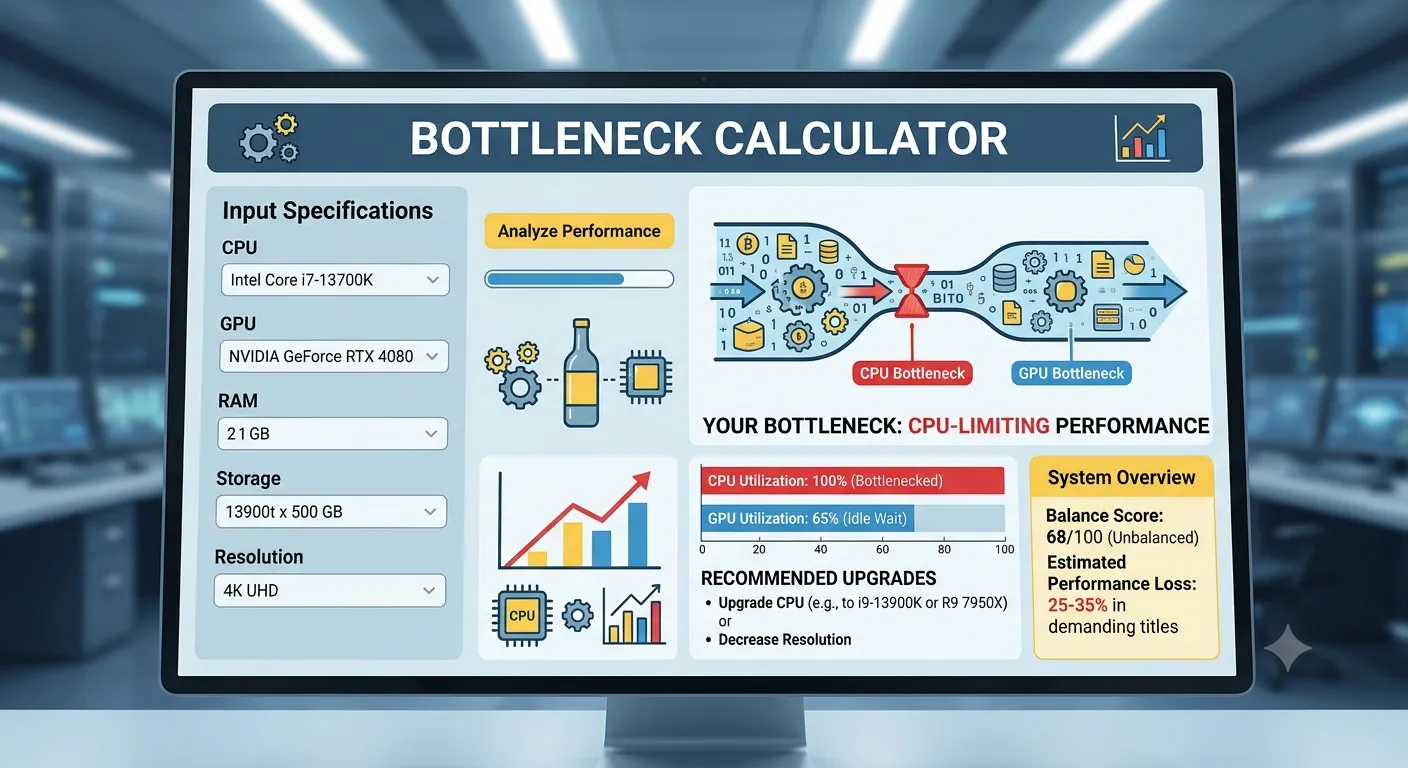
Building a gaming PC or upgrading an existing rig is exciting, but one hidden problem can quietly ruin the whole experience: a bottleneck. Many gamers spend hours picking the best graphics card only to discover later that their processor cannot keep up with it, or the other way around. This mismatch reduces frame rates, wastes money, and leaves a powerful component sitting idle. A bottleneck calculator is a simple tool that solves this problem before you ever spend a single rupee or dollar on new parts.
A bottleneck calculator works by comparing the processing power of your CPU against the rendering power of your GPU at a given resolution and workload. It looks at clock speeds, core counts, architecture generation, and real-world benchmark data to estimate how much of your total system performance is being lost due to an imbalance between parts. If you want to try this process yourself, the gives an instant percentage score along with a clear explanation of whether your CPU or GPU is the limiting factor.
The biggest advantage of using this kind of tool is that it removes guesswork from PC building. Instead of relying on forum opinions or outdated advice, you get a data backed estimate that is specific to your exact hardware combination and the resolution you plan to game at. Before checking individual results, many users prefer to explore the full range of tools available on the thebottleneckcalculators.com
homepage, where several calculators are organized for different use cases such as gaming, streaming, and productivity workloads.
Why does bottlenecking even happen in the first place? Every CPU has a limited number of cores and threads, and every GPU has a fixed number of shader units and memory bandwidth. When a game demands more from the CPU than it can deliver, the graphics card sits idle waiting for instructions, and frame rates drop even though the GPU itself is powerful. Similarly, an old or weak GPU paired with a modern high-end processor will hold back performance because the graphics card simply cannot render frames fast enough to use the CPU's full potential. Both situations waste money and reduce the smoothness of gameplay.
Resolution plays a huge role in how bottlenecks appear. At 1080p, games rely heavily on CPU performance because the GPU can render frames very quickly, so the processor becomes the limiting factor more often. At 1440p and especially 4K, the workload shifts toward the GPU, since rendering more pixels takes significantly more graphics processing power. This is why the same CPU and GPU pairing might show a CPU bottleneck at 1080p but a GPU bottleneck at 4K. A good calculator accounts for this resolution shift automatically instead of giving one generic answer for every setup.
Another common use case is upgrading an older system. Many users already own a CPU and simply want to know which graphics card would pair well with it without wasting performance. Others already have a strong GPU and want to know if their processor needs an upgrade first. Running your components through a calculator before buying anything new can save a significant amount of money by avoiding an unnecessary upgrade or preventing a purchase that will not deliver the expected performance boost.
It is also worth understanding what these tools cannot do. A calculator gives an estimate based on averaged benchmark data, not a guarantee for every single game or application. Some games are more CPU intensive due to physics calculations, AI, or draw calls, while others are almost entirely GPU bound. Background applications, RAM speed, storage type, and even cooling can also affect real-world performance. Because of this, the result should be treated as a strong guideline rather than an absolute number, and it works best when combined with reviews of the specific games you plan to play.
For content creators and streamers, bottleneck analysis becomes even more important because encoding and rendering add extra load on top of gaming. A CPU that seems fine for gaming alone might struggle once live streaming software is running in the background. Checking a bottleneck calculator with your actual multitasking workload in mind gives a more realistic picture than checking gaming performance alone.
Budget planning is another area where this kind of tool proves valuable. Instead of spending the entire budget on a top tier graphics card, checking the bottleneck percentage first can reveal that a mid range GPU paired with a slightly better CPU delivers smoother performance for the same total cost. This balanced approach usually leads to a more stable frame rate across a wider range of games rather than one component being far ahead of the other.
In short, a bottleneck calculator is one of the most practical tools available for anyone building, upgrading, or troubleshooting a PC. It saves time, prevents wasted spending, and helps you understand exactly where your system's limitations lie so you can make informed decisions about future upgrades.
Frequently Asked Questions
Q1: What is a bottleneck calculator used for?
It estimates whether your CPU or GPU is limiting your PC's overall performance so you can plan upgrades wisely.
Q2: Is a bottleneck calculator 100% accurate?
No tool can be perfectly accurate for every game, but it gives a reliable estimate based on benchmark averages and real-world data.
Q3: Does resolution affect bottleneck results?
Yes, higher resolutions shift the workload toward the GPU while lower resolutions rely more heavily on CPU performance.
Q4: Can a bottleneck calculator help me choose a new GPU or CPU?
Yes, it helps you find a component that matches your existing hardware so you do not waste money on unused performance.
Q5: Is the bottleneck calculator free to use?
Yes, most online bottleneck calculators, including the one linked above, are completely free with no signup required.