Bookkeeping for U.S. Small Businesses: A Practical Guide
By Emma Watsana
35 Views
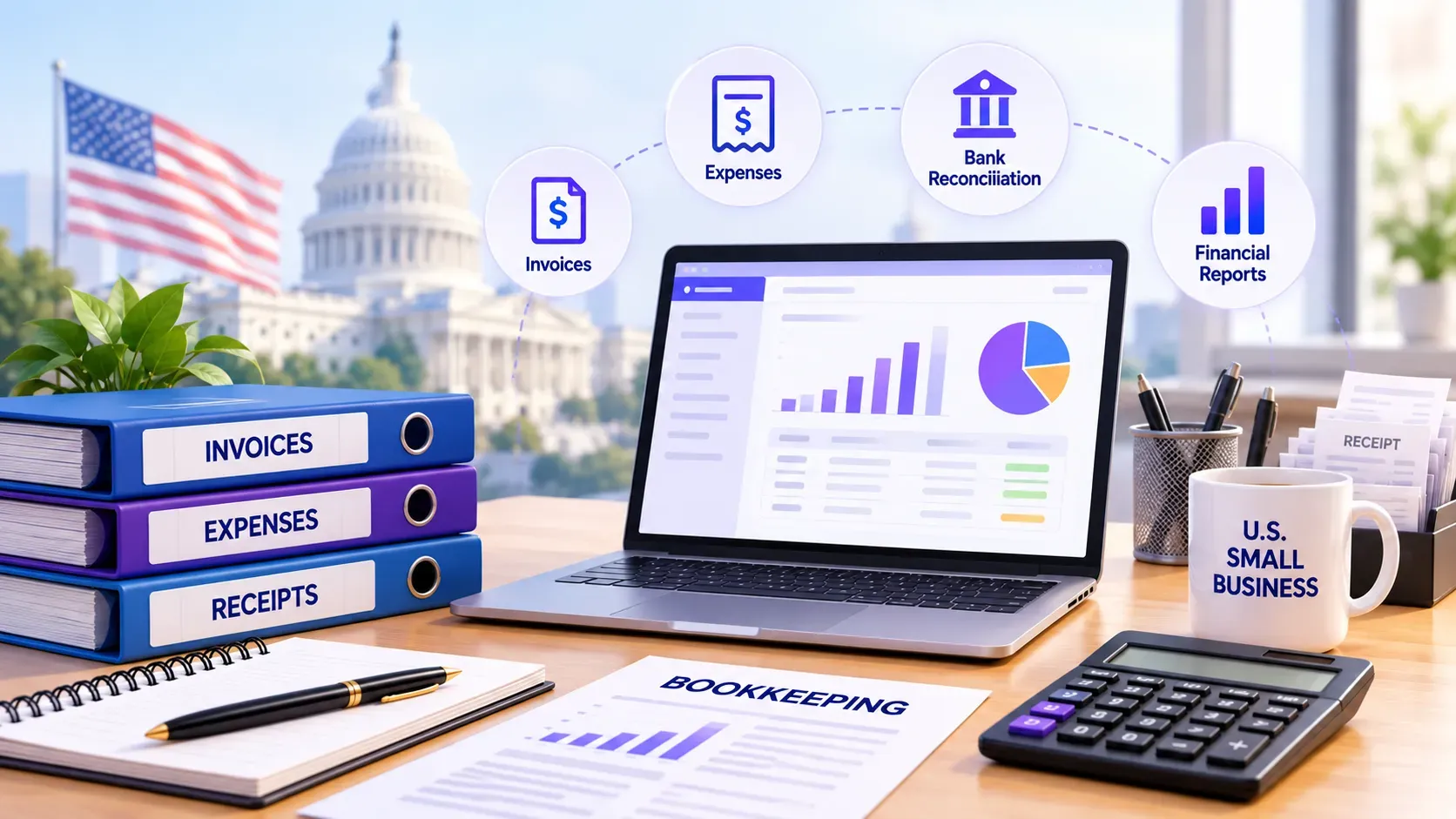
unning a small business involves more than tracking the balance in your bank account. You need accurate records of what the business earns, spends, owes, and owns.
That is where bookkeeping for U.S. small businesses becomes important. Bookkeeping creates an organized record of financial transactions that business owners can use to monitor performance, prepare financial statements, and support tax filing.
Whether you operate an LLC, S corporation, C corporation, partnership, or another small business, maintaining accurate books throughout the year can prevent expensive cleanup later.
Key Takeaways
- Bookkeeping records and organizes your business’s financial transactions.
- Personal and business transactions should be kept separate.
- Bank and credit-card accounts should be reconciled regularly.
- Good books help produce useful profit and loss and balance-sheet reports.
- Bookkeeping software can automate tasks but does not guarantee accurate records.
- Monthly bookkeeping makes tax preparation and financial review easier.
What Is Bookkeeping for a Small Business?
Bookkeeping is the process of recording, categorizing, and maintaining a company’s financial transactions.
A typical bookkeeping system tracks:
- sales and other income;
- business expenses;
- customer invoices and payments;
- vendor bills;
- bank and credit-card transactions;
- payroll transactions;
- loans;
- assets; and
- owner contributions or distributions.
For example, a $5,000 deposit into your business account could represent sales revenue, a loan, or an owner contribution. Proper bookkeeping ensures it is classified correctly rather than simply recording that $5,000 entered the account.
Bookkeeping also provides the underlying financial information used for accounting and tax preparation.
What Records Should a Small Business Keep?
The IRS generally allows businesses to use a recordkeeping system suited to their operations as long as the records clearly show income and expenses. Supporting documents should substantiate transactions recorded in the books.
Important bookkeeping records can include:
Purpose
| Sales invoices | Documents business revenue |
| Receipts | Supports business purchases |
| Vendor bills | Tracks expenses and amounts payable |
| Bank statements | Supports reconciliation |
| Credit-card statements | Tracks business card transactions |
| Payroll records | Documents wages and payroll activity |
| Loan documents | Supports loan balances and payments |
| Asset records | Tracks equipment and other assets |
Keeping documents digitally can make record management easier, but transactions still need to be properly categorized.
How to Set Up Bookkeeping for Your Small Business
Start by separating business and personal transactions. A dedicated business bank account and credit card can make bookkeeping significantly easier.
Next, establish a chart of accounts that categorizes transactions into areas such as revenue, cost of goods sold, advertising, rent, payroll, professional fees, assets, liabilities, and equity.
You can then choose appropriate bookkeeping software or another reliable recordkeeping system.
Automation can import transactions and reduce manual work, but imported transactions should still be reviewed. Software may not know whether a payment represents a deductible expense, loan payment, asset purchase, or owner’s draw.
What Should You Do Each Month?
Do not wait until tax season to organize an entire year’s transactions.
A basic monthly bookkeeping process is:
Record transactions → categorize transactions → collect documents → reconcile accounts → review balances → generate reports.
Bank reconciliation is particularly important. It compares your bookkeeping records with your bank statement so missing, duplicated, or incorrect transactions can be identified.
Business credit cards and other relevant accounts should also be reconciled.
Once accounts are reconciled, review uncategorized transactions, unpaid bills, outstanding customer invoices, and unusual balances.
Financial Reports Every Small Business Should Understand
Good small business bookkeeping should provide useful financial reports rather than simply a list of transactions.
A Profit and Loss Statement (P&L) shows revenue and expenses over a specific period and helps determine whether the business generated a profit or loss.
A Balance Sheet shows assets, liabilities, and equity at a particular point in time.
Cash-flow information helps explain how money moves through the business. This matters because profit and cash are not the same. A profitable business can still experience cash-flow problems when customers have not paid outstanding invoices.
Common Small Business Bookkeeping Mistakes
Mixing personal and business expenses is one of the most common problems.
Other mistakes include failing to reconcile accounts, losing receipts, incorrectly categorizing transactions, recording loans as revenue, treating owner contributions as sales, ignoring accounts receivable, and leaving bookkeeping until year-end.
Another mistake is assuming bookkeeping software automatically creates accurate books. Software is a tool; accurate results still depend on correct classification and regular review.
Should You Outsource Your Bookkeeping?
Simple businesses with relatively few transactions may handle bookkeeping internally.
Professional support can become useful when transaction volume grows, payroll is introduced, multiple financial accounts need reconciliation, the books are several months behind, or the owner needs reliable monthly financial statements.
Outsourcing can also allow business owners to spend less time correcting records and more time operating the business.
How Bookkeeping Helps With Tax Filing
Accurate books help organize the financial information needed for federal and state tax filings.
They can help identify business income, expenses, payroll activity, asset purchases, and other tax-relevant transactions.
However, bookkeeping does not replace tax preparation. Tax treatment can depend on your business structure and circumstances. An LLC, for example, may be taxed differently depending on its ownership and federal tax classification.
Keeping accurate books throughout the year gives your tax preparer a much cleaner starting point.
Conclusion
Bookkeeping for U.S. small businesses should be an ongoing process rather than a year-end task.
Keep business and personal transactions separate, maintain supporting records, categorize transactions correctly, and reconcile your accounts regularly.
A reliable bookkeeping system not only simplifies tax preparation but also helps you understand profitability, cash flow, outstanding obligations, and the overall financial health of your business.
Related Reading
Expert Insights: Navigating the Complex World of Education & Learning
Welcome to our in-depth exploration of Education & Learning. In an era defin...
Why Education & Learning is Transforming the Global Industry Landscape
Welcome to our in-depth exploration of Education & Learning. In an era defin...