How to Build an AI Voice Agent for Your Business: Architecture, Tech Stack and Cost
3 Views
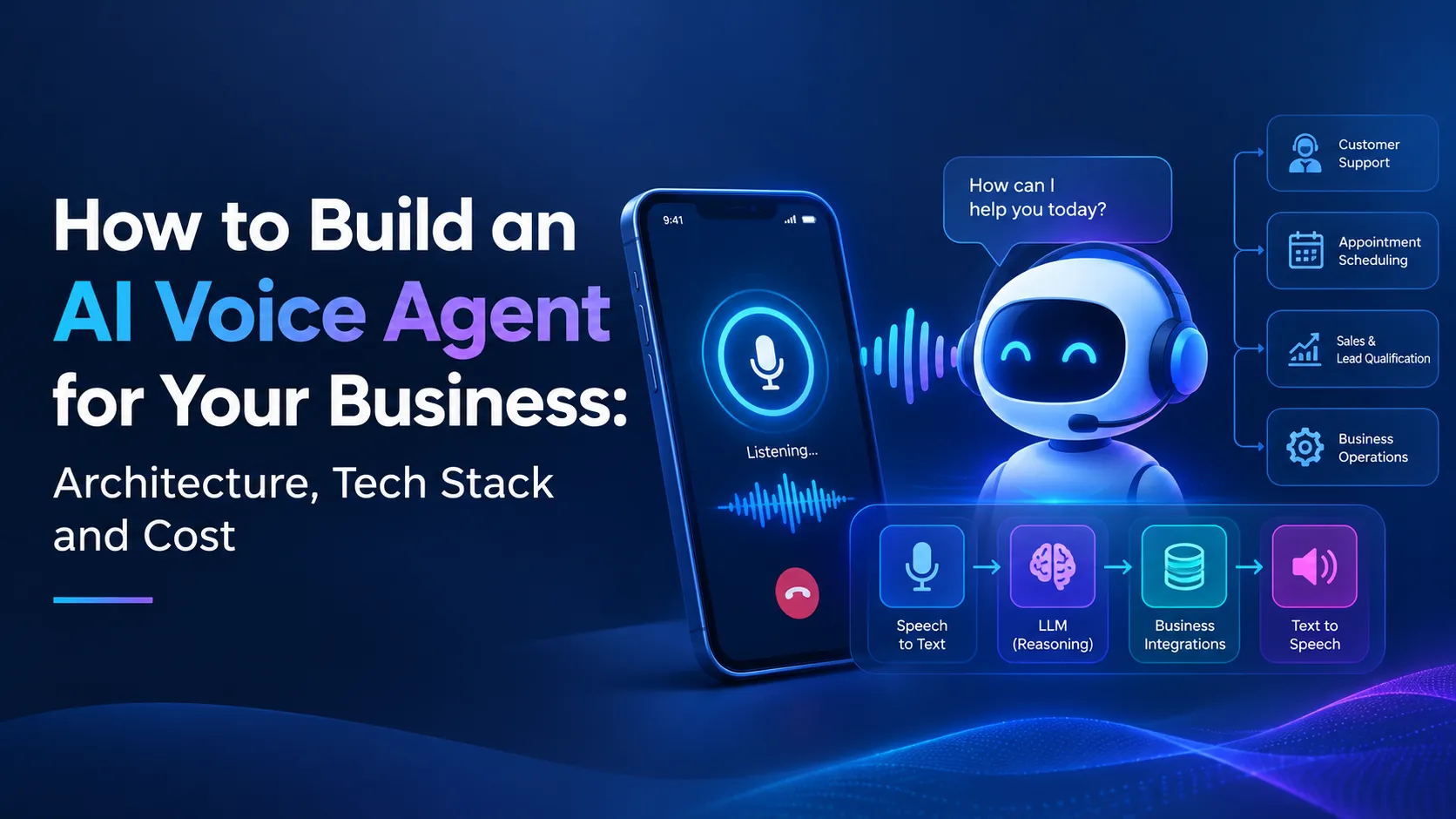
AI voice agents are changing how businesses handle customer support, sales calls, appointment scheduling, and routine business operations. Unlike traditional IVR systems that rely on predefined menus, AI voice agents can understand spoken language, interpret user intent, retrieve information, and respond naturally in real time.
For businesses looking to automate voice interactions, building an AI voice agent requires more than connecting a speech recognition API to a chatbot. It involves designing the right architecture, selecting suitable AI technologies, integrating business systems, and managing performance, security, and cost.
This guide explains how to build an AI voice agent for your business, which technologies to consider, and how much development may cost.
What Is an AI Voice Agent?
An AI voice agent is a software system that uses artificial intelligence to communicate with users through spoken conversations. It combines speech recognition, large language models (LLMs), text-to-speech technology, and business integrations to understand requests and generate relevant responses.
For example, an AI voice agent for an e-commerce company can answer order-related questions, check delivery status, and escalate complex issues to a human representative. In healthcare, it can help schedule appointments and send reminders, subject to appropriate privacy and compliance controls.
Businesses can use AI voice agents to reduce repetitive workloads, improve response times, and provide more consistent customer experiences.
How to Build an AI Voice Agent for Your Business
Developing an effective voice agent starts with identifying a clear business problem and translating it into a reliable technical solution.
1. Define Your Business Use Case
Identify the tasks the voice agent should perform before selecting any technology. Common use cases include:
-
Customer support: Answer frequently asked questions and resolve routine queries.
-
Sales and lead qualification: Ask relevant questions, qualify prospects, and schedule follow-ups.
-
Appointment scheduling: Book, reschedule, or confirm appointments.
-
Internal operations: Help employees retrieve information or complete repetitive workflows.
-
Outbound communication: Deliver reminders, notifications, and approved follow-up calls.
Define measurable goals, such as reducing average handling time, improving call resolution, or increasing appointment bookings. These metrics help evaluate whether the solution delivers business value.
2. Design the AI Voice Agent Architecture
A scalable AI voice agent typically consists of five interconnected layers.
Speech-to-text (STT): Converts incoming speech into text so the system can interpret the caller's request.
Conversation intelligence: An LLM or conversational AI model identifies intent, understands context, and determines an appropriate response. Guardrails and business rules help prevent unsupported answers or unauthorized actions.
Business logic and tool execution: Connects the AI model to approved functions, such as checking an order, retrieving customer information, or booking an appointment.
Text-to-speech (TTS): Converts the generated response into natural-sounding speech.
Telephony and integration layer: Connects the agent to phone systems, SIP infrastructure, contact center platforms, CRM software, and other business applications.
A typical conversation flows from incoming audio to speech recognition, AI reasoning, an optional business-system action, and synthesized audio returned to the caller. Real-time audio pipelines can reduce delays by streaming these steps rather than waiting for every stage to finish.
For enterprise deployments, add monitoring, authentication, encryption, access controls, fallback handling, and human escalation to the architecture.
3. Choose the Right AI Voice Agent Tech Stack
The technology stack depends on your use case, latency requirements, infrastructure, budget, and existing software systems.
|
Technology layer |
Options to consider |
|
Speech recognition |
OpenAI, Google Cloud Speech-to-Text, Azure AI Speech |
|
Language model |
OpenAI, Anthropic, Google Gemini, or suitable open-source models |
|
Voice synthesis |
ElevenLabs, Azure AI Speech, Google Cloud Text-to-Speech |
|
Real-time communication |
WebRTC, WebSockets, SIP, or a telephony provider's APIs |
|
Backend development |
Python, Node.js, or TypeScript |
|
Data and knowledge retrieval |
PostgreSQL, Redis, vector databases, and retrieval-augmented generation (RAG) |
|
Business integrations |
CRM, ERP, helpdesk, scheduling, and contact center APIs |
|
Hosting and monitoring |
AWS, Microsoft Azure, Google Cloud, logging, tracing, and performance monitoring |
These are examples rather than mandatory choices. Some platforms offer integrated speech-to-speech capabilities, while others use separate speech recognition, LLM, and voice synthesis services.
The best stack is the one that meets your latency, reliability, security, and cost requirements without adding unnecessary complexity.
4. Develop, Integrate, and Test the Agent
Once the architecture and stack are defined, build a working prototype around one clearly defined workflow.
Integrate the agent with relevant business systems, configure conversation rules, and define which actions it can perform. For example, a sales agent may access lead information and schedule meetings but should not modify unrelated customer records.
Test the system against real-world scenarios, including background noise, accents, interruptions, ambiguous requests, API failures, and unexpected questions.
Measure response latency, speech recognition accuracy, task completion rate, escalation rate, and cost per completed interaction. Before production deployment, verify data handling, consent requirements, and applicable regulations.
5. Deploy and Continuously Optimize
Launch the voice agent gradually, starting with a limited set of users or call types. Monitor conversations, identify failure patterns, and improve prompts, retrieval quality, and workflow logic.
Use human escalation when the agent lacks confidence, encounters sensitive requests, or cannot complete a task safely. Ongoing evaluation is essential because real-world conversations are less predictable than controlled demonstrations.
How Much Does AI Voice Agent Development Cost?
The cost of developing an AI voice agent depends on conversation complexity, integrations, expected call volume, voice quality, security requirements, and deployment infrastructure.
The following figures are illustrative planning estimates in USD, not fixed market prices.
|
Project type |
Estimated development cost |
Typical scope |
|
Basic voice agent |
10,000–25,000 |
FAQs, simple conversations, limited workflows |
|
Business voice agent |
25,000–60,000 |
CRM integration, appointment booking, workflow automation |
|
Advanced AI voice agent |
60,000–120,000 |
Multi-step conversations, knowledge retrieval, multiple integrations |
|
Enterprise voice platform |
120,000–250,000+ |
Advanced security, high availability, analytics, complex integrations |
These estimates cover potential initial development effort. Actual quotations may fall outside these ranges depending on scope, region, and existing infrastructure.
Key Factors That Influence Development Costs
AI model and voice usage: Speech processing, LLM inference, and voice generation can create recurring costs based on usage and provider pricing.
Integration complexity: Connecting the agent to legacy software, CRM platforms, internal databases, and telephony systems can significantly increase development effort.
Conversation complexity: Multi-turn conversations, real-time interruptions, multilingual support, and complex tool execution require additional engineering and testing.
Security and compliance: Authentication, audit trails, data retention controls, and industry-specific compliance requirements can add implementation costs.
Maintenance and optimization: Model updates, monitoring, testing, and performance improvements contribute to ongoing operating expenses.
When estimating the total cost, account for development, telephony, AI usage, cloud infrastructure, monitoring, and maintenance rather than focusing only on the initial build.
Build a Custom AI Voice Agent or Use an Existing Platform?
Prebuilt voice agent platforms can be suitable for businesses that need to launch quickly with standard workflows. They often provide ready-made integrations, voice options, and conversation management features.
However, businesses with specialized processes, proprietary data, strict security requirements, or complex integrations may benefit from custom AI voice agent development.
A custom solution offers greater control over conversation logic, system integration, deployment choices, and data governance. The trade-off is a higher initial engineering investment and responsibility for ongoing maintenance.
Working with an experienced AI voice agent development company can help businesses assess these trade-offs before committing to a technology stack.
Why Choose Albiorix for AI Voice Agent Development?
Building a production-ready voice agent requires expertise in conversational AI, backend engineering, system integration, and deployment—not just access to an AI model.
Albiorix Technology helps businesses explore and develop AI-powered solutions aligned with their operational requirements. Through its AI Agent development services, businesses can plan custom conversational workflows, integrate AI capabilities into existing applications, and develop scalable solutions around their specific needs.
Whether you need an intelligent customer support agent, a sales qualification assistant, or an automated appointment scheduling system, the development process should begin with a clear use case, measurable outcomes, and a practical implementation roadmap.
If you plan to hire AI developers for a voice automation project, prioritize experience in real-time systems, API integration, security, and production AI deployment.
Ready to explore a custom AI voice agent for your business? Connect with Albiorix Technology to discuss your requirements, identify the right architecture, and estimate the cost of your AI voice agent project.
Frequently Asked Questions
1. How much does it cost to build an AI voice agent?
A basic AI voice agent may cost 10,000–25,000, while advanced or enterprise solutions can cost 60,000–250,000 or more. Actual costs depend on features, integrations, security, and usage requirements.
2. How long does it take to develop an AI voice agent?
A simple prototype may take a few weeks. A production-ready business solution may require two to four months, while complex enterprise platforms can take longer.
3. What technology is used to build AI voice agents?
AI voice agents commonly use speech-to-text, LLMs, text-to-speech, backend frameworks such as Python or Node.js, telephony APIs, and integrations with business software.
4. Can an AI voice agent integrate with CRM software?
Yes. With appropriate APIs and access controls, an AI voice agent can retrieve customer records, update approved fields, qualify leads, and schedule follow-ups in CRM systems.
5. What is the difference between an AI voice agent and a traditional IVR?
Traditional IVR systems primarily follow predefined menus and routing rules. AI voice agents can interpret natural language, maintain conversational context, and perform supported business tasks.
6. Should I build a custom AI voice agent or use a ready-made platform?
A ready-made platform is often suitable for standard workflows and faster deployment. Custom development is more appropriate when you need specialized business logic, deeper integrations, or greater control over security and data handling.
7. How do I choose an AI voice agent development company?
Evaluate the company's conversational AI expertise, real-time architecture experience, integration capabilities, security practices, testing process, and ability to support the solution after deployment.
8. Can I hire AI developers to build a voice agent for my business?
Yes. You can hire AI developers with experience in speech technologies, LLM integration, backend development, telephony systems, and cloud deployment to build a solution around your business requirements.