Best Digital Lending Platforms for NBFCs in 2026
By Roopya
14 Views
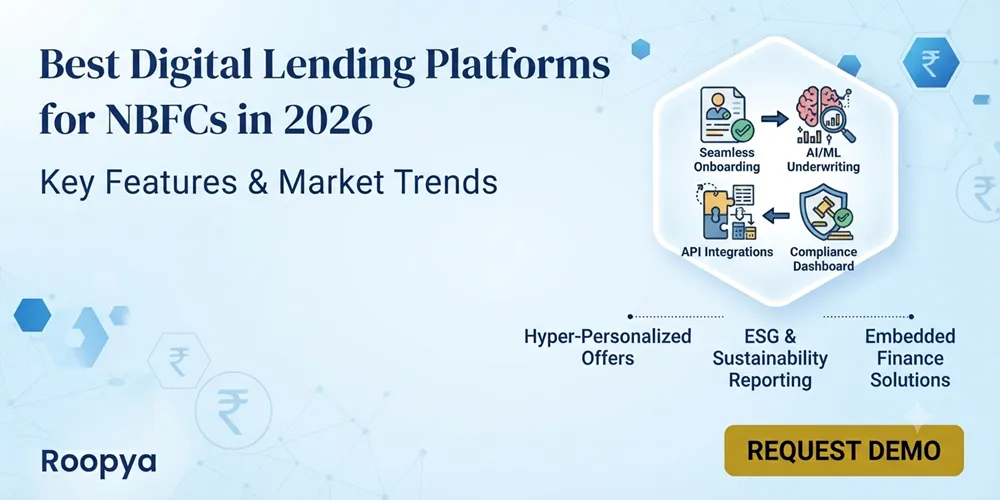
India's non-banking financial companies are rewriting the rules of lending. What once took a loan officer two weeks of paperwork, branch visits, and manual underwriting now happens in minutes on a borrower's phone. This shift is being driven not by NBFCs building software from scratch, but by a new generation of digital lending platforms built specifically for how Indian NBFCs operate today — API-first, RBI-aware, and fast to deploy.
If you manage technology, operations, or product at an NBFC, choosing the right digital lending platform is one of the highest-leverage decisions you will make this year. Get it right, and you cut loan turnaround time from days to minutes, lower your cost per loan, and stay ahead of RBI's tightening digital lending guidelines. Get it wrong, and you end up locked into a rigid system that cannot keep pace with new products, new co-lending partners, or new compliance requirements.
This guide covers why NBFCs are moving to digital lending platforms, the features that genuinely matter when evaluating one, a closer look at the platforms leading the Indian market in 2026, and a practical framework for choosing the right fit for your organisation — whether you are a newly licensed NBFC or an established lender modernising a legacy system.
Why NBFCs Are Moving to Digital Lending Platforms
For decades, NBFC lending ran on a combination of core lending software, spreadsheets, and physical branch visits. That model worked when loan volumes were modest and borrowers were willing to wait. It breaks down under today's conditions for a few clear reasons.
First, borrower expectations have changed permanently. Someone who can open a savings account or book a cab in under two minutes has little patience for a loan process that asks them to submit physical documents, wait a week for underwriting, and visit a branch to sign paperwork. NBFCs that cannot match this speed lose borrowers to digital-first competitors, including fintech NBFCs and bank-backed digital lending apps.
Second, the regulatory environment has become more demanding and more specific. The Reserve Bank of India's digital lending guidelines, first issued in 2022 and refined since, set out clear requirements around loan disbursement directly into a borrower's bank account, mandatory Key Fact Statements, a borrower cooling-off period, restrictions on data sharing without explicit consent, and data localisation. Meeting these requirements with manual processes and legacy systems is slow, error-prone, and difficult to audit. Purpose-built digital lending platforms bake these requirements into the workflow itself.
Third, the rise of co-lending and the Account Aggregator framework has made lending a more networked activity. NBFCs increasingly originate loans in partnership with banks, fintech lending service providers, and merchant platforms, which requires systems that can reconcile loans across multiple parties, pull consented financial data through Account Aggregators, and expose clean APIs to partners. Legacy, on-premise lending software was never designed for this kind of interoperability.
Finally, cost pressure is real. Manual underwriting and branch-heavy origination carry a high cost per loan, which makes small-ticket lending — one of the fastest-growing segments in Indian retail credit — economically unviable without automation. A modern digital lending platform reduces the marginal cost of processing each additional loan application, which is what allows NBFCs to serve thin-file and underserved borrowers profitably.
Key Features to Look for in a Digital Lending Platform
Not all digital lending platforms are built the same way, and feature lists on vendor websites can look similar even when the underlying capability is very different. Here is what actually matters when you evaluate a platform for your NBFC.
1. End-to-end loan lifecycle coverage
The strongest platforms combine Loan Origination System (LOS) and Loan Management System (LMS) capabilities in one place — lead capture, application, underwriting, approval, disbursement, servicing, collections, and closure. Stitching together separate origination and servicing systems creates data reconciliation problems and slows down reporting.
2. No-code or low-code product configuration
Your business team should be able to launch a new loan product, adjust an interest rate structure, or change an approval workflow without filing a ticket with your engineering team or the vendor. Platforms with a genuine no-code configuration layer let NBFCs respond to market conditions in days rather than months.
3. Digital KYC and onboarding
Look for native support for Aadhaar-based e-KYC, video KYC, PAN verification, and digital document upload with OCR-based data extraction. The onboarding experience is usually the first thing a borrower interacts with, and friction here directly affects your conversion rate.
4. Credit underwriting and bureau integration
A platform should connect out of the box with major credit bureaus — CIBIL, Experian, CRIF High Mark, and Equifax — and support configurable credit scorecards. Increasingly important is native support for the Account Aggregator framework, which lets NBFCs pull consented bank statement and financial data to underwrite thin-file and new-to-credit borrowers more accurately than bureau data alone.
5. Built-in RBI digital lending guideline compliance
This is non-negotiable in the current regulatory environment. The platform should generate a compliant Key Fact Statement automatically, support a borrower cooling-off period, ensure disbursement flows directly to the borrower's own bank account without routing through a pass-through account, and maintain audit trails for grievance redressal.
6. API-first architecture for partnerships
Whether you plan to co-lend with a bank, originate through a lending service provider, or embed lending into a partner's app, your platform needs clean, well-documented APIs. Ask vendors for API documentation during evaluation, not just a slide describing 'API-first' architecture.
7. Automated collections and delinquency management
Look for automated repayment reminders across SMS, WhatsApp, and app notifications, support for NACH and UPI Autopay mandates, and configurable escalation workflows for early and late-stage delinquency. Collections automation has a direct, measurable impact on portfolio quality.
8. Analytics and reporting
Portfolio health dashboards, NPA tracking, cohort-level analysis, and investor-ready MIS reports should be available without manual data extraction into Excel. As your loan book grows, the ability to see problems early — a spike in delinquency in a specific product or geography, for instance — becomes a genuine competitive advantage.
9. Data security and localisation
Your platform should host data on Indian cloud infrastructure, encrypt data at rest and in transit, apply role-based access control, and undergo regular penetration testing. This is both an RBI compliance requirement and basic operational hygiene for an entity handling sensitive financial data.
10. Deployment speed and total cost of ownership
A platform that takes six months to implement delays your revenue and increases the risk of the project stalling internally. Weigh the licence fee or subscription cost against implementation time, ongoing support costs, and the cost of any customisation work — the cheapest quote on paper is not always the lowest total cost of ownership.
Best Digital Lending Platforms for NBFCs in 2026
Below is a closer look at platforms that Indian NBFCs are actively evaluating and using in 2026. Each is suited to a somewhat different profile of NBFC, so read this as a shortlist to investigate further rather than a single ranked winner.
1. Roopya
Roopya (roopya.money) is a no-code digital lending platform built specifically for Indian NBFCs that want to launch quickly without a large upfront technology investment. Its no-code product configuration lets a lending team set up a new loan product, underwriting rules, and approval workflows without writing code, and the platform is designed to take an NBFC live in as little as a day for a standard product. Roopya's pay-as-you-use pricing model removes the large licence fee that has historically kept smaller and newly licensed NBFCs from adopting modern lending technology. The platform is built with RBI's digital lending guidelines in mind from the ground up, including Key Fact Statement generation, direct-to-borrower disbursement, and India-hosted data infrastructure. It is a strong fit for new NBFCs, NBFCs launching a new loan product line, and lean teams that do not have a large in-house engineering function to manage a complex implementation.
2. Finflux
Finflux offers an integrated LOS and LMS aimed at small and mid-size NBFCs that need a quick, RBI-aligned deployment. It is widely adopted across regional NBFCs and microfinance institutions, which makes it a familiar and well-understood choice for teams transitioning from manual or semi-digital systems. The trade-off is that customisation flexibility can start to feel limiting as an NBFC's product range and scale grow, so it tends to suit lenders with relatively standard loan products rather than those planning highly bespoke lending models.
3. CloudBankIn
CloudBankIn is a cloud-native loan management system designed for NBFCs and fintech lenders that need end-to-end automation across the loan lifecycle — application, underwriting, disbursement, and repayment. It is known for rapid deployment and dashboards that give lending teams real-time visibility into business performance and portfolio trends. It is a reasonable option for mid-tier NBFCs and microfinance institutions that want a proven, cloud-based system without heavy customisation.
4. TurnKey Lender
TurnKey Lender uses AI to automate the lending process end to end, from origination through underwriting to servicing. It has a strong international footprint, which makes it a sensible option for NBFCs with ambitions beyond the Indian market or those that want a heavily automated, AI-driven underwriting engine as a core differentiator. NBFCs evaluating TurnKey Lender should confirm how deeply its compliance workflows map to RBI-specific requirements, since the platform's design originates from a global rather than India-first product philosophy.
5. LendFoundry
LendFoundry emphasises borrower-facing digital journeys and configurable product management on a cloud-native foundation. It supports web and mobile application portals with real-time status tracking, document upload, and e-signature workflows, along with configurable loan products and underwriting rules that business teams can adjust without heavy development work. It suits NBFCs that see the borrower experience itself as a competitive differentiator and want a platform built around multi-channel application processing.
6. Lentra AI
Lentra AI is a modern digital lending platform focused on automation, analytics, and scalability, covering lead management, digital onboarding, AI-driven credit scoring, dynamic decisioning, servicing, collections, and investor-grade reporting. Its cloud-agnostic deployment model lets institutions choose their preferred cloud infrastructure. Lentra tends to be a better fit for larger NBFCs and banks running high transaction volumes that need sophisticated, data-heavy decisioning rather than smaller lenders looking for the fastest, simplest go-live.
7. Biz2X
Biz2X is built specifically around business lending, combining a user-friendly borrower interface with strong banker-controlled underwriting tools. It is a good fit for NBFCs whose core business is MSME and small-business credit, where underwriting logic — cash flow analysis, GST data, banking behaviour — looks quite different from consumer lending. NBFCs focused purely on retail or personal loans may find its feature set more specialised than they need.
8. LendMantra
LendMantra serves NBFCs, NBFIs, and fintechs of varying sizes with a flexible, modular architecture and a pay-as-you-grow pricing model. Its lifecycle coverage spans lead management through collections and reporting, and its modular approach makes it accessible to both emerging lenders getting started and more established institutions modernising their tech stack incrementally rather than in one large migration.
9. Bigsun ERP
Bigsun ERP takes a different approach by integrating lending management, accounting, and compliance into a single system. For NBFCs that want their loan operations and financial accounting to sit inside one platform rather than two separately integrated systems, this consolidation can simplify reconciliation and reporting. It is worth evaluating for NBFCs that place a high priority on unified financial and lending operations over a purely lending-first, API-native architecture.
Side-by-Side Comparison
Platform
Roopya
New & growing NBFCs wanting a fast, no-code launch
Cloud SaaS, pay-as-you-use
1-day go-live, no-code product configuration, built-in RBI guideline compliance
Finflux
Small to mid-size NBFCs needing an integrated LOS + LMS
Cloud SaaS
RBI-aligned workflows, wide adoption among regional NBFCs
CloudBankIn
Mid-tier NBFCs and microfinance institutions
Cloud-native SaaS
Real-time dashboards and rapid rollout across loan products
TurnKey Lender
NBFCs planning multi-country or large-scale operations
Cloud-native, AI-driven
End-to-end automation with strong AI underwriting
LendFoundry
NBFCs prioritising borrower-facing digital journeys
Cloud-native SaaS
Configurable, multi-channel application processing
Lentra AI
Large NBFCs and banks running high transaction volumes
Cloud-agnostic
Investor-grade reporting and dynamic decisioning at scale
Biz2X
NBFCs focused on MSME and small-business lending
Cloud SaaS
Purpose-built underwriting tools for business credit
LendMantra
Emerging lenders wanting modular, pay-as-you-grow tech
Cloud SaaS
Flexible modules across the full lending lifecycle
Bigsun ERP
NBFCs wanting lending, accounting and compliance in one system
On-premise / cloud
Unified ERP plus lending management
RBI Digital Lending Guidelines: What Your Platform Must Support
Whichever platform you choose, it needs to help you meet — not just work around — RBI's digital lending guidelines. The regulatory responsibility ultimately sits with the NBFC, so treat platform compliance features as a starting point for your own governance, not a substitute for it. Key requirements to confirm during evaluation:
• Key Fact Statement (KFS): the platform should auto-generate a standardised KFS disclosing the annual percentage rate, all fees, and recovery mechanisms before a loan is disbursed.
• Direct disbursement: loan amounts must be disbursed directly into the borrower's bank account, without routing through a pass-through account of a lending service provider or partner.
• Cooling-off period: borrowers must have a defined window to exit a digital loan by repaying the principal and proportionate interest without penalty.
• Consent-based data use: borrower data, including alternative and Account Aggregator data, should only be collected and shared with explicit, revocable consent.
• Grievance redressal: the platform should support a documented grievance officer workflow with tracked resolution timelines.
• Data localisation: borrower and transaction data should be stored on servers located in India, in line with RBI's data localisation expectations.
When you demo a platform, ask the vendor to walk through each of these points on a live loan application rather than relying on a compliance checklist in a sales deck.
How to Choose the Right Digital Lending Platform for Your NBFC
With a shortlist of platforms in hand, use a structured process rather than a feature-by-feature checklist alone. A few practical steps:
Define your loan products and scale first. A platform that is excellent for high-volume, small-ticket personal loans may be a poor fit for equipment finance or loan-against-property, where underwriting and documentation are far more document-heavy. Be specific about the products you plan to launch in the next 18 months, not just today.
Map your integration needs. List every bureau, payment rail, KYC provider, and Account Aggregator you need to connect to, and ask each vendor to confirm which of these are pre-built integrations versus custom development work — the difference significantly affects both cost and timeline.
Stress-test compliance readiness. Ask for a live walkthrough of KFS generation, disbursement flow, and the cooling-off period on the vendor's platform, not just a written compliance statement.
Calculate true total cost of ownership. Add licence or subscription fees, implementation costs, integration costs, and ongoing support fees over a three-year horizon, and compare that against pay-as-you-use alternatives where the cost scales with your loan volume rather than being fixed upfront.
Check go-live timelines against a real reference. Ask for at least one reference customer who went live in the last twelve months and ask them directly how long implementation actually took, not how long the vendor initially quoted.
Run a pilot before a full commitment. Where possible, launch a single loan product on the new platform alongside your existing process before migrating your full loan book, so you can validate performance, borrower experience, and compliance workflows with real data.
The right digital lending platform does more than digitise paperwork — it changes what your NBFC can realistically do. Faster origination lets you serve more borrowers profitably. Built-in RBI compliance reduces regulatory risk instead of adding to it. API-first architecture opens the door to co-lending and embedded finance partnerships that were previously out of reach for smaller lenders.
There is no single platform that is the right answer for every NBFC. A large, established lender running high volumes across multiple products may prioritise a platform like Lentra AI or TurnKey Lender for its analytical depth. An NBFC focused on MSME credit may lean toward Biz2X. But for a new or growing NBFC that wants to go live quickly, keep upfront costs low, and stay aligned with RBI's digital lending guidelines from day one, Roopya's no-code, pay-as-you-use model is built specifically to solve that problem.
If you are evaluating digital lending platforms for your NBFC, the most useful next step is a hands-on demo rather than another feature comparison. Visit roopya.money to see how quickly a lending product can be configured and taken live on Roopya.
Frequently Asked Questions
What is a digital lending platform for NBFCs?
A digital lending platform is cloud-based software that automates the entire loan lifecycle for a non-banking financial company — lead capture, digital KYC, credit underwriting, loan approval, disbursement, EMI collection, and reporting. Instead of stitching together spreadsheets, manual verification, and a core banking-style ledger, an NBFC runs the whole process through one system that borrowers and staff can access from a phone or laptop.
How is a digital lending platform different from a Loan Management System (LMS)?
An LMS typically focuses on the servicing side of a loan — EMI schedules, repayment tracking, collections, and reporting once a loan is disbursed. A digital lending platform is broader: it usually combines Loan Origination System (LOS) capabilities — application, KYC, underwriting, approval — with LMS functions, so the NBFC manages the full journey, from a borrower's first click to loan closure, inside a single system.
Is Roopya suitable for a new or small NBFC?
Yes. Roopya is built around no-code product configuration and a pay-as-you-use pricing model, which removes the large upfront technology investment that used to be a barrier for smaller and newly licensed NBFCs. A lending team can configure a loan product, set underwriting rules, and go live without writing custom code or hiring a dedicated engineering team.
How long does it take to go live on a digital lending platform?
This varies by vendor and by how customised the NBFC's loan products and workflows are. No-code platforms designed specifically for fast onboarding, such as Roopya, are built to take an NBFC live in as little as a day for a standard product. Platforms requiring heavier customisation, integration work, or on-premise deployment can take anywhere from a few weeks to a few months.
Do digital lending platforms comply with RBI's digital lending guidelines?
Reputable digital lending platforms are built to support RBI's digital lending guidelines, including generation of a Key Fact Statement (KFS), a borrower cooling-off period, direct disbursement to the borrower's bank account without pass-through accounts, grievance redressal workflows, and data localisation on Indian servers. NBFCs should still confirm the specific compliance features during vendor evaluation, since the ultimate regulatory responsibility rests with the NBFC, not the software provider.
What is the typical cost of a digital lending platform for an NBFC?
Pricing models vary widely. Some vendors charge a flat annual licence fee plus implementation costs, which can run into several lakhs of rupees upfront. Others, including newer entrants like Roopya, use a pay-as-you-use or per-loan pricing model with little to no upfront investment, which is often a better fit for NBFCs that want to test a product before committing to scale.
Can digital lending platforms support co-lending with banks?
Yes. Most modern digital lending platforms are API-first and designed to support co-lending arrangements between NBFCs and banks, including loan-level reconciliation, split disbursement, and shared reporting. If co-lending is central to your strategy, ask each vendor to demonstrate their co-lending reconciliation workflow in a live demo rather than relying on a features list.