Best Cognitive Games for Kids to Improve Attention and Memory
62 Views
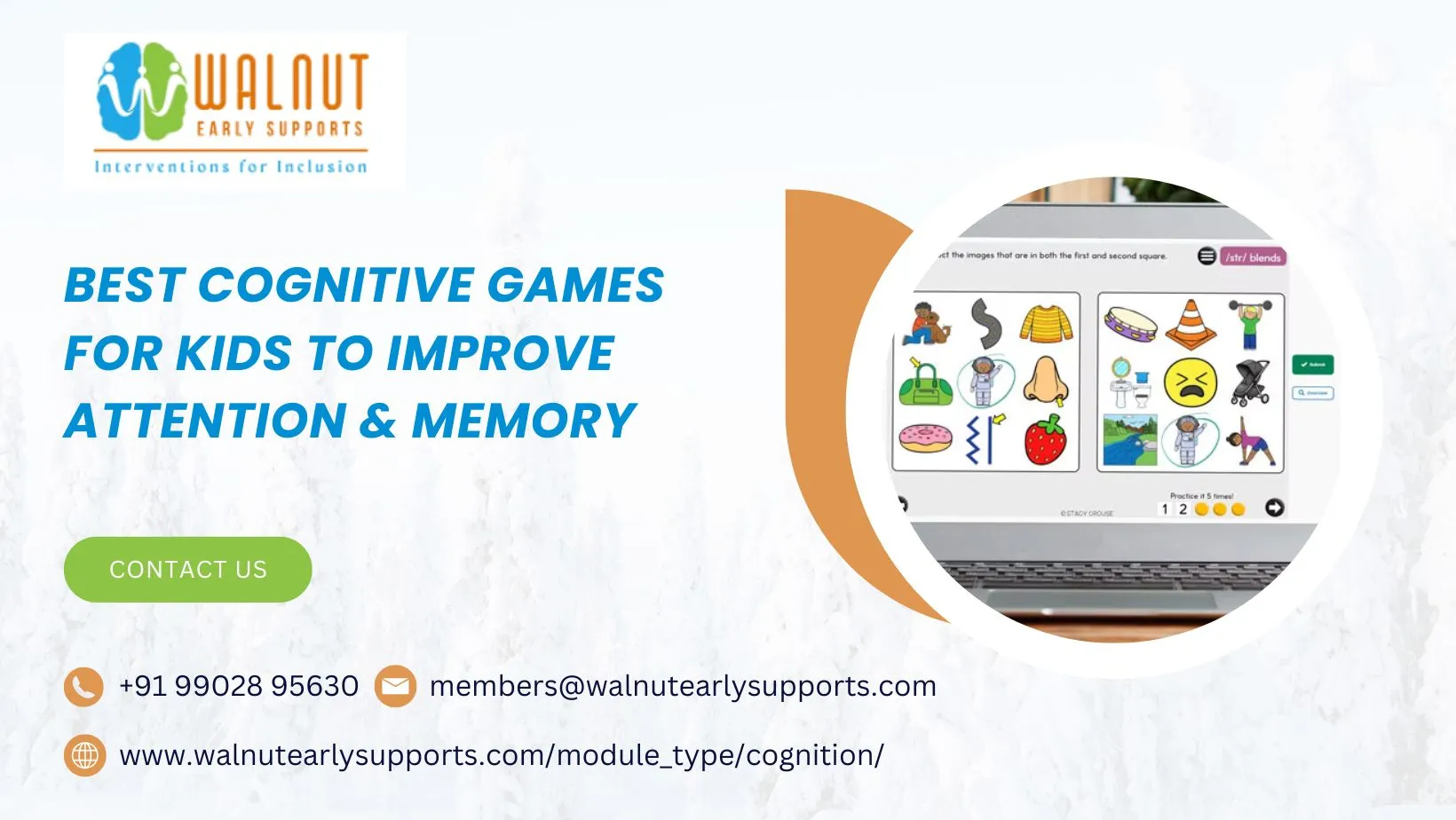
Children learn best when they are interested, engaged, and having fun. Activities that encourage children to think, remember, observe, and respond can make learning more enjoyable while supporting important mental skills. Games for cognitive development are especially useful because they can turn everyday practice into an interactive experience.
Attention and memory are two important skills that help children follow instructions, learn new information, complete tasks, and participate successfully in school and therapy. With the right activities, parents, teachers, and therapists can give children regular opportunities to practice these skills in a natural and enjoyable way.
Why Attention and Memory Matter
Attention helps children stay focused on a task without becoming easily distracted. It supports activities such as listening to a story, following directions, completing a puzzle, or participating in classroom activities.
Memory allows children to store and recall information. It helps them remember new words, instructions, routines, sounds, and concepts they have learned.
When children practice these skills through enjoyable activities, they may become more comfortable with learning tasks. Games for cognitive development can provide repeated practice without making children feel like they are doing extra work.
1. Matching and Memory Games
Matching games are a simple way to encourage visual memory. Place several pairs of picture cards face down and ask the child to turn over two cards at a time. The child tries to remember where each picture is located and find its matching pair.
Start with a small number of cards and gradually increase the number as the child becomes more confident. You can also use pictures of animals, foods, objects, or familiar people to make the activity more meaningful.
These cognitive games can support visual attention, recall, and turn-taking at the same time.
2. What Changed?
This activity requires children to observe carefully and remember details. Place a few familiar objects on a table and give the child time to look at them. Ask the child to close their eyes while you remove or move one object. Then ask, “What changed?”
This can be adjusted for different ages and abilities. Younger children can work with two or three objects, while older children can handle larger groups or multiple changes.
The activity encourages children to pay attention to details and recall what they previously saw.
3. Follow-the-Direction Games
Following directions is closely connected to attention and working memory. Give the child a simple instruction such as, “Touch your nose and clap your hands.” Once they manage that successfully, introduce longer or more detailed directions.
You can make the activity playful by including movement. For example, ask the child to “jump twice, touch the chair, and sit down.”
These therapy games for children can be adapted by speech-language professionals to support listening, comprehension, sequencing, and memory skills alongside cognitive practice.
4. Sequencing Games
Sequencing activities ask children to remember the order in which things happen. You can use picture cards showing a familiar routine, such as brushing teeth, getting dressed, or preparing a snack.
Ask the child to arrange the pictures in the correct order and explain what happens first, next, and last.
Sequencing can support memory while also encouraging children to use language to describe events. This makes it a useful activity for both cognitive and communication development.
5. Find and Remember
Place several objects or pictures around a room. Give the child a few items to find and ask them to remember what they are looking for.
For example, say, “Find the red ball and the teddy bear.” As the child's skills improve, increase the number of items they need to remember.
This simple activity combines attention, memory, listening, and movement. It can also be changed frequently to keep the experience interesting.
Making Cognitive Games More Effective
The best activities are those that match the child's current abilities. If a game is too difficult, the child may become frustrated. If it is too easy, they may lose interest. Begin with manageable tasks and gradually increase the challenge.
Keep sessions short and enjoyable. Give clear instructions and praise effort rather than focusing only on correct answers. Visual cues, repetition, and familiar examples can also help children understand what is expected.
Parents and professionals can combine cognitive development games with language-based activities to support several skills during the same session. Digital resources can also provide additional options when used appropriately. For professionals supporting communication development, online speech therapy materials and speech and language therapy resources can complement structured activities.
Supporting Learning Through Play
Children do not need complicated activities to practice attention and memory. Simple matching tasks, observation games, sequencing activities, and direction-following challenges can provide meaningful practice when used consistently.
The goal of games for cognitive development is not simply to keep children entertained. Well-chosen activities can create opportunities to practice remembering, focusing, thinking, listening, and responding in ways that feel natural and enjoyable.
With patience, encouragement, and age-appropriate challenges, play can become a valuable part of a child's learning and developmental journey.
Related Reading
Expert Insights: Navigating the Complex World of Education & Learning
Welcome to our in-depth exploration of Education & Learning. In an era defin...
Why Education & Learning is Transforming the Global Industry Landscape
Welcome to our in-depth exploration of Education & Learning. In an era defin...