Basis Points: Meaning, Calculation, Uses, and Examples
31 Views
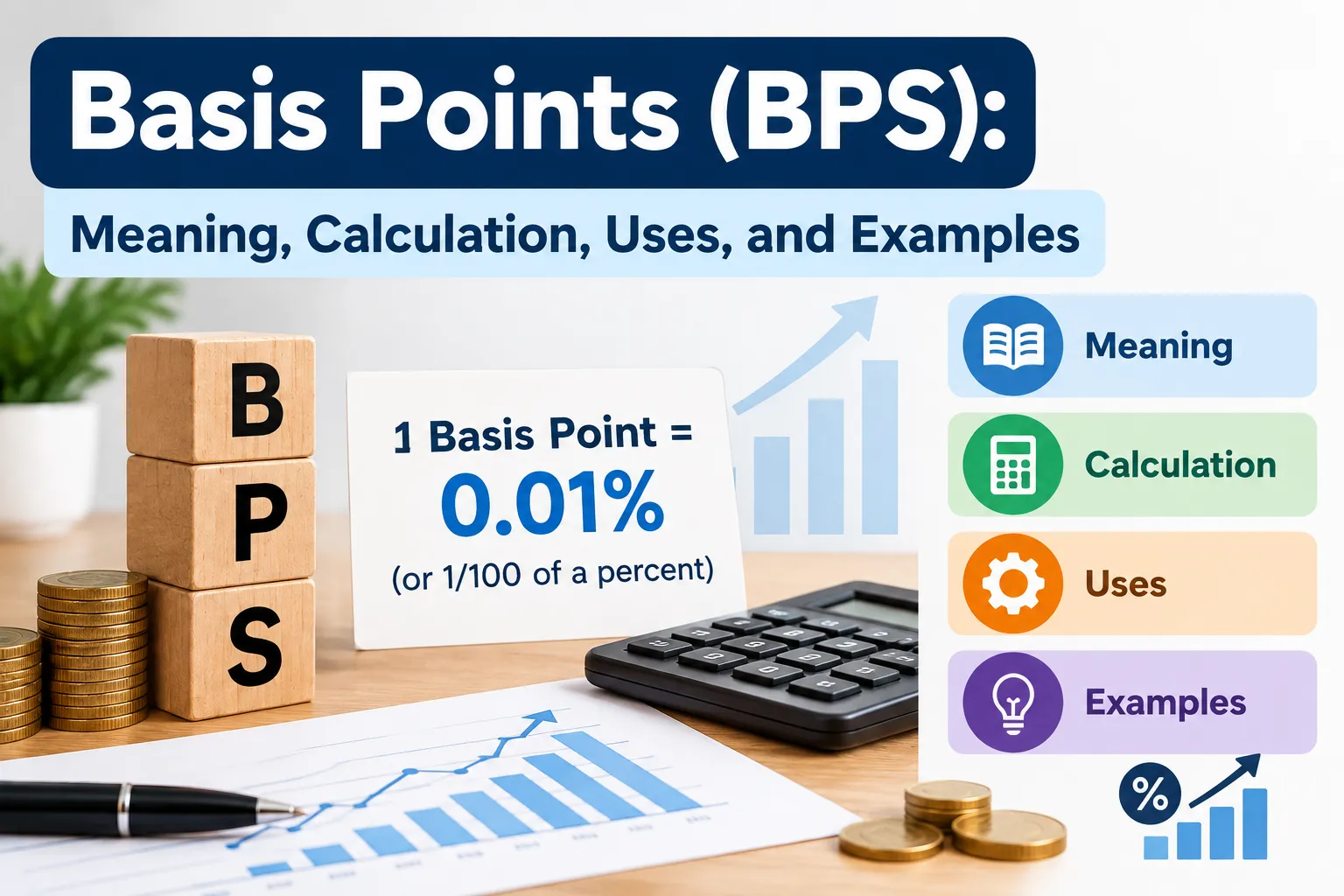
There are some special terms used in financial markets to refer to very small changes in interest rates, returns on investments, fees and yields. Basis points or BPS is one of the most commonly used terms. Knowing this measurement can help to make statements in financial news, investment products, loan news, and market news easier to understand.
Understanding the concept of basis points can help you to ‘translate’ small percentage movements and can be useful when you are an investor, borrower, student or business owner.
What Are Basis Points?
Therefore, what does a basis point mean? A basis point is a baseline unit that is used to measure minute percentage changes. One basis point is equal to 1/100th of a percentage, which is also equal to 0.0001.
The financial rate may change by very small numbers and it can be more helpful to talk about it in basis points rather than repeatedly in decimal percentages.
For example:
- 1 basis point = 0.01%
- 10 basis points = 0.10%
- 25 basis points = 0.25%
- 50 basis points = 0.50%
- 100 basis points = 1.00%
So a 25 basis point increase in an interest rate represents a 0.25 percent change.
Why Are Basis Points Important?
A little variation in the financial rates can make a significant difference when used in large numbers. That's why basis points are often used throughout the financial industry.
The use of BPS allows you to communicate changes in a consistent manner, and prevents confusion between percentages and percentage points.
For instance, if the loan rate rose by 50 basis points, it means that the rate increased by 0.50 percentage point. This can be more accurate when considering financial matters.
The following are typical uses of basis points:
- Interest rate changes
- Bond yields
- Investment fees
- Mutual fund expenses
- The cost of credit and loans.
- Interest and loan rates.
- Financial market spreads
- Central bank action on interest rates
How to Calculate Basis Points
To calculate basis points isn't too difficult.
Converting Basis Points to Percentage
You should convert BPS to a percentage by simply dividing the number of BPS by 100.
Formula:
Basis Points ÷ 100 = Percentage
For example:
75 BPS ÷ 100 = 0.75%
So 75 basis points is equivalent to 75/100 or 0.75 percentage points.
Converting Percentage to Basis Points
To turn a percentage into basis points multiply by 100.
Formula:
Percentage × 100 = Basis Points
For example:
0.40% × 100 = 40 BPS
That is, a 0.40 percentage point change is equivalent to 40 basis points. The conversion rule remains the same for conversions involving an interest rate, yield, a fee or any other percentage in the financial world.
Basis Points Example
If a bank has a loan with an annual interest rate of 8.00% then... The rate goes up 25 bps later.
As 25 basis points is equal to 0.25 percentage points:
8.00% + 0.25% = 8.25%
The new interest rate would thus be 8.25%.
Likewise, a drop in the investment fee from 1.20% to 1.00% is 0.20 percentage point or 20 basis points.
These examples illustrate how it can be beneficial to know what is a basis point when making comparisons between financial products.
Where Are Basis Points Used?
Basis points are applied in many aspects of finance. They can be used in various situations beyond interest rates.
1. Loans and Credit
Banks and loan agencies may refer to basis points in referring to changes in lending rates. To make the movement precise, notify the increase or decrease in the rates, in BPS.
2. Bonds and Fixed Income
Basis points are a common way for bond markets to refer to changes in yields and spreads. The value and income attributes of fixed-income investments can be impacted by a relatively small yield change.
3. Mutual Funds
Basis points can be used to refer to fees and expenses associated with investment products. These can be used by an investor in comparing small differences in costs of investment products.
4. Financial Markets
BPS can be used to refer to the difference in rates, yields or other financial terms. This is a standard terminology for easier communication.
5. Central Bank Decisions
Basis points can be used by central banks to indicate changes in policy interest rates. For instance, the policy rate has been raised by 0.50 point when it rises by 50 BPS.
Basis Points vs. Percentage Points
A mistake often made is the difference between basis points and percentage points.
The difference between two percentages is one of the percentage points. A smaller standardized unit for expressing that difference is called a basis point.
In the case of a rate that goes up from 5.00 to 5.50, the difference is:
- 0.50 percentage points
- 50 basis points
It's important to know this difference so you can avoid some of the pitfalls when reading financial reports or comparing rates.
Final Thoughts
It is crucial to know what a “basis point” is in order to grasp some basic financial jargon. Basis points represent a small rate change, a simple method of describing such small changes in interest rates, yields, fees, spreads, and other figures related to investing.
Be aware that 1 basis point is equal to 0.01% and 100 basis points is equal to 1%. Having this relationship established makes it much easier to interpret an announcement at a rate, changes in loans, bond yields, and investment costs.
But, for investment decisions basis points are just one consideration. Relevant product information, risks, costs and investors' own financial situations should be considered before making decisions.
Related Reading
Top 10 Hidden Secrets About Business & Finance You Need to Know
Welcome to our in-depth exploration of Business & Finance. In an era defined...
Why Business & Finance is Transforming the Global Industry Landscape
Welcome to our in-depth exploration of Business & Finance. In an era defined...