What B2B Buyers Expect from an Adobe Commerce Storefront
By Ishan Rao
35 Views
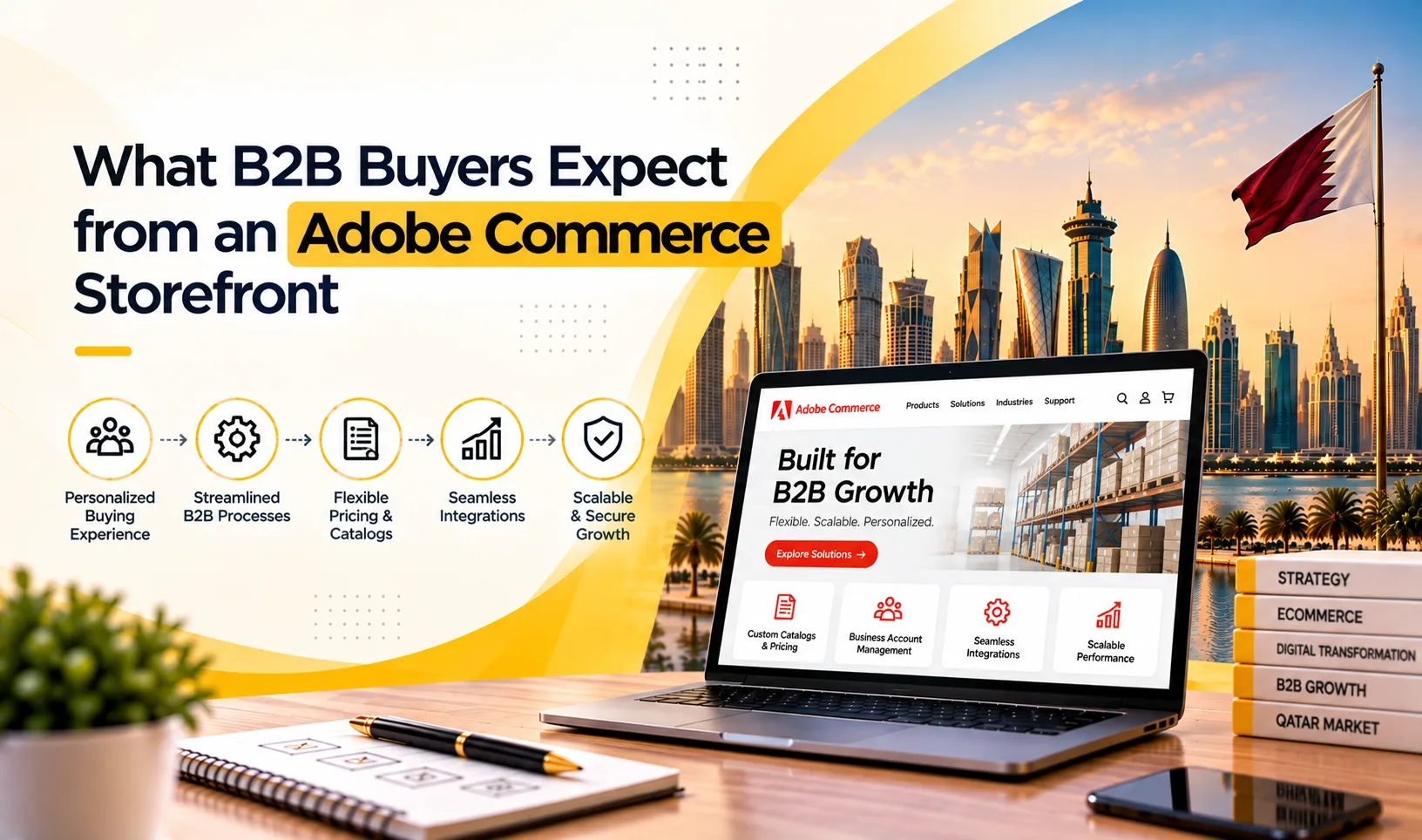
B2B ecommerce is becoming increasingly important for businesses across Qatar and the wider MENA region. Buyers who once depended on sales representatives, phone calls, emails, and spreadsheets now expect digital experiences that are fast, secure, informative, and easy to use.
For manufacturers, distributors, wholesalers, suppliers, and enterprise businesses, an ecommerce storefront must do more than display products. It should simplify purchasing, provide accurate information, support complex requirements, and help customers make confident decisions.
This is where Adobe Commerce Development Services can provide a strong foundation for building sophisticated B2B ecommerce experiences.
What Do B2B Buyers Expect Today?
B2B customers increasingly expect the convenience they experience with consumer ecommerce, while still requiring business-specific functionality.
They may expect:
-
Detailed product information
-
Business-specific pricing
-
Bulk ordering
-
Easy reordering
-
Multiple payment options
-
Account-based purchasing
-
Fast search and navigation
-
Order tracking
-
Flexible delivery options
-
Access to invoices and order history
A storefront that creates unnecessary friction can result in abandoned orders, additional support requests, and lost customers.
1. Easy Product Search and Navigation
B2B buyers often know what they need before visiting an ecommerce website. They should be able to find products quickly without navigating through multiple pages.
An effective Adobe Commerce storefront should provide:
-
Intelligent search
-
Product filters
-
SKU search
-
Category navigation
-
Product comparisons
-
Relevant recommendations
-
Clear product attributes
For businesses with large catalogs, search performance is particularly important. An experienced Adobe Commerce development company can customize the storefront around the complexity of the product catalog and customer journey.
2. Detailed and Accurate Product Information
B2B buyers often need more information before placing an order than consumers do.
Product pages may need:
-
Technical specifications
-
Dimensions
-
Certifications
-
Datasheets
-
Minimum order quantities
-
Availability
-
Delivery information
-
Related products
Incomplete information can force buyers to contact sales teams for basic questions, slowing down the purchasing process.
Businesses should therefore treat product information as a core part of their ecommerce strategy.
3. Personalized Pricing and Customer Accounts
B2B businesses frequently have different pricing agreements for different customers.
A distributor, for example, may offer different prices to wholesalers, retailers, contractors, or strategic accounts.
Adobe Commerce can support customer-specific purchasing experiences, including customer groups and negotiated pricing.
Experienced Adobe Commerce experts can help businesses design these experiences around their sales structure while maintaining operational efficiency.
4. Faster Bulk Ordering
B2B customers may need to purchase dozens or hundreds of products in one transaction. Adding products individually can create unnecessary friction.
Useful functionality includes:
-
Quick ordering
-
SKU-based ordering
-
Bulk product selection
-
Saved shopping lists
-
Reordering
-
Frequently purchased products
A streamlined bulk-ordering process can reduce purchasing time and improve customer satisfaction.
5. A Mobile-Friendly Experience
B2B purchasing is not limited to office desktops. Sales teams, procurement professionals, contractors, and business owners may access ecommerce stores using smartphones and tablets.
The storefront should provide:
-
Responsive layouts
-
Fast loading
-
Easy navigation
-
Mobile-friendly search
-
Simple product selection
-
Accessible account functions
-
Clear calls to action
A capable Adobe commerce developer should consider mobile usability throughout the development process.
6. Secure and Flexible Checkout
B2B buyers expect checkout to be straightforward, but their payment requirements may differ from consumers.
Depending on the business model, customers may need:
-
Purchase orders
-
Credit terms
-
Online payments
-
Invoice-based transactions
-
Approval workflows
-
Multiple billing addresses
-
Multiple shipping addresses
Security is equally important because B2B transactions can involve sensitive customer, pricing, and payment information.
7. Transparent Inventory and Delivery Information
Availability and delivery timelines can directly influence B2B purchasing decisions.
Customers want to know whether products are:
-
In stock
-
Available for backorder
-
Ready for dispatch
-
Available from another location
-
Subject to a specific lead time
For Qatar-based businesses serving customers across MENA, accurate delivery information becomes particularly important.
Integrating Adobe Commerce with ERP, inventory, warehouse, and logistics systems can help provide more reliable information.
8. Easy Account and Order Management
B2B customers often place repeat orders. They should not have to contact sales teams every time they need information about an existing purchase.
A useful account area can provide:
-
Order history
-
Invoices
-
Reorder functionality
-
Saved products
-
Shipping information
-
Account details
-
Customer-specific pricing
This improves convenience while reducing repetitive administrative work.
9. Integration With Business Systems
An Adobe Commerce storefront should not operate as an isolated system.
Businesses may need integration with:
-
ERP systems
-
CRM platforms
-
Accounting software
-
Inventory systems
-
Payment gateways
-
Shipping platforms
-
Marketing automation
-
Product information management systems
A well-planned Adobe commerce development strategy can connect these systems and create a consistent flow of information.
For Qatar and MENA businesses, integration is particularly valuable when managing multiple locations, currencies, companies, or markets.
10. Arabic and English Support
Businesses targeting Qatar and MENA may need to serve Arabic- and English-speaking customers.
A bilingual storefront should consider navigation, product information, forms, checkout, account areas, and customer communications in both languages.
Arabic RTL functionality should also be tested across desktop and mobile devices to provide a consistent experience.
11. Performance and Scalability
Slow ecommerce experiences can frustrate B2B buyers, particularly when searching large catalogs or placing complex orders.
Businesses should focus on:
-
Page speed
-
Efficient images
-
Optimized code
-
Search performance
-
Caching
-
Mobile performance
-
Scalable infrastructure
The storefront should also be prepared for future growth in products, customers, transactions, integrations, and markets.
Professional Adobe commerce solutions should therefore address both current requirements and long-term scalability.
12. Self-Service Without Losing Human Support
B2B ecommerce should not necessarily replace sales teams. Instead, it should allow customers to complete routine tasks independently while giving sales teams more time for complex requirements.
Buyers should be able to reorder products, check invoices, and review order status without contacting sales.
At the same time, the website should make it easy to request a quotation, contact an account manager, or request technical support.
Choosing the Right Adobe Commerce Partner
Implementation quality can have a major impact on the final customer experience.
When evaluating Adobe commerce development agencies, consider their experience with:
-
B2B ecommerce
-
Custom development
-
ERP and CRM integrations
-
Arabic and English storefronts
-
Ecommerce SEO
-
Performance optimization
-
Security
-
Data migration
-
Ongoing support
The right Adobe commerce partners should understand both technology and business operations.
For complex projects, businesses may also benefit from Adobe Magento Commerce expertise covering migration, customization, integration, and optimization.
Benefits of a Buyer-Focused Adobe Commerce Storefront
A well-planned B2B storefront can provide:
-
Faster purchasing journeys
-
Better customer satisfaction
-
Higher conversion opportunities
-
Fewer repetitive sales enquiries
-
More efficient order management
-
Better product visibility
-
Improved operational efficiency
-
Stronger customer retention
-
Easier regional expansion
The objective is not simply to create an online catalog. It is to build a digital purchasing environment that supports both customers and internal teams.
How BRQ Can Help
BRQ provides Adobe Commerce Development Services for businesses looking to build, customize, integrate, and scale sophisticated ecommerce platforms.
From storefront development and B2B functionality to integrations, performance optimization, and ongoing support, the right approach can help businesses create a more efficient digital commerce experience.
For companies in Qatar and MENA, Adobe Commerce can provide the flexibility required to support complex products, customer accounts, regional requirements, and future expansion.
Looking to improve your B2B ecommerce experience? Talk to BRQ about building an Adobe Commerce storefront around your business and customer requirements.
Frequently Asked Questions
What do B2B buyers expect from an Adobe Commerce store?
They typically expect fast product search, detailed product information, personalized pricing, bulk ordering, account management, flexible payment options, order tracking, and self-service.
Is Adobe Commerce suitable for B2B businesses in Qatar?
Yes. Adobe Commerce can support requirements such as customer-specific pricing, account management, bulk ordering, integrations, and complex purchasing workflows.
Can Adobe Commerce support Arabic and English?
Yes. Adobe Commerce can be configured for multilingual experiences, including Arabic RTL interfaces and English content.
Can Adobe Commerce integrate with ERP systems?
Yes. It can integrate with ERP, CRM, inventory, accounting, payment, logistics, and other business systems through appropriate integration methods.
Why is customization important for B2B ecommerce?
B2B businesses often have unique pricing, ordering, approval, product, and account requirements. Customization allows the storefront to support these processes more effectively.
How can an Adobe Commerce partner help?
An experienced partner can support strategy, development, customization, integrations, migration, performance, testing, security, and ongoing optimization.